Do universities need a rethink on AI use for students? Singapore’s NTU case causes a stir [South China Morning Post]

I was interviewed by the South China Morning Post (SCMP) about the incident in NTU where three students were accused of academic misconduct over the use of #GenAI, though they claimed they did not use GenAI to write their essays. Here’s what I shared with them:

Jonathan Sim, who teaches AI and philosophy at National University of Singapore, urged educators to exercise nuance and improve their knowledge of AI tools. “The main message is everyone needs to upskill. Educators are no exception.”

He also pointed out that generative AI was becoming increasingly commonplace and available on search engines such as Google.

Fong agreed and said: “The instructors and lecturers have an onus not to vilify AI … Creating a culture of ignorance when students use GenAI in their daily life is like an ostrich sticking its head in the sand and ignoring what’s going on in the world.”

Sim echoed his university’s emphasis on trust between students and teachers in dealing with generative AI disputes. He noted that what was needed urgently in the education system was to build trust between teachers, students and the AI tools.

“Since the day ChatGPT came out, trust has been fractured between teachers and students. And we need that trust for teaching and learning to be effective. This is not an AI issue – it is a human issue.”

Link to article: https://www.scmp.com/week-asia/people/article/3316155/do-universities-need-rethink-ai-use-students-singapores-ntu-case-causes-stir?module=perpetual_scroll_0&pgtype=article

Helping Parents Guide Children in Using Smartphones and Computers: Digital Parenting Guide Proves Effective [Lianhe Zaobao 联合早报]

Thank you once again Lianhe Zaobao 联合早报 for interviewing me about IMDA’s digital resources for parents. Here’s a translation of what I shared for the article:

Jonathan Sim, a lecturer in the Department of Philosophy at the National University of Singapore’s Faculty of Arts and Social Sciences, views the digital parenting resources as a significant step in providing professional and practical guidance for parents.

“In recent years, the most common complaint I’ve heard from parents is that they feel powerless when their children become absorbed in digital devices.”

He believes that many parents lack the knowledge or skills to tackle this issue effectively, making peer support insufficient. This guide acts as a “map,” offering parents a general direction and helping them initiate conversations with their children.

“Such conversations can help parents recognise their own gaps in knowledge or skills, prompting them to seek resources and strategies for self-improvement. Ultimately, this empowers parents to better fulfill their role in guiding their children,” he concluded.

Link to article: https://www.zaobao.com.sg/news/singapore/story20241201-5359974

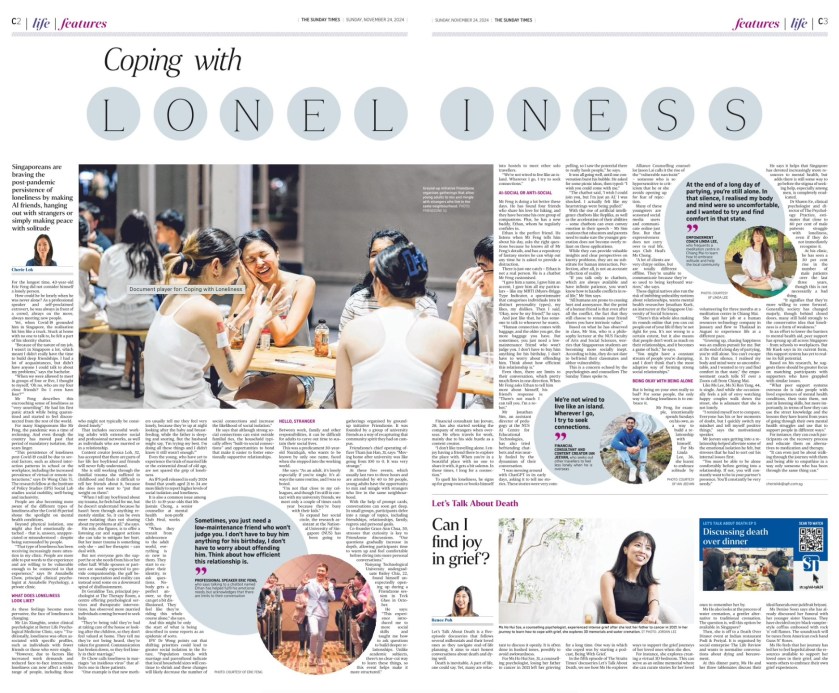
Is being alone really so bad? Coping with loneliness by befriending ChatGPT and embracing solitude [The Straits Times]

Was interviewed for this beautiful and thought-provoking piece for The Straits Times. Here’s an excerpt of what I shared:

“The chatbot said, ‘I wish I could join you, but I’m just an AI.’ I was shocked. I actually felt like my heartstrings were being pulled.”

With the rise of artificial intelligence chatbots like Replika, as well as the acceleration of their abilities – some chatbots can even convey emotion in their speech – Mr Sim cautions that educators and parents need to make sure the younger generation does not become overly reliant on these applications.

While they can provide valuable insights and clear perspectives on knotty problems, they are no substitute for human interaction. Perfection, after all, is not an accurate reflection of reality.

“If you talk only to chatbots, which are always available and have infinite patience, you won’t know how to handle conflicts in real life,” Mr Sim says.

“All humans are prone to causing hurt and annoyance. But the point of a human friend is that even after all the conflict, the fact that they still choose to remain your friend shows you have intrinsic value.”

Link to article: https://www.straitstimes.com/life/is-being-alone-really-so-bad-coping-with-loneliness-by-befriending-chatgpt-and-embracing-solitude

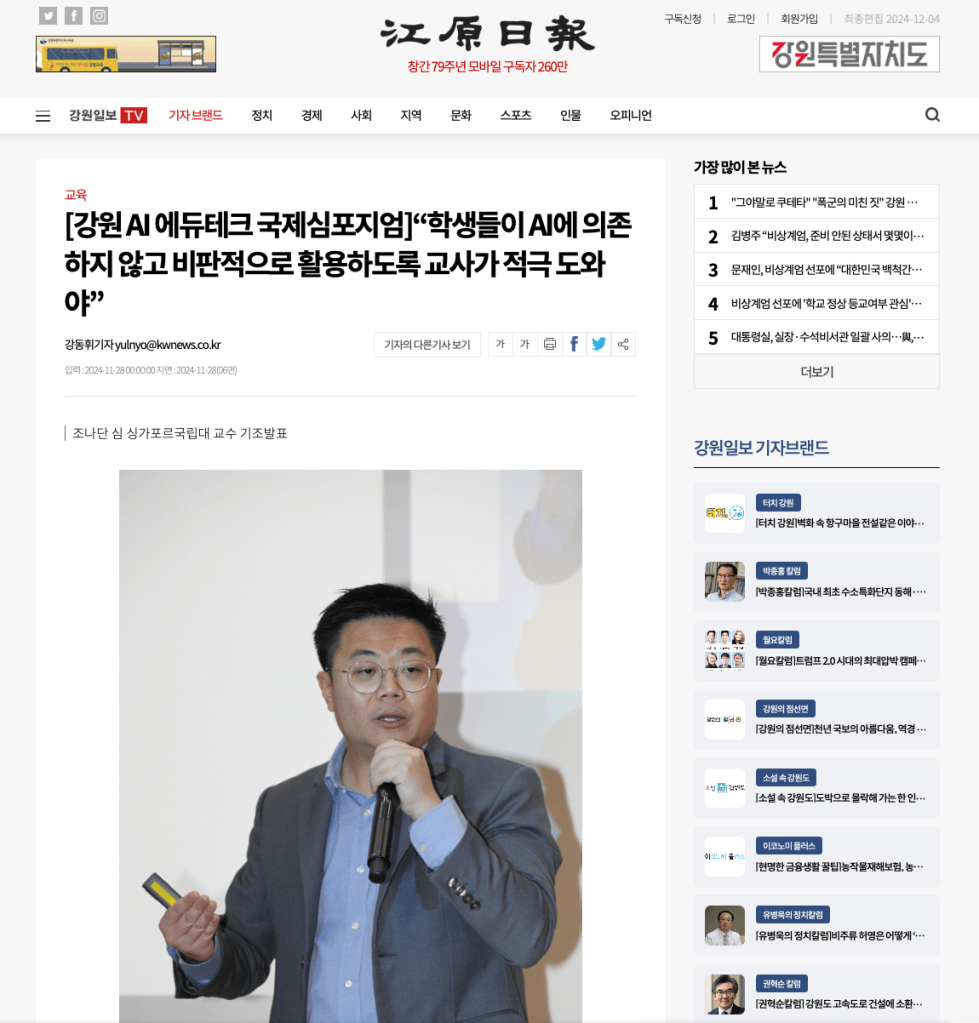
Teachers should actively help students use AI critically rather than depend on it [Gangwon Ilbo 강원일보]

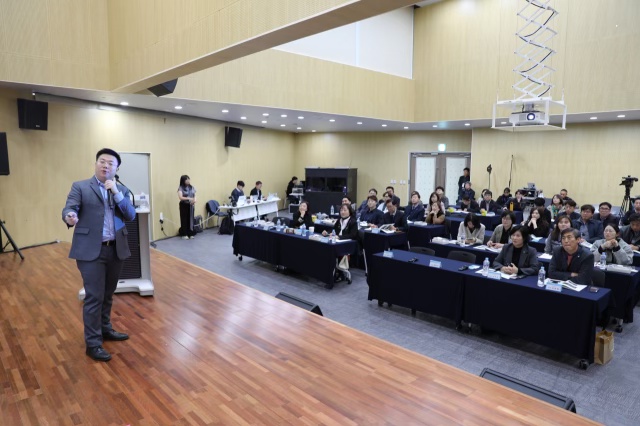
I had the opportunity to visit South Korea recently to share insights as a keynote speaker at the Gangwon AI Edutech International Symposium.

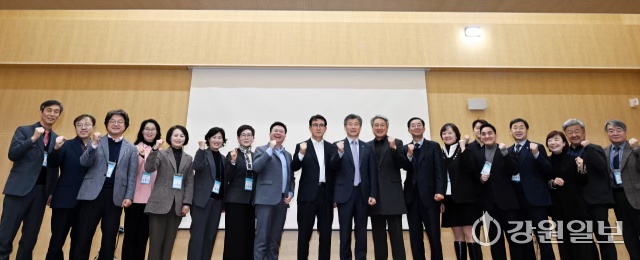
The event brought together many senior leaders from Gangwon’s Provincial Office of Education, allowing for a meaningful exchange of ideas.

The provincial newspaper, the Gangwon Ilbo (Gangwon Daily), published a summary of my talk:

Here’s a translation of the article (with minor edits due to reporting errors):

Keynote Speech, “From Books to Bots” by Jonathan Y. H. Sim, National University of Singapore

I am delighted to visit the beautiful city of Chuncheon. Today, I would like to share lessons learnt from implementing AI in Singapore’s education system. The latest version of ChatGPT demonstrates astonishing capabilities, making it difficult to distinguish between AI tasks and human efforts.

The Singaporean government has already mandated that all students and civil servants must learn AI; and we must ensure out students are prepared for the digital future from an early age. At the same time, it is crucial to maintain human empathy and emotional intelligence.

From a teacher’s perspective, using technology to improve teaching methods is essential. Teachers must serve as role models because students learn and adopt technology by observing them. However, the application of technology fundamentally depends on people. Simply adding more technology is not enough. Educational innovation is not about technology alone but about pedagogy and teaching methods.

How can teachers ensure students retain their creativity and learning abilities? First, building trust and motivation between teachers and students is crucial. Education is, ultimately, about managing the learner’s motivation.

Next, we must address the cognitive confusion caused by a loss of autonomy when we use AI. If AI provides all the answers, we lose our ability to decide and we lose our sense of autonomy. Socrates, long ago, criticised writing as a technology that made people overly dependent on written records. This reduced their efforts to memorise things. Today, we celebrate writing as a tool that enhances our thinking. Similarly, technology like AI should enhance our capabilities rather than diminish them.

As educators, we must ensure students do not rely on technology uncritically. AI should be used in ways that enhance creativity and critical thinking. For example, instead of using ChatGPT to generate answers, it can be employed to help students create meaningful questions. AI can also make learning more enjoyable; for instance, by asking it to create math problems in the context of stories like Star Wars. Math could become more engaging for students and provide them with concrete examples that they can relate with to understand better.

The potential applications of AI in education are limitless.

Link to article: https://www.kwnews.co.kr/page/view/2024112623274546546

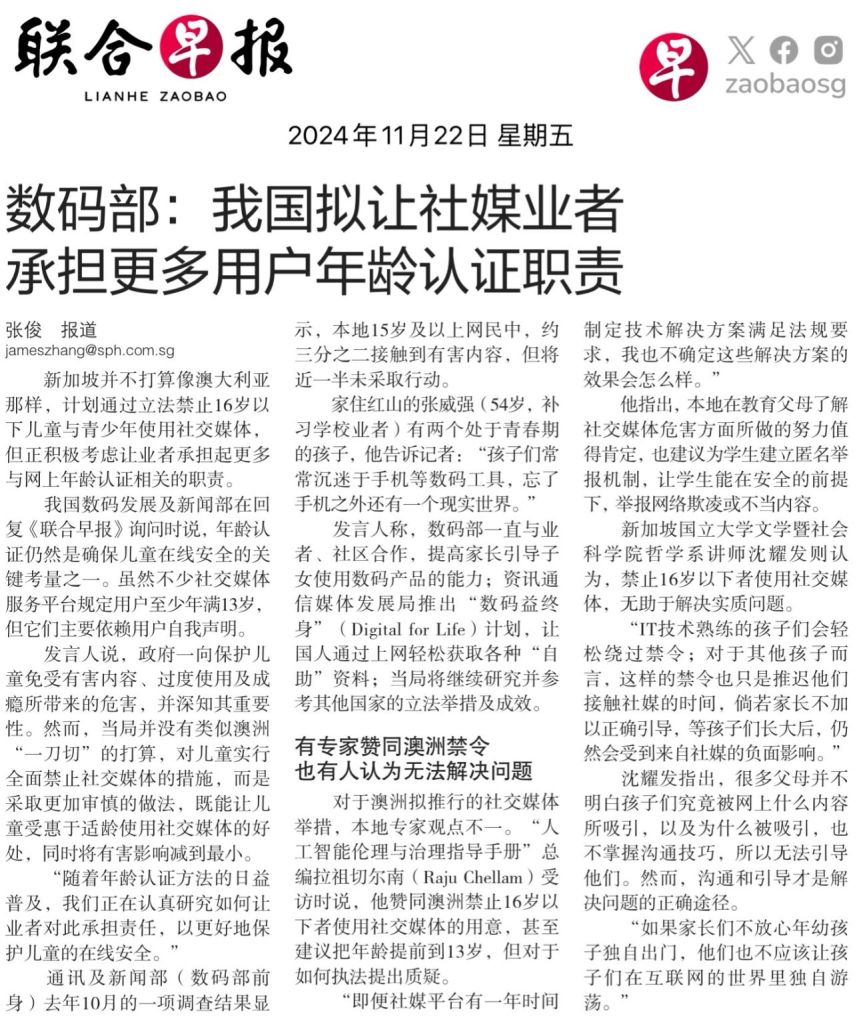
Ministry of Digital Development and Information: Singapore Plans to Require Social Media Operators to Take Greater Responsibility for User Age Verification [Lianhe Zaobao 联合早报]

I was interviewed for an article for Lianhe Zaobao 联合早报. Here’s what I shared:

Children are not only affected by social media – adults are just as susceptible! Regardless of age, if we don’t have the right values/guidance/practices inculcated in us, we will not be well-equipped to handle the negative influences of social media.

Banning social media for those under 16 is not the right solution. IT-savvy kids will know how to circumvent such bans, so we’re back to the same problem. All it does is delay the inevitable yet important issues that we must confront with our children.

Many parents complain that they don’t know what to do when their child uses digital devices – they can’t understand or make sense of what their child is doing; and/or they don’t know how to talk about these matters in a productive way. They often receive conflicting advice from other parents who may not be well-informed.

What we need are resources – concepts, ideas, good practices, and given guidance and advice – to best manage the issues we face online, regardless of age. This will better equip parents to teach their kids well.

IMDA is doing the right thing by providing parents with sound and sensible guidance.

However, these resources are not enough to fully equip parents. At best, these resources can be thought of as a map, providing us with a general direction on how to guide our children well. They give us something to kickstart these conversations with our kids. These discussions will help us identify what we don’t know so that we seek out the kinds of support and resources we need to better guide our children well.

Some say that the problem is that we do not have age appropriate spaces meant for children online. It’s true that we cannot control who our kids interact with online, and it is challenging to ensure that they avoid materials inappropriate for their age.

The same can be said about our physical world – we are less worried about our children being exposed to dangers in the physical world than in the online world. That’s because we often accompany our children when we go out together, but we do not always accompany our children when they go online – we often think of online activity as an individual activity where we are literally left to our own devices.

This is implicitly the thread underlying IMDA’s resources – just as how we would not let our child freely roam the streets alone, we should not let them freely roam the Internet without adult supervision either. As parents, we should experience their world together with them and have conversations about what they encounter – as moments for parent-child bonding, and as opportunities or moments for learning and growth for both parent and child.

Link to article: https://www.zaobao.com.sg/news/singapore/story20241121-5382735

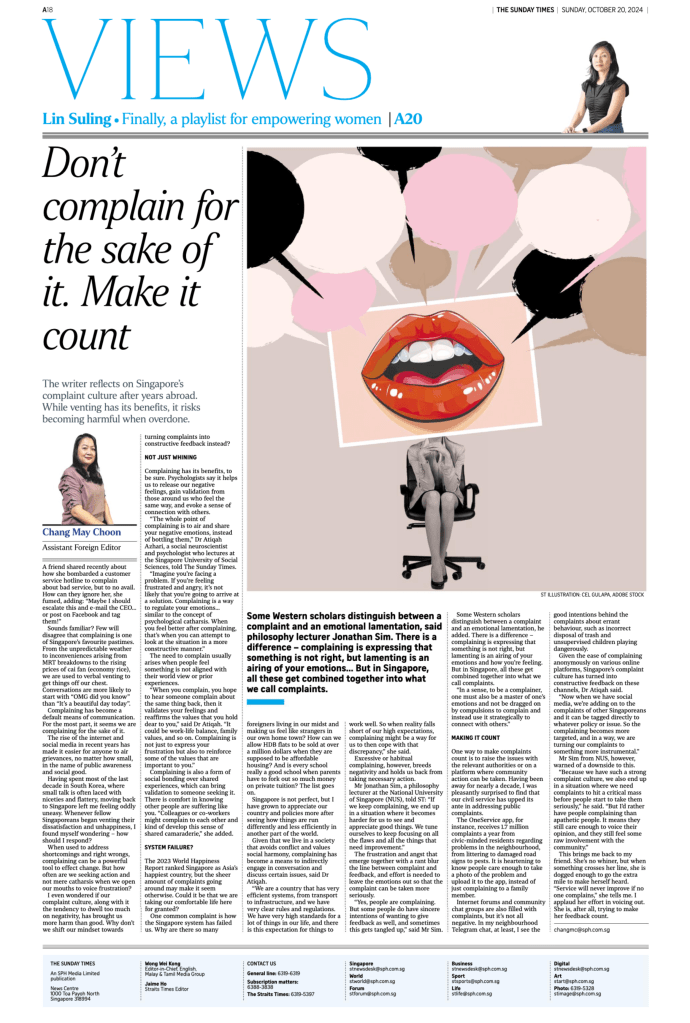
Don’t complain for the sake of it. Make it count [The Straits Times]

I had a great time speaking with Chang May Choon for her article on Singapore’s complaint culture in The Straits Times.

Here’s an excerpt from the article:

Excessive or habitual complaining, however, breeds negativity and holds us back from taking necessary action.

Mr Jonathan Sim, a philosophy lecturer at the National University of Singapore (NUS), told ST: “If we keep complaining, we end up in a situation where it becomes harder for us to see and appreciate good things. We tune ourselves to keep focusing on all the flaws and all the things that need improvement.”

The frustration and angst that emerge together with a rant blur the line between complaint and feedback, and effort is needed to leave the emotions out so that the complaint can be taken more seriously.

“Yes, people are complaining. But some people do have sincere intentions of wanting to give feedback as well, and sometimes this gets tangled up,” said Mr Sim.

Some Western scholars distinguish between a complaint and an emotional lamentation, he added. There is a difference – complaining is expressing that something is not right, but lamenting is an airing of your emotions and how you’re feeling. But in Singapore, all these get combined together into what we call complaints.

“In a sense, to be a complainer, one must also be a master of one’s emotions and not be dragged on by compulsions to complain and instead use it strategically to connect with others.” Making it count

One way to make complaints count is to raise the issues with the relevant authorities or on a platform where community action can be taken. Having been away for nearly a decade, I was pleasantly surprised to find that our civil service has upped its ante in addressing public complaints.

The OneService app, for instance, receives 1.7 million complaints a year from civic-minded residents regarding problems in the neighbourhood, from littering to damaged road signs to pests. It is heartening to know people care enough to take a photo of the problem and upload it to the app, instead of just complaining to a family member. More On This Topic Podcast: Why does it feel like Singaporeans are angry all the time? Singaporeans less happy, but those with balanced approach to life more satisfied: Survey

Internet forums and community chat groups are also filled with complaints, but it’s not all negative. In my neighbourhood Telegram chat, at least, I see the good intentions behind the complaints about errant behaviour, such as incorrect disposal of trash and unsupervised children playing dangerously.

Given the ease of complaining anonymously on various online platforms, Singapore’s complaint culture has turned into constructive feedback on these channels, Dr Atiqah said.

“Now when we have social media, we’re adding on to the complaints of other Singaporeans and it can be tagged directly to whatever policy or issue. So the complaining becomes more targeted, and in a way, we are turning our complaints to something more instrumental.”

Mr Sim from NUS, however, warned of a downside to this.

“Because we have such a strong complaint culture, we also end up in a situation where we need complaints to hit a critical mass before people start to take them seriously,” he said. “But I’d rather have people complaining than apathetic people. It means they still care enough to voice their opinion, and they still feel some raw involvement with the community.”

This brings me back to my friend. She’s no whiner, but when something crosses her line, she is dogged enough to go the extra mile to make herself heard. “Service will never improve if no one complains,” she tells me. I applaud her effort in voicing out. She is, after all, trying to make her feedback count.
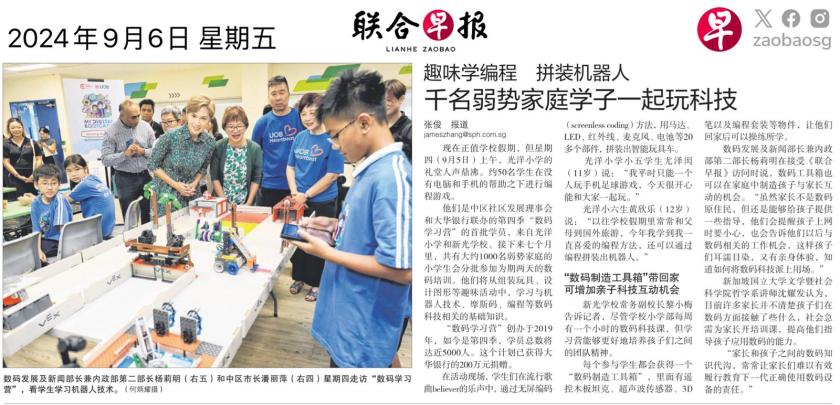
Digital Learning Camp Enables a Thousand Students from Disadvantaged Families to Learn Programming and Assemble robots [Lianhe Zaobao 联合早报]

I was recently interviewed by Lianhe Zaobao 联合早报 about the launch of a digital bootcamp for children.

Here’s what I said in the interview:

At the moment, I think the market is too saturated with workshops and programmes teaching kids digital/tech skills. What’s really missing are programmes for parents to empower them and build their capabilities to meaningfully engage with their children on these devices, to understand what their children are doing online.

A comment I hear too frequently from parents is, “I don’t know what my kids are doing.” This knowledge gap is what makes it difficult for parents to fulfil their roles effectively. What this means is that even if the kids learn all these wonderful things – more often than not, there is no continuity because the parents can’t help to maintain the interest or help to keep their interest going; or even participate in what their kids do to bond together. These digital skills and device use becomes an increasing point of divide separating parents from their children.

Link to original article in Chinese: https://www.zaobao.com.sg/news/singapore/story20240905-4638569

GEP ‘not only about academics’: Current, former students highlight small class sizes, special resources [Channel News Asia]

I was interviewed about changes to the Gifted Education Programme. Here’s an excerpt of what I shared with Channel News Asia:

The changes to the selection criteria, in particular, take into account that students mature at different stages of their lives and send a “strong message” about second chances, said Mr Jonathan Sim, a philosophy lecturer at the National University of Singapore (NUS).

“The stress of our education system has always been that people feel that there is no second chances – you either make it or that’s it. This creates a lot of unnecessary pressure,” said Mr Sim who is also fellow at the NUS Teaching Academy.

“This (gives) our learners the psychological safety they need to experiment, explore and grow well.”

Here, I’d like to add a further thought on the matter: There are concerns that gifted students will not have the opportunity to learn in a conducive environment outside the nine GEP schools. We must not forget that it is the responsibility of educators to create conducive environments for their learners. The move to push GEP beyond the nine schools is a good strategic move – if this is done well, what it means is that we will commit more training and resources to our teachers and schools, enabling more teachers to have what it takes to provide their students with enriching learning opportunities and to create the necessary conducive environment they need to thrive well.

Link to article: https://www.channelnewsasia.com/singapore/gifted-education-programme-gep-revamp-students-parents-concerns-4558096

Nearly 90% of local workers use AI on the job; experts warn it may impact corporate data security [Lianhe Zaobao 联合早报]

I was recently interviewed by Lianhe Zaobao 联合早报 about a recent report by Microsoft and LinkedIn on the “State of AI at Work in Singapore.”

I was asked two questions. Not all I said made it to the final article, but I thought it’s worth sharing my answers here:

Q1: “84% of Singapore AI users are bringing their own tools to work—Bring Your Own AI (BYOAI)—putting company data at risk.” Why are people doing this and what can we do?

For starters, there are some who are unaware of their own company’s data management/protection policies, so they don’t realise that what they are doing is risky. There are some who violate these policies because they cannot find a better AI alternative, and they downplay the risks – it’s hard to see negative consequences now because we won’t know if or when the data we give feed to the AI will be used to train another AI model in the future. It’s more important that employers have a good discussion with employees on what constitutes good practices and be clear on what kinds of information should not be uploaded to AI tools.

Q2: “77% of employers say they’d rather hire a less experienced candidate with AI skills than a more experienced candidate who lacked them.” What are the downsides to such hiring practices? What can we do?

The term, “AI skills,” is a very ambiguous term. It can mean technical skills at developing AI, and it can also mean skills at using Generative AI (GenAI) tools like ChatGPT. We need to be cautious with people who claim to have GenAI skills – it is important to discern whether they are only good at using it as a substitute to their own ability, or if they are they very good at using it to enhance their abilities, how they think, write, learn, and work.

I have met many capable A-grade students who don’t like to use GenAI. They say that they’d rather use their time to do the work themselves because they can produce better results. I found that many of these students have not explored the full capabilities of what these GenAI tools can do. If we can train them to use such tools effectively, they will have the capabilities to go even further, and to do so much.

At the end of the day, AI can only enhance what one has. If you give it to someone less capable, AI can only go so much. But if you train up someone who is very capable, they will go very far with the assistance of AI. People can learn and adapt. If they are lacking AI skills and are keen to learn, we should give them the chance the learn it.

Link to article: https://www.zaobao.com.sg/news/singapore/story20240604-3795476