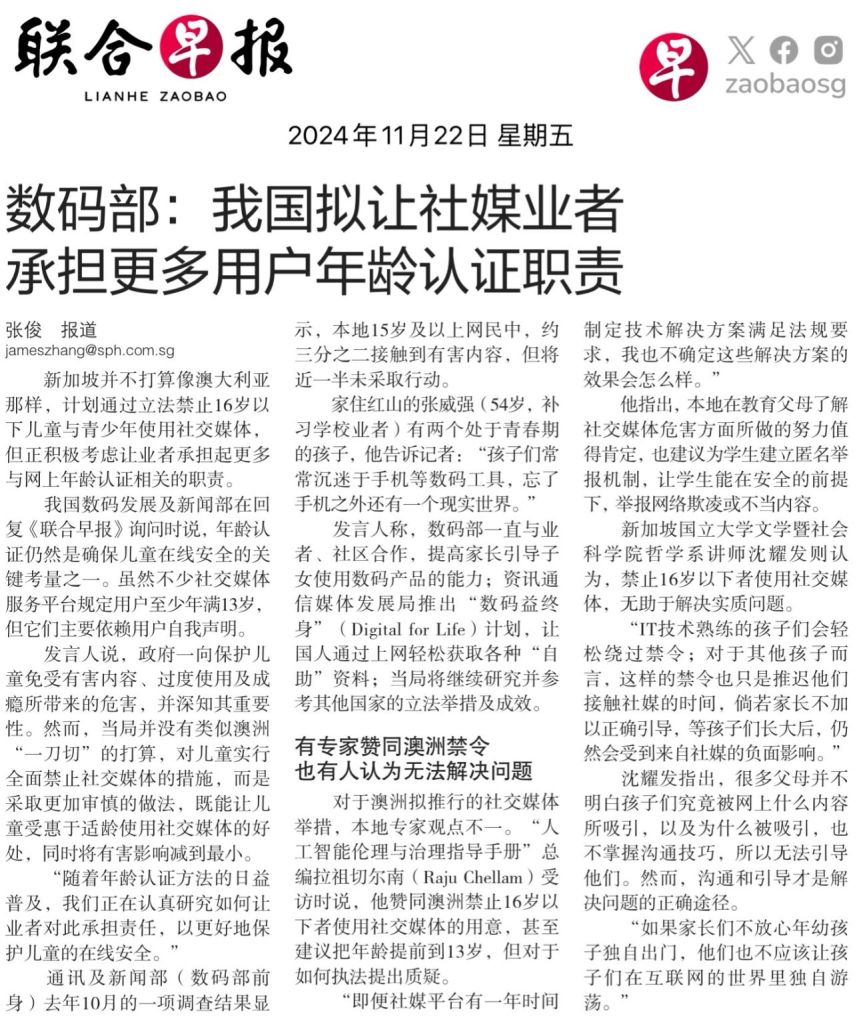
I was interviewed for an article for Lianhe Zaobao 联合早报. Here’s what I shared:
Children are not only affected by social media – adults are just as susceptible! Regardless of age, if we don’t have the right values/guidance/practices inculcated in us, we will not be well-equipped to handle the negative influences of social media.
Banning social media for those under 16 is not the right solution. IT-savvy kids will know how to circumvent such bans, so we’re back to the same problem. All it does is delay the inevitable yet important issues that we must confront with our children.
Many parents complain that they don’t know what to do when their child uses digital devices – they can’t understand or make sense of what their child is doing; and/or they don’t know how to talk about these matters in a productive way. They often receive conflicting advice from other parents who may not be well-informed.
What we need are resources – concepts, ideas, good practices, and given guidance and advice – to best manage the issues we face online, regardless of age. This will better equip parents to teach their kids well.
IMDA is doing the right thing by providing parents with sound and sensible guidance.
However, these resources are not enough to fully equip parents. At best, these resources can be thought of as a map, providing us with a general direction on how to guide our children well. They give us something to kickstart these conversations with our kids. These discussions will help us identify what we don’t know so that we seek out the kinds of support and resources we need to better guide our children well.
Some say that the problem is that we do not have age appropriate spaces meant for children online. It’s true that we cannot control who our kids interact with online, and it is challenging to ensure that they avoid materials inappropriate for their age.
The same can be said about our physical world – we are less worried about our children being exposed to dangers in the physical world than in the online world. That’s because we often accompany our children when we go out together, but we do not always accompany our children when they go online – we often think of online activity as an individual activity where we are literally left to our own devices.
This is implicitly the thread underlying IMDA’s resources – just as how we would not let our child freely roam the streets alone, we should not let them freely roam the Internet without adult supervision either. As parents, we should experience their world together with them and have conversations about what they encounter – as moments for parent-child bonding, and as opportunities or moments for learning and growth for both parent and child.
Link to article: https://www.zaobao.com.sg/news/singapore/story20241121-5382735
 Jonathan Y. H. Sim