Helping Parents Guide Children in Using Smartphones and Computers: Digital Parenting Guide Proves Effective [Lianhe Zaobao 联合早报]

Thank you once again Lianhe Zaobao 联合早报 for interviewing me about IMDA’s digital resources for parents. Here’s a translation of what I shared for the article:

Jonathan Sim, a lecturer in the Department of Philosophy at the National University of Singapore’s Faculty of Arts and Social Sciences, views the digital parenting resources as a significant step in providing professional and practical guidance for parents.

“In recent years, the most common complaint I’ve heard from parents is that they feel powerless when their children become absorbed in digital devices.”

He believes that many parents lack the knowledge or skills to tackle this issue effectively, making peer support insufficient. This guide acts as a “map,” offering parents a general direction and helping them initiate conversations with their children.

“Such conversations can help parents recognise their own gaps in knowledge or skills, prompting them to seek resources and strategies for self-improvement. Ultimately, this empowers parents to better fulfill their role in guiding their children,” he concluded.

Link to article: https://www.zaobao.com.sg/news/singapore/story20241201-5359974
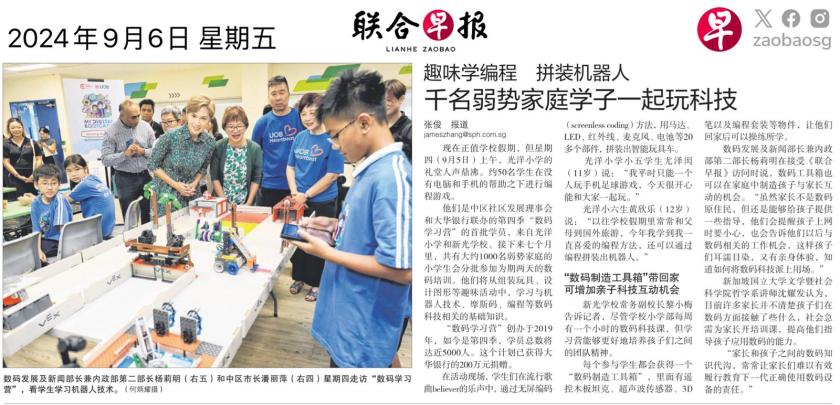
Digital Learning Camp Enables a Thousand Students from Disadvantaged Families to Learn Programming and Assemble robots [Lianhe Zaobao 联合早报]

I was recently interviewed by Lianhe Zaobao 联合早报 about the launch of a digital bootcamp for children.

Here’s what I said in the interview:

At the moment, I think the market is too saturated with workshops and programmes teaching kids digital/tech skills. What’s really missing are programmes for parents to empower them and build their capabilities to meaningfully engage with their children on these devices, to understand what their children are doing online.

A comment I hear too frequently from parents is, “I don’t know what my kids are doing.” This knowledge gap is what makes it difficult for parents to fulfil their roles effectively. What this means is that even if the kids learn all these wonderful things – more often than not, there is no continuity because the parents can’t help to maintain the interest or help to keep their interest going; or even participate in what their kids do to bond together. These digital skills and device use becomes an increasing point of divide separating parents from their children.

Link to original article in Chinese: https://www.zaobao.com.sg/news/singapore/story20240905-4638569