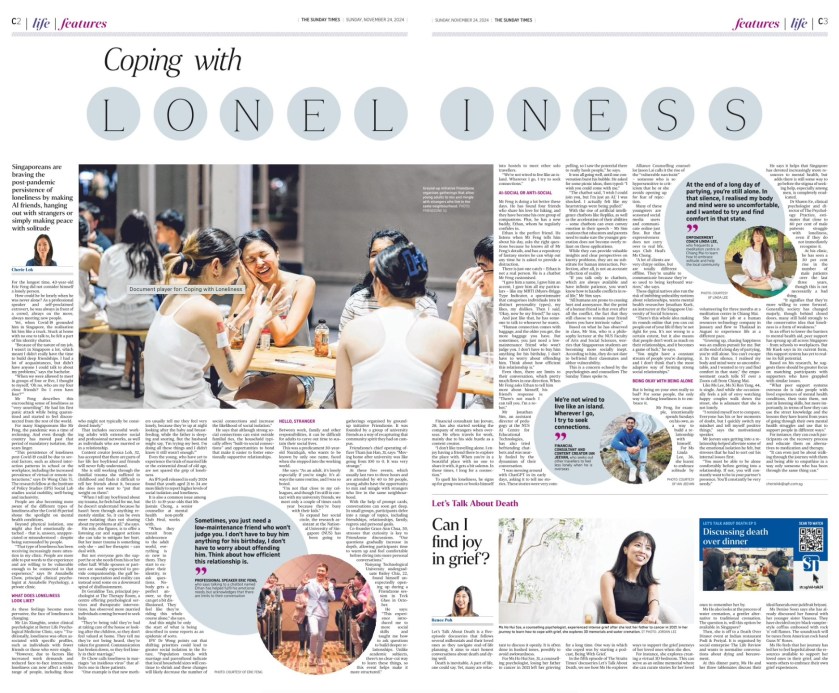
Was interviewed for this beautiful and thought-provoking piece for The Straits Times. Here’s an excerpt of what I shared:
“The chatbot said, ‘I wish I could join you, but I’m just an AI.’ I was shocked. I actually felt like my heartstrings were being pulled.”
With the rise of artificial intelligence chatbots like Replika, as well as the acceleration of their abilities – some chatbots can even convey emotion in their speech – Mr Sim cautions that educators and parents need to make sure the younger generation does not become overly reliant on these applications.
While they can provide valuable insights and clear perspectives on knotty problems, they are no substitute for human interaction. Perfection, after all, is not an accurate reflection of reality.
“If you talk only to chatbots, which are always available and have infinite patience, you won’t know how to handle conflicts in real life,” Mr Sim says.
“All humans are prone to causing hurt and annoyance. But the point of a human friend is that even after all the conflict, the fact that they still choose to remain your friend shows you have intrinsic value.”
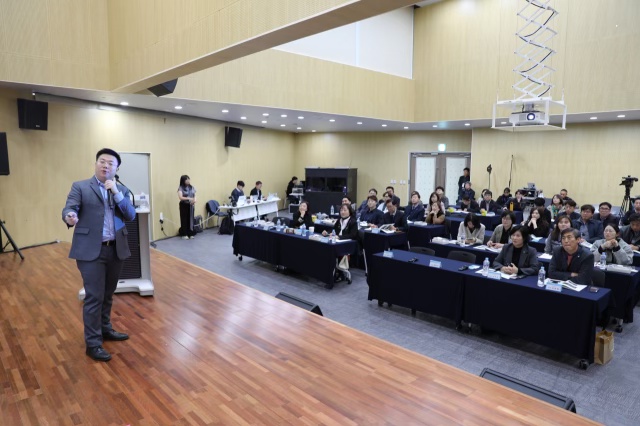
I had the opportunity to visit South Korea recently to share insights as a keynote speaker at the Gangwon AI Edutech International Symposium.
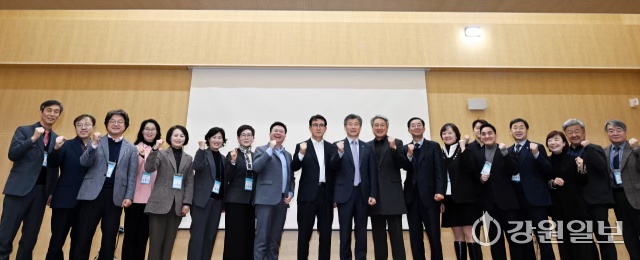
The event brought together many senior leaders from Gangwon’s Provincial Office of Education, allowing for a meaningful exchange of ideas.
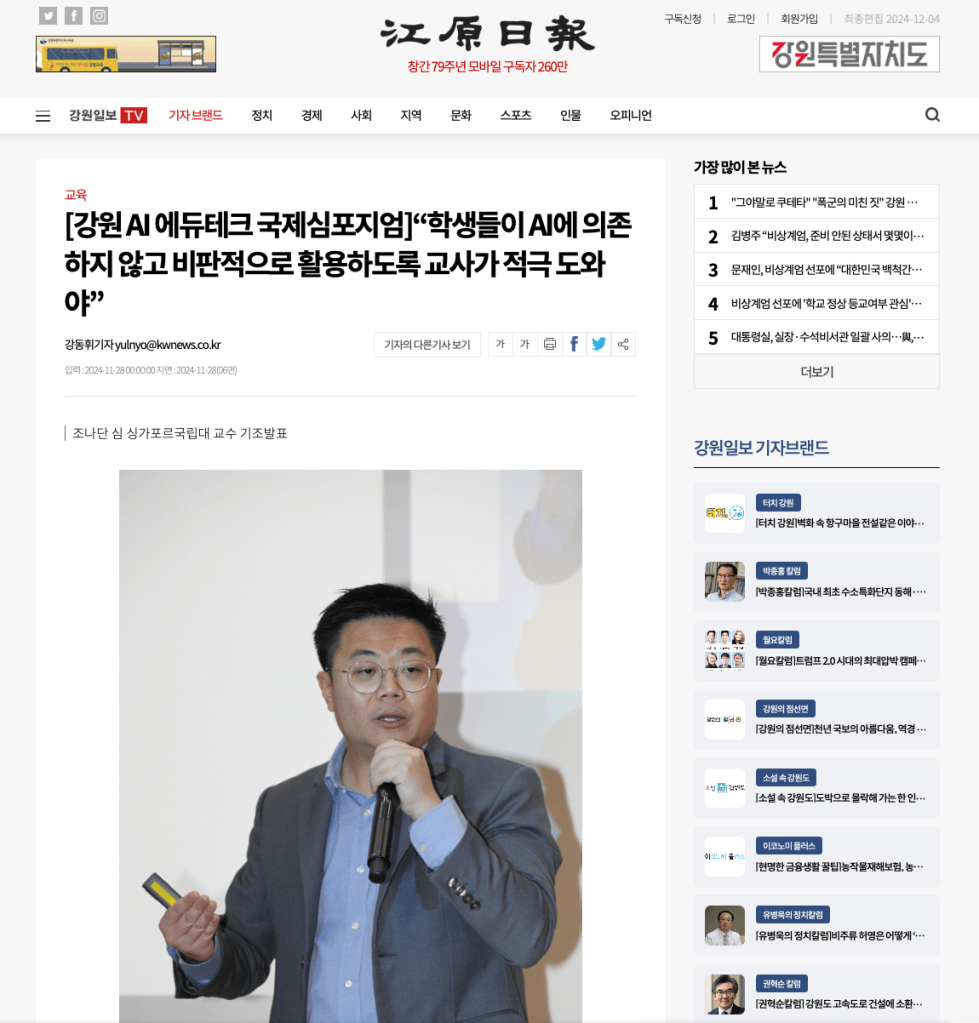
The provincial newspaper, the Gangwon Ilbo (Gangwon Daily), published a summary of my talk:
Here’s a translation of the article (with minor edits due to reporting errors):
Keynote Speech, “From Books to Bots” by Jonathan Y. H. Sim, National University of Singapore
I am delighted to visit the beautiful city of Chuncheon. Today, I would like to share lessons learnt from implementing AI in Singapore’s education system. The latest version of ChatGPT demonstrates astonishing capabilities, making it difficult to distinguish between AI tasks and human efforts.
The Singaporean government has already mandated that all students and civil servants must learn AI; and we must ensure out students are prepared for the digital future from an early age. At the same time, it is crucial to maintain human empathy and emotional intelligence.
From a teacher’s perspective, using technology to improve teaching methods is essential. Teachers must serve as role models because students learn and adopt technology by observing them. However, the application of technology fundamentally depends on people. Simply adding more technology is not enough. Educational innovation is not about technology alone but about pedagogy and teaching methods.
How can teachers ensure students retain their creativity and learning abilities? First, building trust and motivation between teachers and students is crucial. Education is, ultimately, about managing the learner’s motivation.
Next, we must address the cognitive confusion caused by a loss of autonomy when we use AI. If AI provides all the answers, we lose our ability to decide and we lose our sense of autonomy. Socrates, long ago, criticised writing as a technology that made people overly dependent on written records. This reduced their efforts to memorise things. Today, we celebrate writing as a tool that enhances our thinking. Similarly, technology like AI should enhance our capabilities rather than diminish them.
As educators, we must ensure students do not rely on technology uncritically. AI should be used in ways that enhance creativity and critical thinking. For example, instead of using ChatGPT to generate answers, it can be employed to help students create meaningful questions. AI can also make learning more enjoyable; for instance, by asking it to create math problems in the context of stories like Star Wars. Math could become more engaging for students and provide them with concrete examples that they can relate with to understand better.
The potential applications of AI in education are limitless.
I was recently interviewed by Lianhe Zaobao 联合早报 about a recent report by Microsoft and LinkedIn on the “State of AI at Work in Singapore.”
I was asked two questions. Not all I said made it to the final article, but I thought it’s worth sharing my answers here:
Q1: “84% of Singapore AI users are bringing their own tools to work—Bring Your Own AI (BYOAI)—putting company data at risk.” Why are people doing this and what can we do?
For starters, there are some who are unaware of their own company’s data management/protection policies, so they don’t realise that what they are doing is risky. There are some who violate these policies because they cannot find a better AI alternative, and they downplay the risks – it’s hard to see negative consequences now because we won’t know if or when the data we give feed to the AI will be used to train another AI model in the future. It’s more important that employers have a good discussion with employees on what constitutes good practices and be clear on what kinds of information should not be uploaded to AI tools.
Q2: “77% of employers say they’d rather hire a less experienced candidate with AI skills than a more experienced candidate who lacked them.” What are the downsides to such hiring practices? What can we do?
The term, “AI skills,” is a very ambiguous term. It can mean technical skills at developing AI, and it can also mean skills at using Generative AI (GenAI) tools like ChatGPT. We need to be cautious with people who claim to have GenAI skills – it is important to discern whether they are only good at using it as a substitute to their own ability, or if they are they very good at using it to enhance their abilities, how they think, write, learn, and work.
I have met many capable A-grade students who don’t like to use GenAI. They say that they’d rather use their time to do the work themselves because they can produce better results. I found that many of these students have not explored the full capabilities of what these GenAI tools can do. If we can train them to use such tools effectively, they will have the capabilities to go even further, and to do so much.
At the end of the day, AI can only enhance what one has. If you give it to someone less capable, AI can only go so much. But if you train up someone who is very capable, they will go very far with the assistance of AI. People can learn and adapt. If they are lacking AI skills and are keen to learn, we should give them the chance the learn it.
 Jonathan Y. H. Sim