Thank you once again Lianhe Zaobao 联合早报 for interviewing me about IMDA’s digital resources for parents. Here’s a translation of what I shared for the article:
Jonathan Sim, a lecturer in the Department of Philosophy at the National University of Singapore’s Faculty of Arts and Social Sciences, views the digital parenting resources as a significant step in providing professional and practical guidance for parents.
“In recent years, the most common complaint I’ve heard from parents is that they feel powerless when their children become absorbed in digital devices.”
He believes that many parents lack the knowledge or skills to tackle this issue effectively, making peer support insufficient. This guide acts as a “map,” offering parents a general direction and helping them initiate conversations with their children.
“Such conversations can help parents recognise their own gaps in knowledge or skills, prompting them to seek resources and strategies for self-improvement. Ultimately, this empowers parents to better fulfill their role in guiding their children,” he concluded.
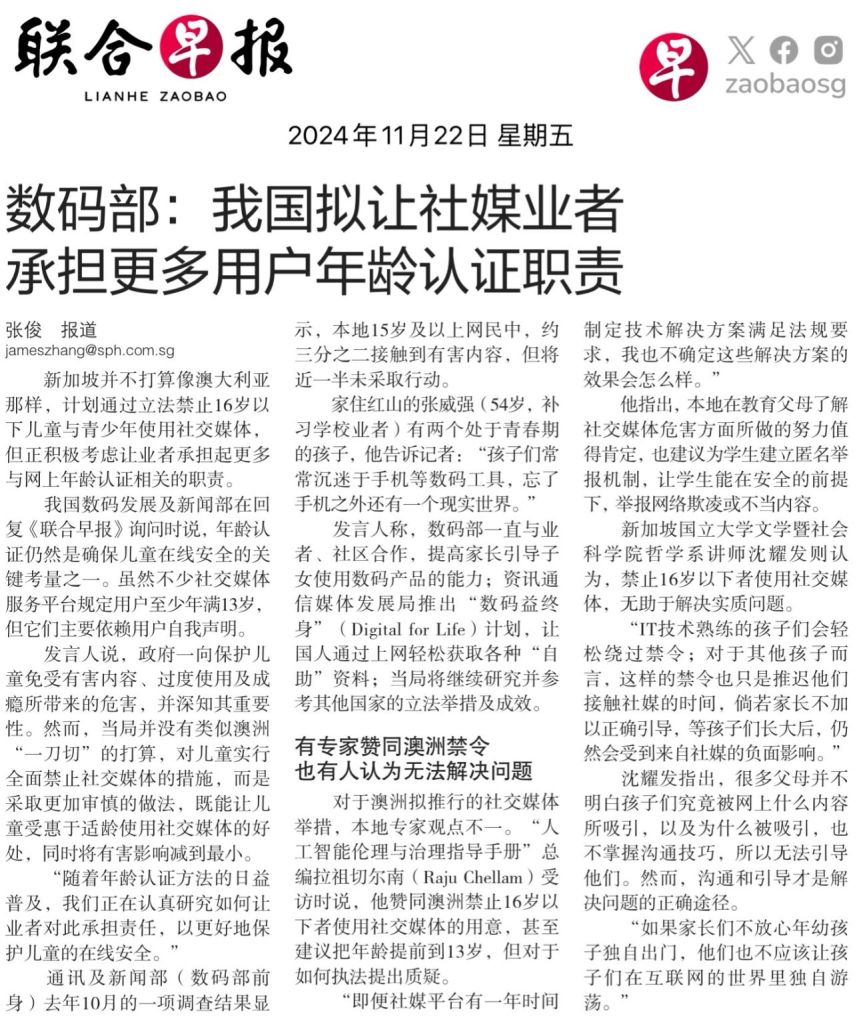
I was interviewed for an article for Lianhe Zaobao 联合早报. Here’s what I shared:
Children are not only affected by social media – adults are just as susceptible! Regardless of age, if we don’t have the right values/guidance/practices inculcated in us, we will not be well-equipped to handle the negative influences of social media.
Banning social media for those under 16 is not the right solution. IT-savvy kids will know how to circumvent such bans, so we’re back to the same problem. All it does is delay the inevitable yet important issues that we must confront with our children.
Many parents complain that they don’t know what to do when their child uses digital devices – they can’t understand or make sense of what their child is doing; and/or they don’t know how to talk about these matters in a productive way. They often receive conflicting advice from other parents who may not be well-informed.
What we need are resources – concepts, ideas, good practices, and given guidance and advice – to best manage the issues we face online, regardless of age. This will better equip parents to teach their kids well.
IMDA is doing the right thing by providing parents with sound and sensible guidance.
However, these resources are not enough to fully equip parents. At best, these resources can be thought of as a map, providing us with a general direction on how to guide our children well. They give us something to kickstart these conversations with our kids. These discussions will help us identify what we don’t know so that we seek out the kinds of support and resources we need to better guide our children well.
Some say that the problem is that we do not have age appropriate spaces meant for children online. It’s true that we cannot control who our kids interact with online, and it is challenging to ensure that they avoid materials inappropriate for their age.
The same can be said about our physical world – we are less worried about our children being exposed to dangers in the physical world than in the online world. That’s because we often accompany our children when we go out together, but we do not always accompany our children when they go online – we often think of online activity as an individual activity where we are literally left to our own devices.
This is implicitly the thread underlying IMDA’s resources – just as how we would not let our child freely roam the streets alone, we should not let them freely roam the Internet without adult supervision either. As parents, we should experience their world together with them and have conversations about what they encounter – as moments for parent-child bonding, and as opportunities or moments for learning and growth for both parent and child.
I was recently interviewed by Lianhe Zaobao 联合早报 about a recent report by Microsoft and LinkedIn on the “State of AI at Work in Singapore.”
I was asked two questions. Not all I said made it to the final article, but I thought it’s worth sharing my answers here:
Q1: “84% of Singapore AI users are bringing their own tools to work—Bring Your Own AI (BYOAI)—putting company data at risk.” Why are people doing this and what can we do?
For starters, there are some who are unaware of their own company’s data management/protection policies, so they don’t realise that what they are doing is risky. There are some who violate these policies because they cannot find a better AI alternative, and they downplay the risks – it’s hard to see negative consequences now because we won’t know if or when the data we give feed to the AI will be used to train another AI model in the future. It’s more important that employers have a good discussion with employees on what constitutes good practices and be clear on what kinds of information should not be uploaded to AI tools.
Q2: “77% of employers say they’d rather hire a less experienced candidate with AI skills than a more experienced candidate who lacked them.” What are the downsides to such hiring practices? What can we do?
The term, “AI skills,” is a very ambiguous term. It can mean technical skills at developing AI, and it can also mean skills at using Generative AI (GenAI) tools like ChatGPT. We need to be cautious with people who claim to have GenAI skills – it is important to discern whether they are only good at using it as a substitute to their own ability, or if they are they very good at using it to enhance their abilities, how they think, write, learn, and work.
I have met many capable A-grade students who don’t like to use GenAI. They say that they’d rather use their time to do the work themselves because they can produce better results. I found that many of these students have not explored the full capabilities of what these GenAI tools can do. If we can train them to use such tools effectively, they will have the capabilities to go even further, and to do so much.
At the end of the day, AI can only enhance what one has. If you give it to someone less capable, AI can only go so much. But if you train up someone who is very capable, they will go very far with the assistance of AI. People can learn and adapt. If they are lacking AI skills and are keen to learn, we should give them the chance the learn it.
 Jonathan Y. H. Sim