Investigating the Relationship between Ritual Propriety and Social Justice in the Early Confucian Tradition

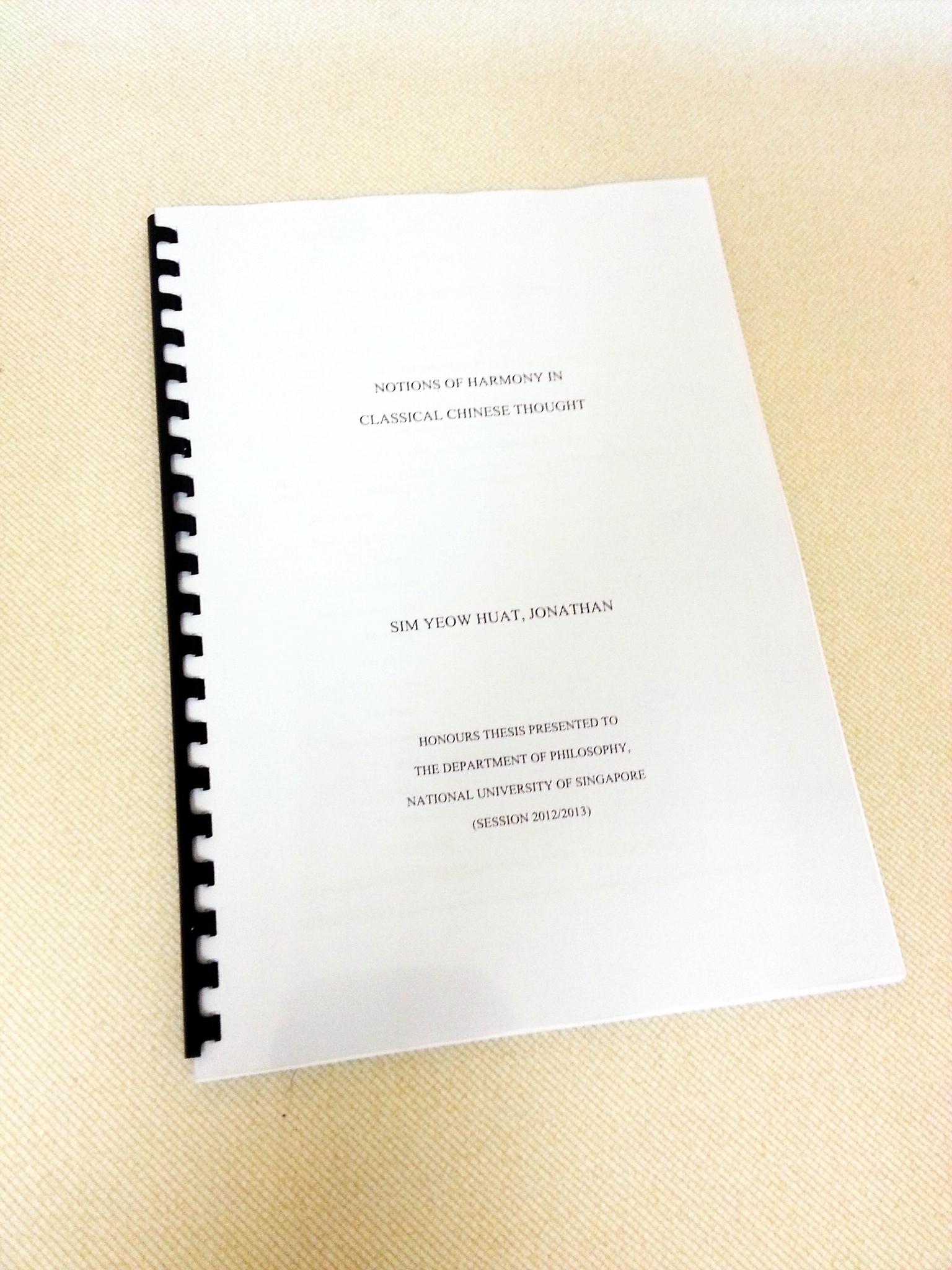
Here is a draft proposal for a paper I wish to write.

In the book, Confucian Perfectionism: A Political Philosophy for Modern Times, Joseph Chan argues that there are three principles of a Confucian perspective on social justice. The three principles are: (1) sufficiency for all, where “each household should have an amount of resources sufficient to live a materially secured and ethical life”; (2) priority to the badly off, where “people who fall below the threshold of sufficiency – those who have special needs and are badly off – should have priority in being taken care of”; and (3) merit and contribution, where “offices and emolument should be distributed according to an individual’s merits and contributions; any subsequent inequality of income is not illegitimate.” (pp.175-176)

Yet it is interesting to note that the concept of li (禮 rites/ritual/ritual propriety) – a key concept central to Confucian thinking – is not mentioned in Chan’s reconstruction of a Confucian perspective of social justice. The Liji (禮記), also known as The Book of Rites, strongly suggests that li plays a key role in supporting the Confucian perspective on social justice. One such example can be found in the first chapter of the Liji, which praises li for its ability to guarantee a condition of security:

In the highest antiquity they prized (simply conferring) good; in the time next to this, giving and repaying was the thing attended to. And what the rules of propriety (li) value is that reciprocity. If I give a gift and nothing comes in return, that is contrary to propriety (li); if the thing comes to me, and I give nothing in return, that also is contrary to propriety (li). If a man observe the rules of propriety (li), he is in a condition of security; if he do not, he is in one of danger. Hence there is the saying, ‘The rules of propriety (li) should by no means be left unlearned.’ (Liji, Chapter 1 “Qu Li Part 1”, 10, trans. James Legge)

Do rituals really play such a key role in supporting social justice? I propose to further investigate the concept of li and its relation to social justice. As the early Chinese thinkers had no concepts of social justice, it is not possible to directly derive a theory of social justice from their thoughts. Instead, I will follow the methods employed by Joseph Chan: instead of asking if the early thinkers had a theory of social justice, I would look at how the early thinkers approached specific problems that are linked to our modern understanding of social justice. How did these early Confucian thinkers try to resolve problems of inequality, poverty, and the distribution of material goods? However, I will go a step further and examine how li was employed to resolve these social justice problems: Was it used to establish certain societal norms (and attitudes) to motivate the regular redistribution of goods? Or was it employed in a more regulatory way to guarantee certain layers of protection for disadvantaged classes in society? Did li establish a certain worldview that shaped the way people perceived themselves and their relations with others in ways that would lead to a more socially just society? Lastly, I will explore how we might be able to adapt li into contemporary discourses on social justice, and how we might strengthen modern Confucian reconstructions of political philosophy with this newfound understanding of li.


Some Initial Thoughts

Well, I’ve read quite a few papers and books so far, and I thought it’d be worthwhile to share some of my initial thoughts on the above topic.

Having read the Liji, there seems to be several interesting components in li that may help to contribute towards a theory on social justice.

Firstly, the function of li is to create discrimination of people of different roles. I’m hesitant to call it class distinctions because it’s not just about class. People can belong to the same class yet hold different roles, some of which hold greater importance over others. Apart from making clear the roles, the other function of li is to form certain attitudes and sympathies of one role towards other roles. Some rites require both rich and poor to be present, so that the rich will receive first-hand exposure of the poor, and through the ceremonies, educate them on the need for greater sympathy and benevolence towards people who are not as well off as they are. In this way, the rich will imbued with sympathy and motivation to share their goods with those who are less fortunate. There are other rites that function to bring a community together for the main purpose of distributing goods. Some ceremonies employ the sacrifice of animals. At the end of the sacrifice, the meat is shared, as a way to provide the necessary nutrition to those who cannot afford meat.

It is also interesting to note that the Liji talks about li as having “definite regulations … to serve as dykes for the people.” (Liji, Chapter 30 “Fang Ji”, 2) There are certain elements codified within some (or all?) rituals to protect certain classes of people who are in a potentially disadvantageous position, depending on the type of interaction they engage in with others. The rituals are formulated such that the potentially disadvantaged are protected from exploitation. Here is an example:

The Master said, ‘According to the rules of marriage, the son-in-law should go in person to meet the bride. When he is introduced to her father and mother, they bring her forward, and give her to him’ – being afraid things should go contrary to what is right. In this way a dyke is raised in the interest of the people; and yet there are cases in which the wife will not go (to her husband’s).’ (Liji, Chapter 30 “Fang Ji”, 39)

These are some of the many ways in which the rites offer protection to the disadvantaged. Of course, in ancient times, laws then weren’t like the laws of today. They were coercive laws of punishment, rather than regulation. It was left up to li to govern and regulate the masses. What is worth exploring in this paper is whether (and how) the context of ritual opens up a new dimension of effectiveness not found in modern-day regulatory laws and policies.

Going beyond this, I get the sense that the Liji seems to describe an expansion of the family-relation template onto the broader society as a whole. In a family, the parents look after and provide for their children (and reciprocity requires that the children do their part in the family too, of course); elder siblings look out for and care for their younger siblings. These two familial relations seem to form the basis of the way in which materials are distributed from the rich to the poor. The community is the family. Neighbours are like siblings who look out for and help each other, and so the rich assist the poor in ways just like how elder sibling helps the younger sibling. Where the elder sibling is unable to help, the parents come in. The analogous equivalent would be the state, providing the necessary assistance in the form of public/state rituals involving the community. Rituals are the way by which the state exercises its parental role to all its “children”.

Ritual ensures that relational connections are established in a community, it facilitates a means, an event, a place, an action, to draw people together and interact in a certain way. Ritual is the tool by which people come to understand how their familial relationships are expanded to a broader society.

Let me now introduce a certain religious dimension into this picture. The power of rituals is that it imposes an as-if ideal world onto a less-than-perfection as-is world. Rituals – whether it’s something as grand as a state sacrifice, or something as simple as bowing between two persons – by its very performance, juxtaposes a certain ideal onto the world.

Take for example, the liturgy of the Eucharist celebrated by Christians. While the as-is reality is that of people sitting/standing/kneeling in pews as they are led in prayer by a priest/pastor, there is an as-if world that comes into play: the ideal Christian society as that mimicking the communion of saints in heaven. This worldview encompasses ideals of how one is to interact with each other in so many different ways.

Here’s another example, but on a more secular level. Let’s think about the ritual of high-fiving: when you and I perform a high-five, what are we communicating? Friendship? Camaraderie? Brotherhood? The celebration of success? Or perhaps there is something more? Whatever it is, it communicates a certain ideal relationship between us. (If you are wondering how that is possible, imagine a situation (or better yet, experience it yourself) where you try to high-five someone, but that person refuses to reciprocate back – you immediately begin to experience certain inadequacies about the relationship just from the failure to execute the reciprocal relation.) There is a certain vision of that relationship encapsulated in that high-five action. While our relationship is far from perfect in real life, that as-if world comes into existence, juxtaposing with the reality of our as-is world, whenever we perform the high-five.

Similarly, the performance of rituals brings into play an ideal world, that reminds constantly the participants about the ideal forms of interaction, and the ideal type of community. We see an illustration of this ideal society, described once again in the Liji:

When the Grand course was pursued, a public and common spirit ruled all under the sky; they chose men of talents, virtue, and ability; their words were sincere, and what they cultivated was harmony. Thus men did not love their parents only, nor treat as children only their own sons. A competent provision was secured for the aged till their death, employment for the able-bodied, and the means of growing up to the young. They showed kindness and compassion to widows, orphans, childless men, and those who were disabled by disease, so that they were all sufficiently maintained. Males had their proper work, and females had their homes. (They accumulated) articles (of value), disliking that they should be thrown away upon the ground, but not wishing to keep them for their own gratification. (They laboured) with their strength, disliking that it should not be exerted, but not exerting it (only) with a view to their own advantage. In this way (selfish) schemings were repressed and found no development. Robbers, thieves, and rebellious traitors did not show themselves, and hence the outer doors remained open, and were not shut. This was (the period of) what we call the Grand Union. (Liji, Chapter 9 “Li Yun”, 1, trans. James Legge)

While having a utopian vision of society doesn’t instantly lead to social justice, it nonetheless provides a goal towards what might be conceived of as a just society, an ideal society for its people to strive for.

Well, these are some of my initial comments. I’ll have more to say when I begin researching deeper on this.


Bibliography

Chan, Joseph, Confucian Perfectionism: A Political Philosophy for Modern Times (Princeton: Princeton University Press, 2014).

Chan, Joseph, “Is There a Confucian Perspective on Social Justice?” in eds. Takashi Shogimen & Cary J. Nederman, Western Political Thought in Dialogue with Asia (Lanhan MD: Rowman & Littlefield, 2008), pp. 261-277.

Chan, Joseph, “Confucianism and Social Justice: Historical Setting,” in eds. Michael D. Palmer & Stanley M. Burgess, Companion to Religion and Social Justice  (Oxford: Blackwell, 2012), pp. 77-92.

Puett, Michael, “Ritual and the Subjunctive” in eds. Seligman A, Weller R, Simon B, Ritual and its Consequences: An Essay on the Limits of Sincerity (Oxford: Oxford University Press; 2008). pp. 17-42.

Puett, Michael, “Innovation as Ritualization: The Fractured Cosmology of Early China,” Cardozo Law Review, 2006: 28 (1).

Puett, Michael, To Become a God: Cosmology, Sacrifice, and Self-Divinization in Early China (Cambridge: Harvard University Asia Centre, 2002).

Tan, Sor-Hoon, Confucian Democracy – A Deweyan Reconstruction of Confucianism (Albany: State University of New York Press, 2004).

Tan, Sor-Hoon, “The Dao of Politics: Rites and Laws as Pragmatic Tools of Government,” Philosophy East and West, 2011: 61 (3).

Tan, Sor-Hoon, “The Concept of Yi (义) in the Mencius and Problems of Distributive Justice,” Australasian Journal of Philosophy 2014: 92 (3).

Tan, Sor-Hoon, “Ritual and Deference: Extending Chinese Philosophy in a Comparative Context,” Philosophy East and West 2012: 62(1).
Some Comments on the 2015 Singapore General Elections

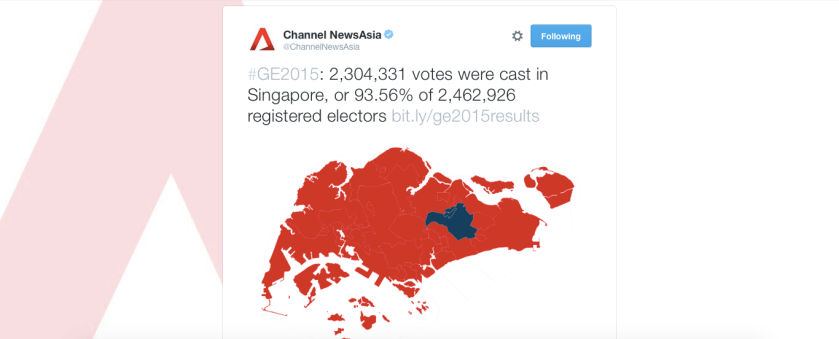
Well, the Singapore election results are out. To the (silent) majority who voted for the ruling party, there is a sigh of relief that its business as usual. To the minority who voted for the opposition, there is grave disappointment and even shock at the results.

screen-shot-2015-09-12-at-6-43-18-pm
The PAP won 83 of the 89 contested seats.

Now that the results are out, I’d like to share my thoughts and comments about the elections and where we might be heading towards. What I say may probably be very unpopular both to supporters of the ruling party and supporters of the opposition. I do hope that this post may provide some food for thought as we recover from the election fever, and return to the mundane routine of our daily lives.

First a disclaimer: I am not pro-PAP (People’s Action Party) neither am I a pro-opposition supporter. Both sides are not ideal neither do I like both sides. My principle for this election has been to vote for the one least capable of damaging the country both in the short term and in the long term. It’s difficult to gauge who’s better from just 10 days of campaigning. But it is very easy to determine who’s the worst, who’s the most incompetent, or the most stupid person/team. Whoever promised to be the least damaging for the country got my vote.

One of the most disturbing comments coming out from opposition candidates in response to the election results was that they were surprised by their poor performance in this elections. Many thought that they’d perform better than the last election, and were thus taken aback by the sharp drop in votes. All that rhetoric about being one with the people and understanding their needs is complete utter rubbish. I think it’s safe to say that this came from all opposition candidates who didn’t belong to the Workers’ Party (WP).

Now, this is disturbing to me because it signals their lack of understanding of the ground. If they are to represent the people of their constituency, they must know the needs and thoughts of their people. Many opposition candidates seemed quite content with receiving feedback from social media, rallies, and the people they met while campaigning – as if these sources of information were sufficient for understanding the sentiments on the ground.

WP and PAP, on the other hand, knew very well that they couldn’t trust the rally attendance or social media as reliable sources of on-the-ground information, which was why Mr. Low Thia Kiang and his team weren’t surprised at all with the drastic “swing” in their election results.

The other opposition candidates thought they knew the ground, and thus they were very surprised. Clearly, they were out of touch, surrounded comfortably with people of similar views. They only had a perceived understanding of the needs and concerns of the people. In the end, they lacked the wisdom to discern and listen to the needs of the people. I certainly wouldn’t want them to represent me in Parliament, would you?

Now, what isn’t helpful to the opposition and their supporters is the narrative they constructed last night: the myth of the silent majority and the surprising national swing in favour of the ruling party. (The other myth is the myth of a large group of new citizens, which I’ll treat in a future post)

Once again, this has revealed just how blind these candidates have been to what’s really going on. The Straits Times, for all its flaws and sins as a mouthpiece of the ruling party, has actually done a somewhat decent job (not great, but can do) in pointing out the daily bread and butter concerns of the majority.

Take for example, the issue of many business owners having difficulty expanding or maintaining their operations due to stricter policies on foreign labour. With the exception of the WP, every other opposition party had been quite happy to shoot down foreigners and foreign labour. This does not bode well for many business owners. Of course, this is one of many other examples. The concerns of the “silent” majority are expressed often on the news, but they weren’t picked up by these opposition candidates at all. Instead, they’ve picked up the supposed problems expressed so often and so loudly on social media, as if everything on the Internet is true (or it may be true, but just blown out of proportion).

Furthermore, it is interesting how many of these opposition candidates seem rather oblivious to the strong pro-PAP sentiments arising from the death of Lee Kuan Yew and the SG50 celebrations. They were so strongly expressed both offline and online. Clearly, an election soon after SG50 celebrations was an attempt by the ruling party to ride this wave. How could anyone miss this? How could these candidates – who desire to represent their constituencies – be completely oblivious to it, and show surprise at the results? What cave have they been hiding in to not be aware of this?

On these two points alone, the opposition parties (excluding the WP) have demonstrated utter ignorance and lack of wisdom to be even barely decent candidates. They have no excuse for being surprised.

Nonetheless, this election has helped to differentiate who are the credible and potentially credible opposition parties for the next round of election. The Workers’ Party is clearly the most credible and reputable party. The Singapore Democratic Party (SDP), having reformed itself, showed much potential for being another credible party in the future. These two parties are worth watching out for in the next election.

The other opposition parties have made a fool of themselves in so many ways in just 10 days (some began displaying utter stupidity weeks in advance). They’re definitely not worth anyone’s time or money, even if they come back promising reforms to their leadership and team. The other problem with many of these small parties is that they’re constantly splitting up due to minor differences. They do not know how to handle differences of opinion and they believe that they hold the truth, despite showing how misinformed they can be. This is dangerous on so many levels. The last thing we should confer to them is power of any kind.

Allow me to say a few words about the WP. I have to commend Mr. Low and his team. They knew in advance that they may experience a drop in election results. They knew they were up against the euphoria of SG50 celebrations and the pro-PAP sentiments arising from Lee Kuan Yew’s passing, and hence fielded their candidates very carefully with the priority of maintaining their stronghold.

But in addition to this, what led to WP’s drop was that they had set in the minds of everyone, too high an expectation of their performance in the past 4 years. In the 2011 General Election, they campaigned for a First-world Parliament, where policies would be debated and probed, as a way of checking the PAP. The expectations people had of them were too high, and many were disillusioned because WP did not meet those expectations.

Sure, WP was heavily bogged down by Town Council matters, and that might have prevented them from doing more in parliament. But perhaps, WP allowed themselves to become too distracted by town council issues because the PAP kept probing them about it. Many say that the PAP was playing dirty. But I wouldn’t fault the PAP for that. The problem lies with the way WP handled the issue. It’s suspicious that WP couldn’t produce a straightforward answer each time they were asked. They answered but skirted several issues while they were at it. Such an approach would raise eyebrows naturally, and hence the reason why this issue looks like a dead horse that’s been flogged for years now. Many supporters have become suspicious of the WP as a result of this.

To many who have held high expectations of WP’s First-world Parliament performance, one key area of disappointment was that they seemed to have failed to debate on many issues. Questions posed by the WP in parliament were more like clarification questions, rather than actual probing of policies.

Most disappointingly of all, was their star candidate, Mr. Chen Show Mao. With a Bachelor, Masters and Doctorate degrees from Harvard, Oxford, and Stanford, one would have expected him to be an eloquent and sharp speaker in Parliament, with the keen ability to detect problems in proposed policies by the PAP. He showed himself a great speaker during the 2011 campaigns. But for reasons beyond my comprehension, his performance in Parliament – his speeches and questions, as well as his replies to questions – were far below expectation. I am not sure if he is silenced by the party, but there is a great disparity in the ability he showed at campaigns and in Parliament. What’s going on?

So, yes, there is much soul searching and improvement that the WP needs to do to regain the trust and confidence. If anything, I think the lesson here is that they shouldn’t have set for themselves too high an expectation beyond what they could deliver. It is for this reason that they have to suffer the consequence of losing a single-member constituency, and a drop in votes.

What about the ruling party, the PAP? A great deal of digital ink has been spilled over the stupidity and arrogance of many of their candidates. There are many candidates who are clearly out of touch with the ground and speak as if they have been sitting in an ivory tower for a very long time. I wished they were voted out. There are some who are competent, but make matters worse for everyone whenever they open their mouths. They should have learnt from the previous election to speak less else they’d appear stupid before the masses. Some have learnt their lesson this time round; others didn’t and continued to make a fool of themselves.

Yet, for all the failings of the PAP in their campaigning, I must salute them for having done a much better job this year. There is a marked improvement in the way they presented themselves.

In particular, PM Lee Hsien Loong has certainly done a fantastic job making himself well-loved by many on the Internet over these past years. His winning point is that he has shown himself to be very human, a joyful, lovable person with many geeky interests that the people share in common with – a stark contrast to the strict and authoritarian person his father was.

He was his own personal brand, and one that accompanied all the constituencies this election. To the eyes of many, PM Lee has certainly helped to soften the image of the ruling party. It wasn’t just a vote for the tough, cold, arrogant, uncaring and authoritarian party, it was also a vote for a lovable and jovial geeky mathematician who would lead his people to greater prosperity and peace. This was the power of his personal brand during the campaign. In the past 10 days, you’d see his happy smiling face everywhere you went. As the results of this election has shown, PM Lee’s personal branding has definitely balanced out some of the negative feelings towards the party. I must give credit to the public relations person who helped to craft this image.

The timing of this election has been most peculiar. Why now rather than next year? Some have joked that it had to do with the Hungry Ghost Festival, and that PM Lee was hoping to seek the blessings of the late Mr. Lee Kuan Yew to assist. It is a funny thought.

Yet, the narrative of the PAP’s victory speeches seems to be preparing us for something more drastic.

Sure, the term “mandate of the people” is a term thrown around in elections, but it is over-used this time round (though not as much as the word, “humble”, which was used so frequently it became meaningless).

Given the impending possibility of yet another economic/financial crisis thanks to mess in the US, EU, and China, this mandate of the people is especially important. If Singapore is going to brace itself for the impending economic/financial doom and gloom that is to come, drastic measures need to be taken, measures that will definitely prove to be very unpopular to many. I suspect the phrase, “bitter medicine” will be thrown about a lot in the coming months.

Since the people have given the PAP their mandate, they cannot complain about what’s going to happen in the next five years (to borrow a phrase from the bitter losing candidate, Mr. Kenneth Jeyaretnam). It is perhaps useful that DPM Tharman Shanmugaratnam received a slightly stronger mandate from the people (whether the PAP put in effort to produce his own personal brand I’m not sure, but his awesomeness shone through and he won the favour of many).

Having received such a strong mandate, he will probably be the spokesperson, planner and implementer of the upcoming unpopular changes in policy to brace the nation for impending economic/financial doom.

Perhaps many voters have sensed the impending crisis and are willing to place their trust in a party that has a record of keeping stable in times of economic turbulence, hence the great swing towards the PAP. I’m not sure.

But whatever it is, the people have issued a strong mandate. And if indeed the PAP is going to implement drastic measures to prepare for the impending global economic crisis, we shall see in the months to come.

So, brace yourself! The ride is going to get rough.

A “Just Desert” is Not a Land of Righteous Sand, and a “Just Dessert” is a Rightly Portioned Cake with Ice Cream

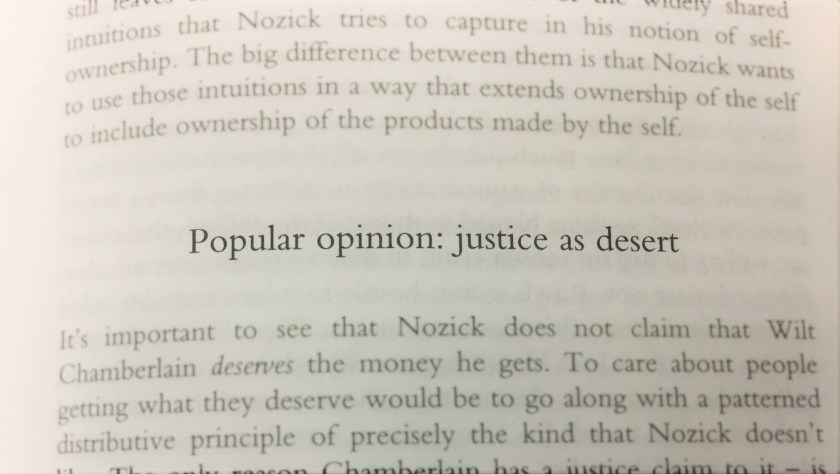
Here’s a little-known trivia about the English language. I was reading a book on Political Philosophy when I encountered this:

20150825_005203500_ios
WHAT?!

The first thing that went through my head was: What does that mean?

For the rest of the chapter, the author continued to use the word, “desert,” but in ways that were so unusual to me. How is a desert (the one with sand) just in any sense?!

I was scratching my head, constantly trying to figure out what he meant. I had to re-read the section repeatedly, until it occurred to me that perhaps he meant: “dessert”?

Well, unfortunately, I wasn’t happy with the realisation because this unusual usage of “desert” made it so difficult for me to figure out what was going on with the chapter. I complained about this to a few friends. How is it possible that the author could have made such a consistent typo throughout the chapter? How did the editor not spot it?

Yet, isn’t it odd that if it were a consistent typo, the author or editor would have spotted and corrected it?

One of my friends became curious about this incident. He went out to investigate (on Google, of course… Keyboard Warriors, charge!!!), and we came to a very VERY surprising discovery: It’s not a mistake!

If you look at the dictionary for the definition of “desert,” one of the definitions you’ll find is this:

screenshot
From the Merriam-Webster Dictionary

So actually, there isn’t such a thing as “just desserts,” unless you are talking specifically about portioning out the right size of cake and ice cream. It should really be “just deserts”!

But I guess so many of us have been using “just desserts” that it has now become the acceptable form in the English language.

Also, “desert” in “just desert” is pronounced differently from the sand type of “desert.”  It sounds like “dessert”, but instead of saying, “dis-seeeert” as you would for cakes and ice-cream, you pronounce it as: “dis-sert” (a very short ‘e’ sound on the second syllable).

So there you go. I learnt something new from this, have you? :)

Sincere Optics: Opticians You Can Trust (And I Most Certainly Did!)

Two months ago, I finally went to the optician to make a new pair of glasses.

My old pair was due for a change for some time. But I’ve been quite reluctant to change it because of the cost and the effort of having to find a good optician. I made my old pair about 6 years ago, but the optician closed down his shop a few years back.

And so, I’ve been tolerating blurry vision for some time. I had to squint just to see the text clearly from a distance.

The last straw came when, about 2-3 months back, I accidentally flagged the wrong bus. I mistook bus 98 for bus 30. It was so embarrassing, especially when I was the only person at the bus stop. I waved and bowed apologetically to the bus driver who kept staring at me. How on earth did I mistake bus 98 for bus 30 remains a mystery to me. But the fact that my blurry vision led me to see the wrong numbers was a sign that it’s finally time to change my glasses. No more delays!

Also, as a philosopher, I really should take better care of my eyes, especially since I read a lot. I know of two philosophers who have strained their eyes so much that they suffered from detached retinas. Yes, that’s right. The wiring, which connects their eyeballs to their brains, had been under so much strain that it broke and detached itself from the eyeball! Eeew… I squirm every time I think about it.

Indeed, no more delays.

Part of the reason for my reluctance to change the old spectacles was that I couldn’t find a good optician. I’ve heard of some horror stories of friends who paid a lot only to get a pair that was so uncomfortable to wear, that they gave up and returned to their old pair. A big waste of money.

Moreover, it really doesn’t help that these days, I find it difficult to find an optician who’s sincerely motivated to help, or one with a decent set of technical knowledge. I’ve been to several shops but many are just bad or meh.

To my annoyance, those who appear passionate/enthusiastic about helping often gave me the vibes that they are more passionate about making a quick buck from you. I don’t trust them or their recommendations. And then there are those who lack the passion to help because they hate their jobs. I’d rather avoid paying for their service because they won’t be motivated to go the extra mile to help in case anything goes wrong.

It’s been such a turnoff, and so, for some time, I’ve had much difficulties finding a shop I could trust.

In the end, I decided to try my friends’ shop (they’re a couple). I knew that they’re involved in their family’s optical shop, but I usually try to separate friends from business because it can make the friendship rather complicated. But due to the urgent need for a new pair, I figured it might be worthwhile to give it a shot. And so I did!

(At this point, I should state that this blog post is done out of my own free will, written because I was genuinely very impressed by the service and experience I had while I was there. I think good businesses should be praised and promoted. It’s hard to find good service these days.)

Their shop is called “Sincere Optics,” and it is located on the 3rd floor of Beauty World Shopping Centre (144 Upper Bukit Timah Road), a very quaint and sleepy shopping centre that still retains its original 70s look and feel. Initially, I thought that no one comes to this shopping centre because it looks so old and run down. But I was wrong. On weekends, it’s filled with lots of people, especially parents who drop their kids off for tuition or dance classes, as they sit outside to read the newspapers.

Sincere Optics is a family business that has been around for about three generations. In fact, they’ve been around for so long, that they continue to serve loyal customers and their families, up to three generations! Talk about personalised service! Imagine that! Up to three generations have come and gone to their shop for spectacles and contact lenses. Wow!

As this business is their life, the people running the place are very friendly, passionate, and sincere in what they do. They have their family reputation and brand to uphold, but above and beyond that, they take pride in their family tradition, and hold true to their values, especially that of being sincere (hence the name of their shop).

The impression I got is that they’ve developed quite a friendship with their customers. Not only do they remember the names of their regular customers, but they also remember the prescription of their disposable contact lenses as well. It takes a lot of care, concern and effort to be able to remember these things very well.

Looking back at my experience with them, this is a truly wonderful service which you don’t get with modern “corporate” businesses. They’re usually so cold and impersonal. This, however, was a truly personalised service made a lot better with the extra care and concern that they have.

These were all that I witnessed when I first walked in to visit their shop. I haven’t even been served by them yet!

When my friends, Hanes and Melissa, were done serving their customers, they came to me. Though we are friends, they nonetheless delivered a very professional service. You could see the teamwork in their family operation. After using the machine to check my eye, they handed me over to their colleague, a long-time family friend and staff, who then tested my eyesight. He was fast yet very meticulous. Within minutes, they’ve determined the new power of my eyes. Turns out the power remained the same, but my astigmatism doubled.

Then came the fun part of choosing a new frame. This time, I was open to the idea of change. After all, I had been wearing this old frame design for 10 years. As I mentioned earlier, I wore the previous pair for 6 years. Before that, I had another pair of the same design for 4 years. I was supposed to wear it for much longer, but I lost that pair while I was out at sea. It was my first time seeing huge waves at the beach in Australia, and so I wanted to see the waves up close in person. My friends advised me to remove my glasses before going into the sea, but I stubbornly refuse. My desire was fulfilled when I got hit in the face by a huge wave, only to discover that my glasses had fallen out, never to be found again. Oops!

So I picked out a new design and paid for the glasses. In less than a week, I got a call that my new glasses was ready. I was excited and rushed down to their shop to collect. I’ve wore this pair for two months, and I can definitely say that it has given me absolutely no problems at all.

Here’s my new glasses and my new look:

OLYMPUS DIGITAL CAMERA
New glasses!

Looks good?

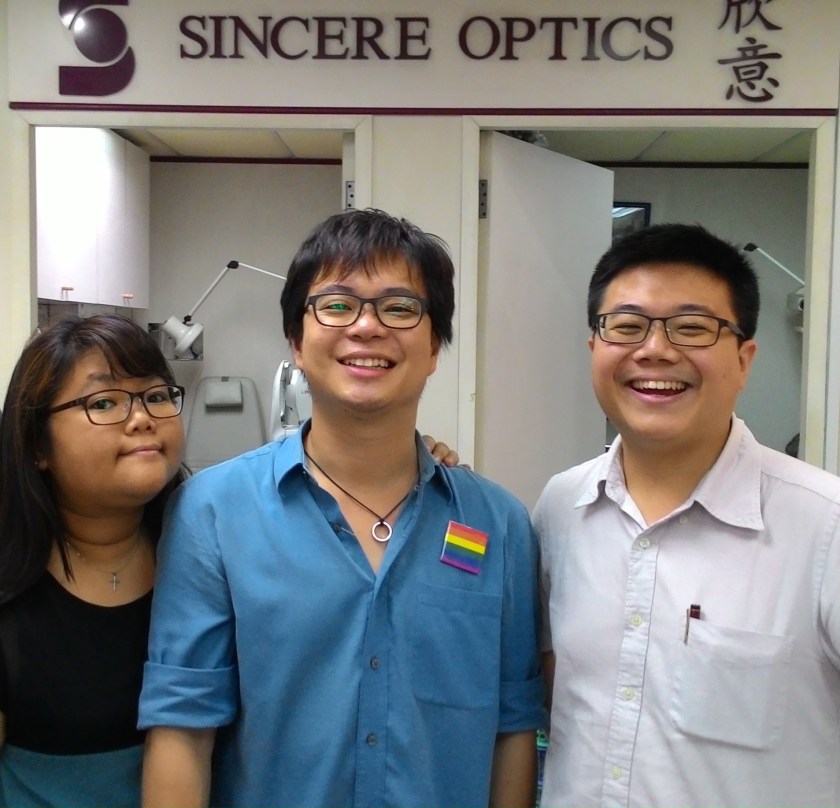
And here I am with the lovely couple who helped made this possible:

Jpeg
The wonderful couple – Melissa and Hanes of Sincere Optics – who made this possible.

Anyway, if you are looking for opticians whom you can really trust, I strongly recommend them. It’s their life and their life’s work. These are people, craftsmen and craftswomen, who take their work seriously, and are truly passionate and sincere in what they do – qualities I find lacking in many optical shops today.

It’s been such a great experience. I am sure to come back here again, and even bring my future children here to make their specs, thus following other loyal customers who have been here faithfully for generations.

Here’s their address if you wish to visit them:

Sincere Optics
144 Upper Bukit Timah Road
Beauty World Centre
#03-20
Singapore 588177 [click here to view map]
Tel: +65 6468 1618

2014 Year-End Review (Part 2) – Don’t Stop Writing!

In Part 2 of my Year-End Review, I’d like to talk about the most important lesson that I learnt throughout the course of this year.

Some of you may know that I stopped blogging some time in the middle of 2013. That was the time when my previous blog grew very popular.

It attracted attention from certain groups of highly undesirable people. Several people (including acquaintances) reached out to me in the name of “developing” friendships (yeah, right…). They’d invite me out for lunch/dinner/tea or something so that we can “catch up,” when in reality, all they wanted was to benefit from the potential publicity that I could give. I don’t mind it if we did these kinds of things on a professional level (don’t mix personal matters with business). But it really disgusts me that people would deny it, and say that they are genuinely doing it for the sake of friendship. How do these people live with themselves? Are they content with such superficial friendships? Have they no shame in the way they conduct themselves?

It was the way these people did it, and the number of such people doing it that really overwhelmed me with great disgust. Maybe I just wasn’t mentally/emotionally prepared to handle so many disgusting and selfish people in such a short span of time.

Maybe… But the experience was so bad that one day I decided that I would stop blogging.

That was, by far, the worst decision of my life.

As I wrote this last sentence, I stopped typing for a while and thought deeply if I was exaggerating this claim. Looking back at every “bad” decision I made or regretted, I still would rank this as the single worst decision of my life ever. At least every other decision produced many learning insights.

When I stopped writing, I realised I lost a big part of myself. I seemed to have lost a deep connection of myself as the self-as-immersed-in-the-world. I realised that as soon as I stopped writing, I failed to give structure to my thoughts. They are scattered all over, disconnected one from the other.

Writing is very much like a meditative process for me. As I write, I focus on the idea developing word for word, and see it appear before my eyes on the screen. And every minute or so, I go back and review what has been written, and ponder deeply on it again and again. Does this make sense? Is it coherent? Could there have been a better way of expressing it?

This process of writing, forces me to meditate on the issue that I wish to discuss. It connects my deepest self – mind and heart – to the words on the screen. It links the thoughts in my head with the issues around me. Writing helps me to draw the connections between the scattered ideas in my mind, and when the dots are all connected, I gain insights into the matter.

This process cannot be replicated from speaking out loud, or simply from thinking to myself. A word, once uttered, is lost in the air. A thought, once entertained, fades away. I don’t have the words – critical feedback – appearing before my very eyes so that I can judge and evaluate each sentence, each word, in the context of its entirety.

What a big difference it makes to the way we think!

Not writing for months. That really affected me a lot. It got to a point where I couldn’t take it anymore, and so I decided to start a new blog – this blog – under a new name. A fresh start, so to speak. Unfortunately, as I had not been blogging when I transitioned from student to employee, I never developed a routine habit from the start for my writing activity. It has been difficult trying to write now that I’m working.

But I’m glad that I have those moments, every now and then, to retreat from life and work, to this little user interface on my screen, where I can pen my thoughts. These rare moments allow me to get in touch with myself and have a deeper understanding of moments and issues around me (and even of myself).

This idea of the importance in writing was further emphasized when a professor one day mentioned that the only way to develop one’s mind is to read a lot, discuss a lot, and most importantly, to write a lot. That resonated so deeply in me. I’ve been reading and discussing, but have been feeling a deep lack within for quite a while. Indeed, read, discuss and write. That is critical to one’s growth.

So yes, the big lesson of 2014 (at least for myself) is this: Don’t stop writing. Pick up your pen, or your keyboard, and write. Let the words flow, let your ideas develop. Don’t worry about perfection for perfection is an abstract ideal with no concrete parameters that will enable you to see that you have arrived at your destination. Just write, and write intimately so that you can hear yourself, and be deeply in touch with yourself.

Don’t stop writing!

2014 Year-End Review (Part 1) – A Gap Year of Exploration

Wow… Time really flies, perhaps faster than ever before. It’s hard to believe that a year has passed because I still have very vivid memories of all the events that happened in the past year (and even further back in time).

I’ll have to say that the year 2014 has been the most challenging year ever. Yet, despite all these challenges and occasional set-backs, I feel like I’ve grown a lot, and gained a lot of insights. And to top that off, I’ve met a lot of profoundly inspiring and amazing people, many of whom have restored my faith in humanity, and given me new lenses with which to see the world.

It’s amazing!

In order to make sense of 2014, I really should talk about it in the context of 2013, only because 2013 was the year that I made a few major decisions on what to do with my life, and it’s only in 2014 that many of these decisions began to unfold in interesting ways.

(I realised, having written so much, that it would be unrealistic to cram all my year-end reviews in a single post. So I’ll split it into several parts. Here’s Part 1…)


A Gap Year of Exploration

At the end of my undergraduate life, I decided to take a gap year from study, so that I could take a step back to explore my options and discover what I might want to do with my life.

I was quite burnt out in my final year of university, to the extent that I didn’t want to go through the ordeal of writing papers night after night. It seems that the experience was so bad that it has developed in me, a small yet powerful dread of writing, to the extent that I don’t enjoy writing very much. In the past, I could just sit in front of the keyboard and words would flow from my mind through my fingers onto the screen. But now, I’m always confronted with a dread and a kind of mental block. Words don’t flow so easily, and it takes me some time to settle down and calm my mind to overcome that psychological obstacle.

Much as I love academic philosophy, I always had this nagging feeling that I might not want to pursue this, or at least not in the way that I encountered it in my undergraduate life. I love the learning, I love reading, I love the process of growth, but I just do not enjoy the painful process of writing academic papers. (But as I slowly come to realise: three positives versus one negative, maybe that’s not too bad? There is no career that is 100% enjoyable, is there? Well, that’s something I still need to discover for myself)

So, instead of plunging myself into graduate school like many of my peers. I figured it would be better to try other things. But I had a lot of reluctance because I couldn’t seem to find a first job that really interested me. Moreover, I was quite afraid that I’d end up doing mindless, meaningless tasks, no more than a cog in the machine.

That all changed one day when I met a professor for lunch one day. (Some introduction to the professor:) This was Prof. Lo Yuet Keung from the NUS Chinese Department. I never thought I would sit in for a class taught in Mandarin, but I did back when I was in my first year (2009). It was the only Chinese philo module that was offered at that time. Though I didn’t understand Chinese very well, I was blown-away by what I could understand. But most of all, Prof. Lo made a very deep and profound impression on me. He was the first person I encountered whom you could call a junzi (君子 gentleman). I looked at him and told myself: this is the type of awesome person I’d like to be. I wanted to study Chinese philosophy the way he did, to be transformed by the wisdom of the ancient philosophers, as he was.

Anyway, many years later, I was very touched to find out from a friend that Prof. Lo remembers me (even though I never interacted with him during or after class in any of his modules). So I decided to drop him an e-mail, asking if it were possible to have lunch. And we did. It was by far, the most life-changing lunch appointment ever. I shared with him my hesitations on applying for a job, and told him that maybe I should take up a course or some certification class. In reply, he said something that changed my reality for the better:

Prof. Lo said: “Why bother paying money to learn a skill, when you can be paid to learn?” He went on to elaborate that I should perceive each and every job as a course in itself. Lessons and insights to acquire every step of the way (and you get paid as well – a double bonus!).

That changed the way I looked at the world, and it helped me with my search. With great confidence, I set out to apply. I eventually landed with a job at an electronics company, handling both the marketing of electronics and training the people who used it. It was a lot of fun.

Half a year later, I got a call from Nanyang Technological University (NTU). They heard that I was looking for a research-related job, and they offered me a position to co-develop a course on Chinese philosophy with the Dean of the College, who was also quite a big name in the field of Chinese philosophy. It was an opportunity too good to miss. And I figured this would be ideal, as it might help me to decide whether or not I should pursue academia as a career.

I said yes, and it was by far the best decision of my life.

It’s been 10 months since I joined NTU. There’s been many challenges and difficult moments. But every step of the way has been meaningful, and it’s been great.

The greatest highlight of my time in NTU was to be involved in a project exploring ways to overcome the East-West barrier, how Chinese philosophy might help to enrich complexity thinking in the sciences (and social sciences), and how the two might just be related to each other. As part of this project, we organised two surveying workshops and invited several prominent researchers, directors of research institutes, and top public servants from around the world. It was amazing sitting in the midst of great and brilliant people.

This very experience gave me two very deep and profound realisations: (1) Firstly, it made me realise that my training in academic philosophy was insufficient in enabling me to comment on policy issues or matters of current affairs. I could listen and critique the ideas of others, but I’ve been unable to formulate anything positive on my part. This has been important to me as I’ve always aspired to be a public intellectual, using my philosophical skills to comment or critique pressing issues of society, or provide ideas, solutions or insights into certain matters. I always felt a sense of this inability, and in some ways, I’ve struggled with trying to write about such matters. But it was during those discussions that this inability became strongly apparent. Here I was, struggling with my training, knowledge, skills, and insights, yet what could I say? I could only speak theoretically (and naively even) about ideals, and I was unable to translate or connect it back to real events or issues. It was a challenge.

(2) Secondly, I came to the realisation that when you study philosophy along with several other disciplines, you will gain very interesting insights that you would not have acquired simply from the study of philosophy alone, or even from a mere interdisciplinary study of philosophy with one other discipline. No, it’s not just about one or two disciplines coming together. It is about bringing several disciplines together like a complete package (e.g. studying these disciplines together at the same time on a particular issue: philosophy, economics, politics, sociology, history). It is through this approach, that one could see certain issues very differently.

These two insights have changed my priorities and objectives. While I would still like to pursue a PhD in Philosophy, I would nonetheless like to branch out and study something else, maybe related to philosophy, but also related to other disciplines, as a good stepping stone in enabling me to address the two realisations above. I’m applying now for a Masters programme. But I’ll say more later once I’m done writing the proposal. What I can say now is that I’m going to take a rather unconventional route, but it seems that this choice will open more doors for me, and lead me to far greater growth.

With 2014 coming to an end, I realised I exceeded the time frame I gave myself when I took the gap year. I expected myself to have started graduate studies by now, or at least to move on to begin building my career.

For a while, I felt rather guilty, but recently, a very brilliant person commented that we all have cycles of activity and cycles of recuperation. Rather than to be worried about not being in the active cycle, I should instead focus (and not feel guilty) about my recuperation period, to recover and prepare myself intellectually, psychologically, and emotionally for all the great challenges and obstacles that will come my way once I begin graduate studies.

There should always be progress, but progress is to be made in the context of cycles of activity and recuperation. When such cycles are disrupted in the name of “progress”, it is not progress but haste. And it is in haste that we lose all insights and direction, and it is because of haste that we tire easily and burn ourselves much sooner than we expect.

In that case, I look forward to prepare myself slowly yet steadily for the changes to come next year.

With a new year starting, I think I now have a sense of what I’d like to pursue, at least over the next few years. In so many ways, I’m glad I didn’t simply rush into graduate school. I wouldn’t have had so many opportunities and life-changing insights. In 2013, I struggled so much trying to find some solution as to what to do next with my life, and thankfully, in 2014, I think I found the answer.

It has been a good year.

Needing Contemplation

Recently, a philosophy professor mentioned that philosophy only advances when one engages in three things: reading, discussing, and writing.

This is so true.

Sadly, ever since I graduated, I rarely had the time to write. As you can see from this blog, I don’t write that often.

But the actual root of the problem is this: in order to have the time to write something significant and profound, one must also have the time to think, to contemplate on issues. I finally understand one aspect of what Aristotle meant when he wrote the Ethics. Aristotle said that the best life to live is the life of contemplation, where one is able to contemplate and marvel at the truth, goodness, and beauty of things. But such a life, as Aristotle acknowledged, is a luxury, and it can only be sustained if one is spared from chores and other matters of life that would rob one’s time and energy from fully engaging in contemplation. (Unfortunately, Aristotle’s solution to grant people that luxury of time and energy to contemplate, was to maintain a slave class in society do handle all those chores.) But anyway, yes, I see why he said that.

Working life is just so exhausting, with so many projects and deadlines. And it gets more hectic when one has other household matters to deal with. Gosh… Sometimes I feel like I’m just firefighting every single day. The alarm blares out loud in the morning, and then I rush to work, and a million and one things come up throughout the day. And before I know it, the day is over. Evening sets and I am fatigued, often too exhausted to do anything else but to function like a statue on the sofa, sometimes functioning like a plant, staying firmly rooted on the couch, while I “photosynthesize” before the television screen.

No time for contemplation!

Thankfully, I do get to enjoy a good hour in the morning to read as I commute to work, and fortunately, I have the company of philosophical friends with whom I get to discuss issues that I read or toyed with at random. So… Reading, checked. Discussing, checked. Writing… Nope!

I have been trying very hard to write. Every day I face a blank white screen with the text cursor flashing. What shall I write? What shall I write? Nothing flows from my mind. It is quite frustrating. Call it a writer’s block if you will. But I think the trouble comes precisely from the lack of contemplation. Not enough time to properly connect the ideas in my head into something coherent, and so the thoughts do not flow smoothly nor coherently enough to form something decent.

I need to contemplate.

Having said all these, here is my firm resolution: I resolve to set aside time each day to contemplate. It’s something I stopped doing, and it is something I definitely want to keep doing once again.

Wish me luck!

A hot cup of toffee nut latte on a cold rainy day

I love how Christmas is coming. Every year Starbucks will offer its special Christmas brew. I look forward to it every year.

A cup of toffee nut latte with its fragrant smell and taste brings me so much happiness. And especially on a cold rainy day, this drink is the perfect beverage to compliment the lovely chilly weather. MMMmmm…

I’ll be honest and say that I don’t particularly like the drink so much anymore now. I guess as one grows with age, one outgrows one’s liking for sweet drinks.

So why do I still drink it? Mainly, for the nostalgia, but also as an annual reminder for what it now represents.

This was the drink that has accompanied me for so many cold and rainy nights back in my undergraduate days, where at the end of the semester (well, at the end of every Semester 1) I’d spend several, almost-consecutive nights in a row, working overnight on campus to write papers after papers, until the sun rose at about 6+am (no kidding!).

It was the drink that in many ways, stayed beside me, sitting with me, keeping me up, keeping me going. The fact that it was a seasonal brew made it all the more special. It also, in a way, gave me something to look forward to at the time when assignments are aplenty, and where stress is high.

Now that I have graduated and don’t need undergo such academic toiling, this drink brings me lovely memories of the those times where I stayed up to write papers. While in some ways, I hated the experience, I still loved it for the kind of peace and quiet that I enjoyed. There’s something really wonderful about sitting in a dim room in the middle of the night, with a small desk lamp over your head, with another one or two other students working in the study room. Maybe it’s the combination of the lack of sleep, stress and the caffeine, but the experience of solitude as you think and write is magical… But I digress.

More significantly, this drink stands as a symbol of the silent companion who stands by your side, cheering you, giving you (mental) strength to keep going, to keep thinking, to keep writing. That you’re never alone even as you’re writing at 4am in the middle of the night, where everyone else is asleep.

That companion, who transforms and gives new meaning and understanding to the experience of the toil and suffering of work; transforming toil into toil-AND-pleasure, adding an element of joy – sips of joy full of flavour, stimulating your senses as if setting off a series of fireworks in your mind – with every small sip I took, as I wrote my papers with frustration.

Toil transformed into toil-and-pleasure.

It is a hopeful drink. It serves as a reminder of those moments, and how I overcame those moments year after year till graduation, with this simple seasonal drink.

To drink it once again, today, on a cold rainy day in December. A timely reminder. A comforting thought. A heartening sip.

Second Person Narratives

Here’s a random thought that came to my mind: why aren’t there stories written in the second person narrative? (i.e. stories involving, “you”).

I’ve not seen any literature out there are employs this mode of writing.

If you think about it, it can be – and in fact, it is! – very exciting. When you read or tell stories from a second person narrative, it’s as if the subjective phenomenal experience of life unfolds before YOU! Yes, even if it is very very mundane, the fact that life unfolds before your very mind is an intriguing experience. It seems that the mind works very differently when you read in the second person.

To demonstrate this, I shall recount a brief description of the start of my day in the second person narrative: (Ready? Let’s go!)

You regain consciousness. You experience darkness. You hear a continuous stream of sound. As you slowly gain more consciousness, you begin to perceive it as classical music. Ah, you remember it as the sound of your radio alarm.

You open your eyes. You experience the fading of darkness into light. You see the sun shining through the curtains. Your body aches. You experience the sour, aching sensation in your shoulders and your calves. You wonder why they are aching, and you slowly remember that last night, you were busy doing some household chores.

You reach for your phone to look at the time. You press the button on the side of your phone: the time now is 6.55am. You try to get up but your aching body doesn’t agree with your decision. You continue to lie in bed. You close your eyes and continue listening to the music.

You’re too tired to think. Nothing goes through your mind. You feel as if you are going back to sleep. You hear a voice. You awake once more and pay close attention to the voice. You realise the radio station is now broadcasting the news. You continue lying in bed with your eyes open. After a while, you try again to get up. You succeed. Now, you are sitting upright on your bed.

You turn to the right and you stand up. You feel the coldness of the floor. You stretch your arms and your legs, and you begin walking towards the toilet. You stand by the urinal and pee. You feel a sense of relief. Now, you turn to the tap, and turn on the water. You feel the cold water flowing onto your hands. You stretch out your hands, you reach for the soap, you lather it up, and put the soap back. You rinse your hands. Now, you reach for the toothbrush and the toothpaste. You brush your teeth…

Well, you get the picture.

Try reading the passage above in an excited tone. It makes for a very thrilling story.

Anyway, yes, we should have more stories like this. It’s very intriguing. Life unfolds before your very eyes.

Pretty cool, isn’t it? Why don’t you try narrating a story in the second person narrative?

Waking Up After September Ends

“Wake me up when September ends…”

Well, ok, it’s October now. Gosh… I actually can’t believe I haven’t been blogging for slightly more than two months. It felt like eternity.

I’ve been so ridiculously crazy over the past two months. Somehow, when the semester began, I found myself flooded with a never-ending stream of activity. It was exhausting and stressful, but it was amazing.

The past 2 months have so far, been the greatest high points of my life and career here in NTU.

I never would have imagined so many amazing events to have happened in two months, but it did! And now that the high tide of activity has subsided, I can breathe a little easy now, recollect, and can’t help but feel like the past two months were nothing but the most amazing beautiful dream that I’ve had.

So, what did I do?

I spent the entire month of August writing a paper for an academic journal. It’s my first paper for an academic journal. I’m pretty excited about it. It’s not the previous post (if you’re wondering, the previous one had too many problems and too little textual material available to make a solid case; I had to write a different paper). In many ways, it was reminiscent of my undergraduate days. In some ways, it was nostalgic.

Anyway, the editor got back to me. The reviewers’ comments were: It was very very interesting. They loved it! But, major revisions required. Oh dear…

In addition, I participated in a small workshop that involved several directors of research centres around the world (including the UN), discussing issues about East-West boundaries, and problems in science and policy making. It was inspiring to sit in a room filled with one of the most brilliant minds in the world. I want to be like them! They spoke elegantly, conducted themselves in the most gentlemanly manner, and most of all, they were full of brilliant ideas and insights.

Those were the mast amazing 3 days of my life. I grew a lot and I came out a changed person.

Not too long after that, in September, I had to fly to China alone, on my own, for the very first time in my life. I made two trips, each trip lasting a week. If you did not know, I’m involved in the production of a massively open online course (MOOC) in Confucian Philosophy. A MOOC is an online course complete with video lessons, online readings, and online quizzes and assignments, which can earn you a lovely certificate by the administering university.

I won’t be the one conducting the lessons in front of the camera. Rather, I’m the one who does all the behind-the-scenes stuff, such as going to China to get government clearance to film lessons in historical sites in China, among many other matters.

Anyway, the birthday of Confucius was coming up, and we wanted to film the Grand Ritual to Confucius at the Confucius Temple in his hometown in Qufu. But that’s not the only thing we wanted to film. There’s a lot more, but I won’t spoil it for you – at least not now. Anyway, all these things required administrative clearance from the Chinese authorities. It was a learning experience, as China has a very different work culture.

But perhaps the greatest eye opener and learning experience was to experience Confucianism as it was lived and practiced by the people of Qufu. Perhaps, it’s because Qufu is the hometown of Confucius that Confucianism is strongly practised till this day (I can’t make the claim for all of China since I’ve only been to this small town). Imagine this: everywhere you go, you are met with the most sincere, authentic, and friendly people ever. Doesn’t matter where I go (and no, it wasn’t special treatment because I was a foreigner, they all thought I was a local – they were very surprised when I told them I was from Singapore). Human affection and close relationships are the number one priority. Everything that is done is done for the sake of deepening the friendship. Even if you are doing business or working, the close friendship is of utmost importance.

It is no wonder the first line in the Analects is so strongly featured in Qufu:

有朋自遠方來,不亦樂乎?

For a friend to come [visit you] from afar, is this not a great joy?

Analects 1.1

I guess you could say I returned from China a convert, a strong fervent believer of the teachings of Confucius.

It was so refreshing to meet sincere people interested more in friendships than in being able to suck something out from you. It’s a tragedy because nowadays in Singapore, there are just far too many pretentious people who lie that they’re interested in being friends, but actually want to gain something from the friendship. (Seriously, I’m ok if you just say point blank that you want something from me – I don’t like this kind of hypocritical bullshit where you can’t voice your true intentions, but have to keep going around in circles.)

That was a wonderful experience.

Anyway, the second week, my professor and the filming crew came down to China, and it was, for me, a really stressful week as I encountered administrative hiccups here and there. The Chinese authorities do not operate as efficiently as the Singapore civil service. So I had to run around China, making phone calls to various offices just to find alternative solutions or to fix the problem. It was the most stressful week. On the bright side, I was able to pamper myself with delicious foods while I was there, so I was quite happy.

I just came back from China last week, and spent the past couple of days recuperating from the two months of madness. I think I’m now properly rested, which means I should be able to work very efficiently and I can return to blogging regularly. Yay!

So stay tuned for more!

The Concept of Harmony in the Medical Context of the Zhou Dynasty

[This is a draft of a paper that I am in the midst of writing]

Medicine in the Zhou Dynasty is particularly interesting in the history of Chinese medicine as it was the period where the first attempts were made to describe the phenomena of illness and disease in naturalistic terms, primarily, in terms of the flow of qi (氣 vapour). At its infancy, Zhou medical theory was still simple and was not complicated by the incorporation of Yin-Yang and Five Phases Theory – concepts that we strongly associate with Chinese medicine today. During the Shang Dynasty (just before the Zhou Dynasty), the phenomenon of illnesses and diseases was understood in terms of punishments met out by ancestral spirits (or evil spirits) who were offended or upset by the inflicted person. Diagnosis, therefore, consisted of determining which ancestor (or evil spirit) had been offended, and the reason for the offence. Similarly, treatment was done and understood in terms of appeasing the offended ancestral spirit or exorcising an evil spirit.

Nonetheless, the medical worldview in the Zhou dynasty was still in its primitive form and had not developed into the familiar complex medical theories that we find in the Huangdi Neijing Suwen. [The Huangdi Neijing Suwen is a medical text compiled during the early part of the Han dynasty. Some scholars have claimed that parts of the text were written during the late Zhou period. This may be true, but it does not change the fact that much of the Zhou dynasty’s worldview of medicine was still in its primitive form.] Moreover, the medical worldview during the Zhou was still very much influenced by the medical worldview of the Shang. Much of the Zhou’s medical ideas and practice, therefore, involved magico-religious elements, including the use of spells, incantations, and magical/tantric arts for treatment: a far cry from the traditional Chinese medical treatments found from the Han period till our contemporary times.

In this post, I will reconstruct the philosophical concept of harmony underlying the Zhou Dynasty medical worldview. To do this, I will first outline the historical understanding of how medical harmony is achieved, based primarily on the Neiye (The Inner Traning), but supported by content from excavated medical texts from the Mawangdui tomb and minor medical prescriptions by Mozi. I have intentionally refrained from making references to the Huangdi Neijing Suwen as I wish to avoid imposing later Han (and post-Han) Dynasty categories and ideas on what is essentially a Zhou medical worldview.

Before I begin, I would like to draw a distinction between the state of harmony, and the process of harmonising. Often, harmony is understood more as a state that one arrives at. However, due to the unique nature of classical Chinese where the same word can be used both as a noun or as a verb, harmony as it appears in the form of 和 he in classical texts, is used both as a state (noun) as well as a process (verb).

The Neiye defines medical harmony as the harmony between qi (氣 vital essence) and xing (形 body/bodily form) (Neiye21). When a state of harmony is achieved, such a person will have vitality (生 sheng, or life). But how is this harmony achieved? The Neiye tells us that if we try to “examine the Way of harmonising” qi and xing, the “essentials are not visible, its signs are not numerous.” (Neiye 21)

Why are there no clear indicators for harmony? I argue that harmony, as a state, is a moving target that varies from individual to individual. It is not an independent, objective state that can be clearly defined. To further complicate matters, it is not easy to pick out clear signs as the process itself involves an interaction between qi and xing, both of which mutually interact and mutually affect each other.

The medical texts excavated from the Mawangdui tomb tells us that bodily health is dependent upon the flow and direction of qi. Qi “should flow in a downward direction,” and it is most beneficial to the lower part of the body. Since qi“follows warmth and departs from coolness,” the sage, as a “model of good hygiene,” thus keeps his head cold and his feet warm to ensure that qi flows in the right direction. However, this also means that the rate qi flow and its direction/movement is sensitive to changes in the weather and the seasons. If one is not cautious, one may fall ill as a result of the irregular flow of qi within the body, either in the form of a surplus flow or a deficient flow of qi, or qi flowing in the wrong direction.

To help regulate the influence of the external environment on the body, just as how the sage makes the effort to keep his head cold and his feet warm, philosophers such as Mozi, have prescribed having adequate shelter and wearing seasonal-appropriate clothes to alter the effects of the external environment to be in harmony with the body. [Mozi Chapter 1] But should such preventive methods fail, medical treatment acts so as to regulate the flow and direction of qi within to body, by redistributing qi using “therapies designed to remove surplus and correct insufficiency.” (Harper, 1998)

The body too has the ability to control the flow of qi within it. What we do with our bodies – in eating, acting, and even with our mental states – will have an effect on qi and its flow within the body. “Over-filling yourself with food will impair your vital energy and cause your body to deteriorate,” while “over-restricting your consumption causes the bones to wither and the blood to congeal.” (Neiye 23)

Fortunately, one can do something with one’s body (both the physical body and the heart-mind) to correct this imbalance:

“When full, move quickly; when hungry, neglect your thoughts; when old, forget worry. If when full you don’t move quickly, vital energy will not circulate to your limbs. If when hungry you don’t neglect your thoughts of food, when you finally eat you will not stop. If when old you don’t forget your worries, the fount of your vital energy will rapidly drain out.” (Neiye 23)

The Neiye places a great emphasis on the role of the xin (heart-mind) in regulating qi in the body. The xin (心 heart-mind),when disturbed or disrupted by strong emotions or desires, such as “sorrow, happiness, joy, anger, desire, and profit-seeking” (Neiye 3), can ruin the delicate harmony between the body and qi. It is for this reason that the Neiye strongly prescribes the use of breathing exercises (or meditation) to help maintain calmness and keep one’s desires and emotions in check. It is in such a state of calm and serenity that “harmony will naturally develop.” (Neiye 3) [Personally, I prefer to translate the phrase “和乃自成” as: harmony will come to its completion by its own accord.]

As I have shown above, both qi and the body mutally affect and mutually influence each other. The point where both qiand the body are said to be in the state of harmony, is therefore constantly moving depending on the external conditions affecting the body, and what one does with the body. In the context of life, health and vitality, it is simply not enough to just acquire the state of harmony once, as this state can easily be lost through changes in the weather, or changes in one’s mood or activity. A true state of medical harmony, in this case, would involve a constant process of harmonising these two variables. The sage would be one who has cultivated himself/herself in such a way whereby this process is almost self-maintained. But this process of harmonising is a delicate one. Doing something to (and/or with) the body will affect the flow of qi within the body, and doing something externally to manipulate the internal flow of qi will also affect the body. Monitoring the changes and trying to balance these two constantly changing variables is not easy.

Thankfully, there are some signs that help to indicate that a harmony between qi flow and the body has been attained: “their skin will be ample and smooth, their eyes and ears will be acute and clear, their muscles will be supple and their bones will be strong”, they will “perceive things with great clarity,” (Neiye 16) and their minds and senses will be calmed and well-ordered (Neiye 14), and thus will well-ordered words issue forth from their mouths (Neiye 10).

I will now attempt to reconstruct the philosophical concept of harmony in the Zhou Dynasty medical context.

This concept of harmony can be likened to a game of tug-of-war, where the two variables, qi flow and the body, are like two players standing at each end of the rope. As both players pull, they will inevitably move each other. But there will be a point where both are pulling each other with the same amount of force that there is no resultant movement between the two. This state would be the state of harmony as it was understood in the Zhou medical context: where the total (resultant) sum of the two vector forces (i.e. the variables, qi flow and the body) is zero. It is important to highlight here that the two variables are still active, just like how the two players playing tug-of-war are still pulling each other. The person performing the act of harmonising is still at work, monitoring and regulating both the external conditions that affect qi flow and the body. Conceivably, this model of harmony could accommodate more than two variables/forces, as long as the point of harmony is that point where the total (resultant) force is zero.

However, this model of harmony is very delicate and fragile. A slight change in (or to) just one variable is enough to destroy the entire state of harmony. The total (resultant) sum of the forces will cease to be zero, and one must attempt to re-harmonise the variables at play. In which case, a long-term state of harmony is, in fact, a continual process of harmonising: it is a continual process of monitoring and regulating the variables involves to ensure that the opposing forces are made to result in a zero-sum sitaution.

As a final note, I should point out that, I have deliberately refrained from describing concept of harmony as an “equilibrium,” even though it is very tempting to refer to it as such. The problem with the term, “equilibrium,” is that it is ambiguous and vague as the term, “harmony.” We think we know what it means, and in some ways we do have a general sense of it, however, just like the term, “harmony,” the term “equilibrium” can be construed and understood in many ways. For example, equilibrium can be construed to refer to a zero-sum state where the two variables/forces cease to exert a force/influence/reaction on each other (e.g. chemical equilibrium in titration). The concept of medical harmony, which I have explained above, does not fit this type of equilibrium. Another example of equilibrium is one that refers to a zero-sum state where the two variables/forces are still continually exerting a force/influence on each other (e.g. equilibrium of forces in physics). This type of equilibrium, on the surface, seems to be a good match with the concept of medical harmony, as the variables (qi and the body), are still continually acting and influencing each other.

References

  • The Nei-Yeh (Inner Training), trans. Harold Roth (New York: Columbia University Press, 1999)
  • Motse: The Neglected Rival of Confucius, trans. Yi-pao Mei (London: Probsthain, 1934)
  • Paul Unschuld, Medicine in China: A History of Ideas (Berkeley: University of California Press, 2010)
  • Donald Harper, Early Chinese Medical Literature: The Mawangdui Medical Manuscripts (London: Kegan Paul International, 1998)

The Headless Statue that Watches Over NTU

The other day, as I was walking around the campus in NTU (I was lost, actually), I discovered a headless statue, standing on one of the upper floors just behind the railings, as if it were vigilantly watching over the entire campus. (Yeah, I know, it has no head, so how does it see? Let’s just be creative for a minute.)

2014-05-29-12-57-56
The headless angel standing on level B3 in Block N3.1.
(Yes, you can see the sky, but that’s Basement 3. The floor numbering system here is silly.)

I decided to use my lunch time today to check it out.

I had many questions about this statue: What could this statue be? Who left it there? It’s quite an odd place for a statue anyway. Did someone vandalise the statue and cut of its head?

I made my way down to Block N3.1, and when I got to the floor (Basement 3 – yes, the flooring system here is stupid) where the statue was, I was pleasantly surprised to find a small little garden!

And there it was, the statue, standing gloriously under the noonday sun!

2014-05-29-12-59-42-2
Wow!

It turns out that there’s a plaque which describes this statue:

2014-05-29-12-55-24-2
Winged Victory of Samothrace (Full size replica of the ancient Greek marble statue). Donated by Dr. John S. T. Cheung. John was an Associate professor in MAE until his retirement in 2003.

As it turns out, this headless angel is the “Winged Victory of Samothrace,” otherwise known as the ancient Greek goddess, Nike! (Just do it!) Nike is Greek for “victory.”

It’s an exact replica of the original statue that was excavated and found to have the head and hands missing.

I did some research online and found that the retired Professor Cheung is quite an artist! He paints and sculpts! Wow! Though he didn’t sculpt the statue, he managed to get NTU, and the School of Mechanical and Aerospace Engineering to use a hydraulic lifting crane to place it on as high a location as possible.

It would have been really cool if the statue was placed on a much higher, more visible location.

Where is it standing at the moment is kinda hidden, and unknown to many who study and work on campus.

Yet oddly enough, this current location adds an air of mystery and wonder to the statue: it is a weird juxtaposition of an ancient Greek goddess standing honourably between humanity and his technological artifices, and nature with her lush greenery and deep blue skies.

2014-05-29-12-55-07
From one angle, you see nature – the forests and the sky, and from another angle, you see nothing but roads and buildings.

Nike, the goddess stands in harmony at the centre of these two poles and watches over humanity and nature in silence. To those who learn to conquer and rise victorious over their own weaknesses and obstacles, without destroying the delicate balance of humanity and nature, she looks kindly upon them who put up the good fight, and blesses them with her wreath of victory.

Complexity Science and Chinese Philosophy

I’m currently involved in a project that is attempting to bridge Complexity Science with Chinese Philosophy. I’m really excited about it!

When I first heard about “Complexity Science”, I was quite puzzled. What on earth is that? Well, complexity science is a relatively new field in the sciences that attempts to study complex systems and phenomena from a non-reductionist manner. It acknowledges that many things are not as simple as a linear, one-cause to one-effect, kind of picture, and attempts to study phenomena in its complexity, as something that is embedded and therefore, related to many other complex processes.

The standard reductionist approach in the sciences are incapable of allowing us to really understand what is going on because such an approach abstracts – takes the subject out of its context – and studies the subject in isolation. This is a huge problem. Certain phenomena arise only because a variety of conditions happen to be in a particular way at that point in time. If you were to tweak just one of these conditions, another type of phenomenon would arise (or maybe even nothing at all). And to complicate matters further, some of these conditions are inter-dependent on each other and on other complex conditions as well.

It is therefore not so easy as to simply change one or two conditions in order to get the desired effect.

Thus far, much of science has been studying such complexities from a reductionist approach. But the linear casual findings are strictly limited to the subject (and experimenters) operating under a fixed set of conditions. Such theories are incapable of saying (or for that matter, predicting) anything more about the subject in a different set of conditions. And hence the need for the study of complexity to try to resolve these issues.

Though this field is still relatively new, attempts have already been made at trying to study complex systems and their phenomena in the fields of physics, engineering, life science, economics, sociology and psychology.

So… How does Chinese Philosophy come into play here?

The problem that science encounters with the study of complexity is this: as a discipline that is deeply rooted in a Western philosophical framework, which is too firmly grounded in the concepts of linear causality and truth as an abstract universal, research in complexity cannot help but tend towards the very problems of reductionism that it is trying very hard to stay away from.

The Chinese philosophical framework, on the other hand, has been comfortable with complexity. In fact, the kind of proto-science that the Chinese has had for thousands of years, has been operating on the very model of complexity itself, with minimal reduction required (or even none at all). The concept of how everything is contextual, inter-dependent and inter-related to everything else has been present even before Confucius, and it has been the very framework by which ancient Chinese thinkers, both the philosophers and naturalists, have been operating on for a long time. It is certainly not essential or primary for such philosophers and naturalists to study phenomena in an abstracted manner. No, rather, their approach has been to study phenomena as they are: embedded within larger complex systems.

But perhaps what allows the Chinese to engage in complexity well is that since the earliest of times, they have acknowledged their proto-scientific abilities as a craft – an art that must be cultivated over a long period of time. For example, in Chinese medicine, the medical theories are many, complex, and inter-related. But what allows the physician to properly diagnose and treat his patients is the fact that the physician has mastered the art of dealing with complexity, of understanding how each factor is related to every other factor, how changing one factor affects many others, and how to counter-balance the unintended effects that arise when doing just one thing, while at the same time seeing the patient and his/her illness in the context of his/her environment. And for that matter, how to deal with one or many factors in order to get results in one or many other areas.

The physician regards the patient as a patient in the context of his environment, family, work, life, etc. Illness is a phenomenon that arises due to a combination of several factors, and thus treatment is not simply in terms of administering A to cure B. Rather, because every action results in several other effects (that also have an effect on other aspects of the body), the physician prescribes several remedies – each ingredient or method with its own effects, some of which are meant to counter-act the unintended effects due to other ingredients/methods, some of which are meant to counter-act with the external environment in which the patient is embedded in, and the rest of which are meant to deal directly with the problem.

The ability to understand and manage such a level of complexity is itself, an art/craft/skill.

Of course, science as an art/craft/skill has always been present in the Western tradition of science. But, perhaps because of the primacy of truth and reason above other things in the Western tradition, science as a craft is rarely talked about in modern science. The focus has been on scientific principles, theories, laws, and methods: as if the ability to diagnose problems, hypothesize or perform successful experiments would fall nicely into place once the scientist understands these things well. But if we were to take all things being equal, what makes one scientist better than another would really fall upon the scientist’s art/craft to hypothesize, craft the experiment, and even to do it. It takes years of laboratory experience to slowly and silently acquire such skills, but little is said about it, as if these skills were unimportant. But at the heart of these skills is the ability to balance complex situations in such a way as to acquire a fixed and constant environment for which the subject operates. This is the focus that is often forgotten.

There are two primary objectives to this project to bridge complexity science with Chinese Philosophy:

(1) To develop a lexicon (based, hopefully on the language of existing complexity theory) that can bridge modern (complexity) science with other cultures (perhaps Chinese thought as the initial starting point). When I say, “home,” for example, people from different cultures may have different conceptions of what counts as a home, and yet there is still a basic understanding common to all these various conceptions that allow these people to still effectively communicate with one another. This is the kind of lexicon that we are looking to develop – a common language that can bridge East and West, as well as to bridge modern science and other philosophical/cultural frameworks so as to shed new light on potentially new approaches to the study of complexity.

More importantly, this lexicon is meant to be action-guiding. It is meant to prescribe how research in complexity should be undertaken: its methods, assumptions, goals, ideals, etc., but in a way broad enough to give researchers the room to freely explore and proceed as they deem fit. Yet, just specific enough to guide and instruct researchers on new means and practices (inspired/borrowed from other philosophical/cultural frameworks, starting with Chinese philosophy) to study and manage complexity and complex phenomena in a non-reductionist manner.

(2) To document practices/exercises/methods useful for developing the very art/craft/skill necessary for dealing with complexity from a modern scientific approach, drawing ideas and inspiration from a Chinese perspective (philosophical/medicinal/proto-scientific). The art/craft/skill of dealing with complexity is one that will probably be taught and cultivated in ways similar to martial arts or even the training of physicians of Chinese medicine. It is a kind of training that will teach the researcher, first of all, how to think and perceive phenomena in a non-reductionist manner, and how to weigh several inter-related, inter-dependent factors at the same time when attempting to analyse or theorise on complex systems.

On the surface, this objective may sound like an attempt at developing a martial arts school for complexity researchers. But really, what this objective aims to do is to draw light on the importance of cultivating a high degree of ability in scientific research/experimentation as an art/craft/skill, as this aspect is often neglected. In addition to drawing inspiration from a Chinese perspective, we should also aim at collecting the best practices from complexity researchers, who from their own experience have already developed some kind of art/craft/skill at handling such complexities. These practices (from both East and West) should then be promoted among other complexity researchers as means for forming in them the ability to perceive and analyse complex systems from a non-reductionist manner.

In this way, the second objective links us back to the first objective. For in the end, the practices/exercises/methods that are documented should use the common lexicon that will be able to best guide researchers from across cultures.

This is a really exciting project. I wonder how far we can go with this.

Back from a long break with good news!

Wow… It’s been about 8 months since I last blogged! Unbelievable! And it’s amazing how many things have happened in my life in just 8 months!

I do apologise for not posting anything for the last 8 months.

I had to undergo the biggest lifestyle change in my life that has made it very difficult for me to blog.

What was it that kept me away from the keyboard? WORK!

At the end of the day, when you’re just so dead and tired from a long day, the last thing you want to do is think!

During my first month of work, I would come back home exhausted and do nothing but watch mindless cartoons like Spongebob Squarepants and laugh like a madman. The last thing I wanted to do was to watch a show that was intellectually stimulating. Seriously… Who in the right mind has the energy for that after a long tiring day?

I have new found respect for parents: they spend the entire day working like crazy, they come back – probably as exhausted as me, if not worse – and then, they still have children to look after. How do they do it? Where do they get the energy for that?!

I’ve gotten the hang of things, and so my evening activities are not simply about watching mindless cartoons. But I’m still usually too tired to do very much.

Well, it’s been 8 months! But I guess I have enough guilt festering within me to want to make a change and do something about my blog.

So, here’s the summary of my life over the past 8 months:

In Sep 2013, I got a job as a Marketing Communications Specialist for an electronics company! Haha yes! A philosopher decided to go into electronics. Well, if anything, it was to prove (on my CV at least) that as a philosopher, I’m capable of many things. And at least, to have a try at electronics (something I gave up in university in favour of Philosophy). It was pretty fun. I got to meet many inspiring people along the way, and I got to design a lot of things! Oh, I even got featured on CNET! It was good fun!

In Jan 2014, I proposed to The Girlfriend, and she said… YES! So The Girlfriend has now become… THE FIANCEE! We plan to get married some time in 2015. (So exciting!)

In Feb 2014, I got a job offer to work as a full-time researcher in classical Chinese philosophy at Nanyang Technological University (NTU). It’s a very rare opportunity! An offer that I couldn’t miss! In fact, working in an electronics company, though electronics was something of a hobby for me, made me realise that I had a huge thirst for philosophy and I needed something with an intellectual challenge. So that strengthened my resolution all the more to make the switch back to philosophy.

So here I am! I won’t exactly say that life has been a bed of roses, but it’s been interesting and certainly most exciting trying out all kinds of stuff.

Of course, I’ll do my best to blog about all the wonderful things in my life – hopefully on a once in two days, or at least once a week basis.

Till then, thanks for reading!

The Consummation and End of My Undergraduate Life (and What is to Come)

I’ve finally graduated!

After four exhausting years of toil, of literally blood (having gone to the hospital thrice and getting needles injected all over my body), sweat, and coffee, I’ve survived university and graduated!

Well, as some of you know, I’ve been pretty busy  finishing my Honours Thesis in my last and final semester.

My thesis was entitled, “Notions of Harmony in Classical Chinese Thought.” In it, I set out to investigate and reconstruct all the various notions of harmony that could be found in the Analects, Mozi, Daodejing, Mencius, Zhuangzi, and the Xunzi. The problem with much of the scholarship on harmony is that scholars have often assumed harmony to be more or less the same idea across thinkers throughout Chinese history. My project was to demonstrate that this is not so. (If you are interested in reading it, please leave me a comment, and I’ll e-mail it to you!)

The final week before the Thesis submission deadline was extremely stressful as I was up almost every night until 3-4am trying my best to edit and polish up the paper.

Friday, 26 April 2013 was the thesis submission deadline and thankfully, I managed to finish my thesis by then.

That day was, for me, a very momentous occasion – it was the big day where after one entire year of researching and writing, the time has finally come for the paper to be printed and submitted! Wow… You know, I never thought it would ever have been possible to write such a lengthy paper. My thesis was approximately 12000 words, and it consisted of 42 pages! That’s right! 42! The number, the answer to life, the universe, and everything!

Somehow, the entire day felt like a momentous victory! I met a friend at the library who was more than happy to help me photograph the momentous occasion while I printed my thesis:

Waiting anxiously for my thesis to be printed - all 41 pages of it!
Waiting anxiously for my thesis to be printed – all 41 pages of it!


Proudly displaying the printed thesis! Notice the disheveled hair from the many overnight editing/writing marathons.


The finished product: complete with binding!

The finished product: complete with binding!


It was somewhat unfortunate that I didn’t have the time to bind my paper into a hardcover book (which was the tradition for submitting theses). Oh well, I didn’t have the luxury of time to do it. But that’s ok. Hardcover isn’t a submission requirement.

With the Honours Thesis out of the way, I felt a huge burden lifted from my shoulders.

But I could not heave a sigh of relief yet as I still had exams to study and sit for. And so, after a day of rest, it was back to the books.

Unfortunately, the exams didn’t end on a very happy note. My last exam was an engineering module (for the life of me, I still don’t understand why on earth did I decide to do an engineering module). It wasn’t an introductory module either (I really have no idea why I put myself through such pains). Anyway, it was the last exam of my undergraduate life, but the paper was so difficult, I was faced with a very real possibility of failing the paper. I counted the marks of the questions where I think I would have gotten right, and I only had just enough to pass. If bell-curve moderation was not in my favour, there was the very very real possibility that I would have failed this paper, and worse of all, I would have to repeat a semester. Gosh… It was a very horrible feeling to have while walking out of the exam hall.

But no matter. A few days after that traumatic experience of the final exam, I was out of the country for a holiday to Penang (I’ll write more about it later). Then it was off to Kuala Lumpur to run some errands and enjoy a bit of holiday by the side. The Girlfriend’s grandmother came down to Singapore some time back and discovered the wonders of the Internet, specifically YouTube, and she wanted to have this amazing Internet in her home. So I volunteered to go down to KL and help buy and set up a computer and an Internet connection. And after Kuala Lumpur, I was off to Bangkok. These three places were amazing in their own way, and I think I’ve grown and learnt a lot while I was there. (But I’ll keep all those thoughts for another blog entry here).

Let me just fast forward by about 2 months to the last seven days leading up to my graduation ceremony.

Gosh… It was quite an exciting week! I was given the opportunity to present a section of my Honours Thesis at an international philosophy conference. It was the 2013 Joint Meeting of the Society of Asian Comparative Philosophy (SACP) and the Australasia Society of Asian Comparative Philosophy (ASACP).

Name tag for the conference. It's such an honour and privilege for an undergraduate/fresh graduate like me to be present wearing this name tag amidst a crowd of about a hundred professors and PhD students all over the world, and to present a paper just like them!
Name tag for the conference. It’s such an honour and privilege for an undergraduate/fresh graduate like me to be present wearing this name tag amidst a crowd of about a hundred professors and PhD students all over the world, and to present a paper just like them!


Not only was I busy helping out with some of the logistic matters, I was also rushing to edit and present my paper for the event. It had been two months since I last wrote papers. It felt good to be writing a paper once again. I had a cup of coffee by my side, soft piano music playing in the background, and I was all ready to write my paper all the way into the midst of the night. So for three consecutive nights, there I was sitting before my computer, typing away until 3am. It was tiring, but it felt so good to be engaging in this paper writing ritual. There’s something so comforting and wonderful about the experience.

Monday, 8 July 2013. At last, it was the day of the Conference. I had to present my paper on the first day, in the afternoon before many academics, some of whom were really really BIG names in the area of Chinese Philosophy. It was intimidating, but nonetheless, a huge honour!

The paper I presented was entitled, “Reconciling Culinary and Musical Models in Classical Chinese Thought.” There’s been some sort of academic debate where there is disagreement as to whether the culinary and musical models of harmony have merged into a single unified notion or remain as two separate models in classical Chinese thought. In my paper, I attempted to present a new way of looking at the relation of the two models and how they can be reconciled together into a single theory despite remaining as two separate yet distinct models.

Did you notice the Dao (道) on my laptop? It's a MacBook Air. I took a piece of card and cut out the Chinese character and pasted it over the Apple logo. It's perfect for a Chinese philosophy conference!
Did you notice the Dao (道) on my laptop? It’s a MacBook Air. I took a piece of card and cut out the Chinese character and pasted it over the Apple logo. It’s perfect for a Chinese philosophy conference!


The cup of coffee on the left was meant to keep me going throughout my paper presentation. I was running on only three hours of sleep.


It turns out that my paper presentation was a huge success! Everybody present enjoyed it and they found the contents very interesting!

The biggest WOW experienced I had was during another panel’s Q&A session. One professor (Prof. Alan K. L. Chan), who is quite a big name in Chinese philosophy replied my question saying that he actually had read my Honours Thesis during his flight to Singapore, and he found it (to quote him), “an enjoyable read” and that it “was very interesting.” Immediately after that, the people sitting on my left and right turned to me asking if I could send my thesis to them.

WOW! If writing an Honours Thesis is meant to make one feel honoured, I think it’s working! I felt so honoured at that moment. Wow…

Anyway, the conference was really amazing. I had the chance to meet so many amazing people. It was also pretty amazing to finally see the faces of people whose books and papers I’ve read and cited in my papers. To be standing amongst the greats in Chinese philosophy from around the world… Woah… All I can say is that it was very inspiring and really awesome to see a bunch of people who are just so passionate about what they’re doing. It was lovely.

The conference went on for three whole days! On the fourth day, Thursday, 11 July 2013, it was finally the day of my graduation ceremony!

Four years of hard work has finally led up to this epic moment:

Notice the Chinese calligraphy necktie?


Let me now present you with the fruit of my labour – the fruit that took four years of coffee, blood and sweat (no tears thankfully):

OMG!!! First Class Honours!!! I never thought that this day would have been possible!


You know, it’s crazy… Ever since my first year in university, I never thought that it would be possible for me – a person who came from the science stream and who initially majored in Computer Engineering – to be able to get this.

But with lots of hard work and the encouragement and support from The Girlfriend, the wonderful professors in the NUS Philosophy Department, and all my other friends both online and offline, I was able to endure and persevere all the way till the end.

So what’s next? Well, if you asked me this question two months ago, I would have only been able to shrug my shoulders and sheepishly reply, “I don’t know.”

But since last month, I’ve slowly come to realise that my true calling is in academia, and especially in (Chinese) Philosophy. In the past months, I’ve been looking through job ads after job ads, and I was never really interested in what was on offer. The greatest tragedy perhaps, was the constant thought of never having to pursue philosophy once again. Every time I contemplated that thought, a part of me dies. It was painful.

It was only at a recent farewell party for a professor that I realised that I should do whatever I can to pursue philosophy. There and then, we were having a fantastic time discussing philosophical issues. My heart was on fire once again after quite a period of dreaded boredom. The pursuit of wisdom has left me thirsting yet for more.

The pursuit of philosophy is an arduous process. It is mentally and even physically exhausting staying up late just to research, think, and write. But it is a process that I value so greatly. These four years of my philosophical pursuits have transformed me in many wonderful ways. And I wish to continue to be transformed, and shaped by the pursuit of wisdom, just as how it has transformed and shaped the professors in the Philosophy Department here in NUS. I’ve interacted with many of them, and all I can say is that I feel like I’ve been interacting with wise exemplary sages.

I want to be as wise and awe-inspiring as they are, and continue to pass on this most splendid and awesome tradition.

But in the mean time, I’ll take a year’s break from study to work. I intend to focus on publishing at least one paper in an academic journal. That would help me get a better chance of securing full funding for a PhD scholarship. And by next year, I shall be off to some other country to pursue my studies in Chinese Philosophy.

It looks like I have a really exciting life waiting for me in the years to come. I look forward to that as I take life one step at a time.

Impending Deadline

I’ve not been updating this blog for a while. I’ve been quite busy writing my Honours dissertation.

I’m just happy to say that it’s almost done. All it needs is several rounds of editing before I can declare it as the greatest accomplishment of my life.

Anyway, there’s four days left before the submission deadline. I hope to get over and done with this as soon as possible because I still have exams to study for.

Here are the books that are currently stacked up next to me:

This is only half of my final bibliography. The rest of the books are in the library. I don’t drive, so it’s very difficult to carry huge heaps of books in my bag pack.

The dissertation is currently 45 pages long. My current word count is 13,147 words. I need to keep everything below 12,000 words. That’s the word limit. It’s a strict limit, so I don’t have the luxury of exceeding it a little. I’ll need to find some ways to shave off those excess words without affecting the presentation of the paper.

Yup! That’s how life has been thus far. I’m crossing my fingers, hoping that I can finish this by tonight.

Wish me luck!

The “Irrationality” of Decision Making

Here’s something interesting about making decisions – at the heart of the decisions we make, there’s some level of irrationality going on.

The best way to illustrate this is by using the example of Newcomb’s Paradox.

Imagine this scenario: There are two boxes – one transparent, and one opaque. You’re supposed to choose either (1) the opaque box OR (2) both boxes. The transparent box contains $1000. But we do not know how much money is inside the opaque box. Now, there’s this magical person known as The Predictor. The Predictor can predict with a 99.999999…% accuracy on which choice you’ll make. If he predicts that you’ll choose option (1), the opaque box, then he’ll put $1million in it, and you’ll get $1million. If he predicts that you’ll go with option (2), of taking both boxes, he’ll put nothing inside, and you’ll get only $1000 at the end of the day.

So will you choose to take only the opaque box or would you choose to take both boxes?

Chances are, if you chose to take the opaque box only, you’d think that people who chose to take both boxes are crazy. Since you’ll probably get $1million, why bother with two boxes where it’s highly likely that you’ll get only $1000?

Yet, those who think that it is perfectly rational to choose both boxes will think that it’s crazy to choose only one box and risk losing all of one’s money.

So who’s crazy and who’s rational?

Well, before I say anything more, I think it’s very very interesting that a study was conducted and people are generally split 50-50 over which option to choose from.

So back to the question: who’s crazy and who’s rational?

Well, if you chose to take only the opaque box, chances are you made your decision using the Expected Value principle. The expected value is calculated using the formula:

Expected Value = Expected Gain x Probability of Acquiring It

Using the Expected Value principle, there are four possible scenarios:

  1. Choose opaque box & $1m put: Get $1m. Expected value = $1m * 99.99…% = 999,999.999…
  2. Choose opaque box & nothing put: Get $0. Expected value = $0 * 0.000001 % = 0
  3. Choose both boxes & $1m put: Get $1.001m. Expected value = $1.001m * 0.0000001% = 0.00000001
  4. Choose both boxes & nothing put: $1000. Expected value = $1000 * 99.99…% = 999.9999…

From the above four scenarios, only scenario one yields the highest expected value. And so, it makes sense, from this point of view, that one ought to choose only the opaque box. This decision is well justified.

Yet, on the other hand, those who choose both boxes have a well-justified decision too. They are operating on the Dominance principle, or what I like to call, the kiasu (Singlish for ‘scared to lose’) principle.

Anyway, the Dominance principle weighs which decision will yield the best result in all possible cases.

There are four possible scenarios that we can construct:

  1. Choose 2 boxes & no money put: Get $1000 (Probability 100%)
  2. Choose 2 boxes & put $1m: Get $1.001million (Probability 0.0001%)
  3. Choose opaque box & no money put: Get $0, i.e. LOSE $1000 (Probability 0.0001%)
  4. Choose opaque box & money put in: Get $1.001million (Probability 99.999%)

In which case, choosing both boxes will yield the best result since:

  1. Choose both boxes and $1m put, get $1.001m > Choose only opaque box, get $1m
  2. Choose both boxes and nothing put, get $1000 > Choosing only opaque box, lose $1000.

From this perspective, it makes sense to choose two boxes instead of one.

The Newcomb’s Paradox is a paradox because in such a situation, people arrive at two different solutions, each justified with a different principle.

But what justifies the use of one principle? Or what justifies choosing one principle over the other?

At this level, reason begins to break down. The two principles above give weight and value to two completely different things. One places value on the expected value while the other places value on which choice yields the best outcomes in every foreseeable case.

But how do you justify which should be given greater weight? In most cases, attempts to justify one value over another already assumes the superiority (or inferiority) of one value. So that wouldn’t be a fair assessment. For example, if I say that it’s better to favour the best outcome in all possible cases rather than the expected value because I will always get some money at the end regardless of the outcome, then I’m implicitly already giving greater value to ‘the best outcome in all possible cases’.

For this reason, a sincere neutral assessment will not be able to answer which principle to choose. That’s why people are divided 50-50 over this issue. We can’t rationally justify why we ought to value one thing over the other.

This is where some level of “irrationality” comes in. We choose one principle over the other for non-rational reasons – gut feeling, our upbringing, our cultural/intellectual context, etc. These things shape us to develop a positive bias for one, and a negative bias for the other.

On the broader picture, we all value different things for different reasons. And even if we can agree that we value a set of things, people rank the things they value differently. I value quiet walks, while others may value loud parties.  I value philosophical discussions more than discussions on sports; while others may value discussions on sports more than philosophical discussions.

We may judge others as being worse than us for valuing some things more than we do. But, as I have mentioned earlier, such judgements are unfair judgements because we are judging them from the perspective of our own order of value. And yet, there really is no means for us to justify why one thing should be valued more than another without already assuming the superiority of one value. Why? Because of some level of irrationality going on in the background that makes us favour one value more than another.

So, the next time someone seems to have made an apparently irrational decision, if that person is capable of rationally justifying the decision – even if you still do not agree with it – that’s because we’re making our decisions while placing value on different things or value something more than others, and there’s really no way of properly justifying why we choose to value one thing over another because of non-rational factors.

Fear is the Mind-Killer

Recently, The Girlfriend and I went to Batam for a short holiday. We didn’t plan this in advance, but it turns out that part of the itinerary included a visit to a place that does flying fox jumps for only S$6!

It isn’t very much, but it’s about 4-floors high.


The only reason why we were there was because it was part of another couple’s tour package (the tour group put us together in the same bus since our itineraries were almost the same). Since we were there, we thought – why not?

Now, here’s the thing… I’ve always had a paralysing fear of heights since young. Well, to be more exact, it’s not so much the fear of heights, but the fear of falling FROM heights. It’s so bad that when such a fear strikes, I can’t move. I’ll tremble in fear and grab on to the most stable thing I can find up there.

I remember that when I was young (before entering nursery school), I was at a particular playground with a suspension bridge (the Indiana Jones kind), and when I reached the middle of the bridge, I realised how high (for my age) I was. I was so paralysed by fear that I clung to the bridge’s suspension chains with all my life, crying for helping at the top of my voice. My parents had to run to me and carry me out of the bridge. The bridge wasn’t really that high. My parents could just lift me out from the bridge by standing next to it. That’s how low it was – but it felt like I was up in the sky at that age.

Anyway, over the years, it got better. I could climb ladders without worrying about dying or be paralysed by fear. So I thought, maybe I’ve outgrown that fear. After all, I’ve changed quite a lot over the years as I age. There used to be so many things that I used to hate eating. Today, I love eating them. There used to be so many things that I was afraid of. Today, they don’t bother me so much. The fear of falling from heights? I’ve not experienced that fear in a while, so I guess it’s gone. Right?

Well, so we paid our S$6, and walked up the steep flight of stairs up to the fourth floor. I asked The Girlfriend to go first so that I could take photos of her going down the flying fox.

Ready?


Go! Wheeee!


It definitely looked like a lot of fun! I really wanted to jump off and experience the thrill.

Then came my turn.

The operator signalled to me to stand at the edge of the post as he fixed the safety cables on me. As I stood there, I saw the vast horizon before me. Worse still, I made a fatal mistake – I looked down.

Immediately, the once familiar fear of (falling from) heights returned in full force.

My legs felt like jelly and I pretty much freaked out very badly. The operator kept asking me to position myself in a seating position so that he could push me off the post (you need to get into a seating position so that the safety vest around your hips and groin wouldn’t suddenly tighten because of the fall and injure your crown jewels). At that point, I kinda lost it. I freaked out and started yelling: “TAK BOLEH!!! TAK BOLEH!!! SAYA TAK BOLEH!!!!!” (Translation: Cannot! Cannot! I cannot do this!!!)

Anyway, the Operator wasn’t very helpful. He kept trying to push me off the post. He said something (in Indonesian) along the lines of, “Don’t worry, it’s safe!”

Hmm… Pushing someone off while telling him that everything’s gonna be alright, while the poor guy’s holding on to stuff to save his life DOES NOT assure him that things are alright. It just freaked me out even more.

The operator gave up and allowed me to climb down the post. Unfortunately, that was quite a horrible ordeal. Now that I’ve been paralysed by fear, going down the super steep staircase was really a challenge. I think it took me about 15-20 minutes to crawl my way down.

It was pretty embarrassing.

Anyway, gosh… It looks like I’ve still not overcome this fear. To think I told The Girlfriend that we should do para-gliding sometime in the future. Looks like that option’s out.

It’s amazing how powerful fear can be. Someone recently mentioned that people are driven by two things: (1) the things they desire, and (2) the things they fear.

We all have our fears and insecurities. But it’s easy to forget how our fears can shape our perception of the world by taking something that’s value-neutral and transforming it into something dark, wretched, and/or scary. It’s easy to forget that fear has the power to paralyse us, and even to make us act so irrationally even if we have been assured or seen enough empirical proof that everything will be ok.

This fear of (falling from) heights is quite ridiculous. But equally ridiculous are the fear of being ostracised, the fear of failure, and perhaps worse of all, the fear of loneliness.

Though ridiculous, I don’t think it’s anything to be ashamed of. We all have such fears. I admit that I too am driven by such fears occasionally.

The Chinese philosopher, Kuo Hsiang (郭象) said that people are basically what they are not – they’re constantly driven by what they lack. The one who feels most unloved will be driven by the fear of loneliness to be as popular and loved as possible. The one who feels unsuccessful will be driven by the fear of failure and constantly work towards success.

Ironically, it’s the ones who are so popular, friendly, and successful who tend to be the ones most plagued by such fears. The ones whom we think are the most ok in life are the ones who, ironically, are the most broken people in the world. But that being said, everyone is driven by at least one fear in their life (usually more, though).

I don’t think there’s anything wrong with that. It does motivate us to do something about our lives.

BUT, sometimes, we can be soooooo paralysed by our fears (just as how I was paralysed by my fear of heights), that we can become so terribly blind to see that we already have what we’ve been searching for. Or, we can be so blinded by our fears to see that things are actually ok (of course, it’s hard to be convinced in such a situation).

And of course, when the fear becomes too much to handle, sometimes bailing out seems like the best option (just as how I felt it was for me when I couldn’t do the jump).

I’m not going to say, “Fight your fears!” I think that’s rather cliche. We all know that we should face our fears.

But I’m writing this so that we learn how to be more human – so that we learn how to be more understanding of others, including ourselves.

There’s this odd misconception that being strong means not having to struggle with fear. I think that’s a problematic mindset because it makes us afraid of admitting to our fears, or daring to show any. Sure, courage is a virtue that’s highly commendable. But part of being human is about struggling with fear. We all have our fears. It may not be a healthy fear, but it’s still a fear nonetheless, and it’s part of the human condition, a part of our human experience, a part of what it means to be alive.

I know most people would laugh at my ridiculous fear of heights and my whole freaking-out incident. It’s amusing, I’ll grant you that. I think so too (on retrospect).

What touched me the most was the fact that The Girlfriend came to hug me after the incident because she remembered that I have this bad fear. And I think what made her most understanding about it is the fact that she too has her own paralysing fear of some creature-that-cannot-be-named.

I used to think that her fear was rather silly. But this episode was very eye-opening for me because after my freaking-out over the heights thing, I understood that we’re both the same and very human in many ways – we both have paralysing fears over stuff, and that it really isn’t easy to pluck up the courage to be strong in the face of our fears (it’s not impossible, but it takes a loooooooooot of moral strength to be able to do it – it’s not like anyone can summon it anytime they like; it doesn’t work that way).

Just as how we are struggling with our own fears in life, I think it’s useful that we recognise that everyone around us are struggling with their own fears too – whether they show it or not. They’re just as human as we are – we have our strengths and weaknesses, our hopes and fears, our joys and sorrows. We crave and yearn for a super hero to save us, but deep down, what we really seek is someone as human, as frail, as ridiculous, as we are. Because it’s only with such people are we able to best understand each other thanks to our shared similar experiences in life.

And I think when we begin to understand that we’re all struggling with our own fears, that we become more understanding of other people and the seemingly-irrational things that they do.

That’s what makes us human.

Death as the Ultimate Climax of Life

One of the best lessons I’ve learnt from one of the professors here in NUS is about the Chinese view on death.

In Chinese culture, there are two words used to describe death: (1) 死 (si) which simply means termination of life; and (2) 終 (zhong) consummation/finale. Of course, zhong also holds the same meaning as si, which is why it is taboo in Chinese culture to give someone a clock as a gift (to give a clock is to 送鐘 songzhong which sounds exactly like 送終 songzhong, which means to send someone off to the grave).

But what’s so unique about the word 終 zhong is the emphasis on death as the consummation, the very climax of life; it is where you wrap up your story with the most awesome ending possible.

Interestingly, I found the perfect illustration of this idea from a movie, entitled “It’s a Great Great World (大世界 Dashijie).” It’s a Singapore production, with several short stories about life in Singapore during the 1940s, revolving around an amusement park known as the Great World. The last story was the most touching and emotionally powerful story I’ve ever come across. It’s beautiful.

The story goes like this: There was a wedding banquet in a Chinese restaurant. Unfortunately, that night, the Japanese were invading Singapore. Their planes were dropping bombs all over the island. The wedding guests weren’t aware of it and they thought that it was merely fireworks outside (it was an amusement park after all). The chef and his assistants decided that most of them would probably not live to see another day, or if they did, life as they knew it wouldn’t be the same forever. So, that night, they decided to cook all the food in the kitchen and give them the best wedding dinner ever. What was beautiful was how the chef and his assistants poured out their entire heart and soul in preparing every good meal to ensure that everyone had the best time ever. The acting was beautiful as it looked as if they were performing their last dance.

The father of the bride was the one who was going to pay for the bill. He was quite upset when he saw all the expensive dishes being served. He stormed into the kitchen wanting to complain, but learnt about the Japanese invasion from the chef. Immediately, as a good father, he went out and made sure everyone dined happily and had the best night of their lives so that they would remember that night.

This is by far, the most beautiful illustration of wrapping up one’s life. It climaxes in the biggest, boldest, and most courageous effort to showcase the best that one could do even in the face of death – to die with dignity, to spread happiness to others, and to give all that one could ever give in one’s final moments. Everything that one has experienced in one’s life leads up to that one final moment – death.

It is like the final dance in a performance (or an action movie). Everything right from the beginning leads up to that final moment where it climaxes with the greatest showcase the dancers could perform before the curtains come to a close.

Admittedly, it is difficult since many of us do dread the thought of death. Perhaps we dread it because we think of death merely as the termination of life. But I think when we begin to see death as the ultimate climax, the ultimate wrapping up of one’s life, where the multitude of one’s personal experiences lead up to that one final performance, I think the idea of death becomes very ennobling and empowering.

I really like how the Chinese (especially Confucian thought) emphasises the importance of dying with dignity. Every one and every thing dies. But as humans, we have the option of choosing to die with the greatest dignity as a human being.

I remember watching “Confucius: The Movie” and the one scene that really struck me was this: One of Confucius’ disciples was in a state invaded by a foreign state. Unfortunately, he was fatally wounded by arrows.

In that situation, the best way for him to wrap up his life was to ensure that he passed on orderly and not in a chaotic manner. All the lessons and values in life that he learnt and experienced led up to that one moment. It would have been a shame to cast away all those years simply because of pain. And so, he made it a point to endure the pain and conducted himself in the greatest possible performance that would consummate all that he learnt in life: he picked up his hat, slowly put it back onto his head, adjusted it so that it was in proper order; he re-adjusted his clothes and his belt to ensure that they were tidy, and slowly yet reverently fell to his knees, closed his eyes with gratitude for all that he has experienced and learnt in life. And there he passed on.

In that short yet simple final performance of his life, he showed great mastery over himself and that he was not a slave to his passions. He showed that as a human person, there are things more important than pain and death, and that it is possible to continue being civil and human despite feeling great pain.

That is what death should be about – dying properly, honourably, and as a consummation of all of the lessons, values, and experiences in life in that final performance of life.

These deaths are beautiful because they show us the beauty and strength of humanity, which we don’t see too often these days. It happens here and there – most of them quietly without much publicity. But I think, whenever we encounter such beautiful deaths, we gain the inspiration not just to live, but to live well, so that we too may go just as beautifully.

Lunch with Dr. Vivian Balakrishnan

Wow… This has got to be one of the most exciting events before the year ends! A few days ago, I received a comment on my blog by Dr. Balakrishnan, saying how he enjoyed reading my blog and would like to have lunch with me. (Dear Dr. Balakrishnan, if you’re reading this, hello!) For those who don’t know who he is, Dr. Balakrishnan is the current minister of Environment and Water Resources.

Wow… A minister enjoys reading my blog! What a surprise and an honour!

For the days leading up to our lunch, I’ve been wondering why he’d like to have lunch with me. In fact, I was very curious as to how he found my blog. Was it because of my blog entries about the rising cost of living, or about the cost of housing? The Girlfriend joked that he probably found my blog while searching how to use Whatsapp for Mac (it’s the most popular post I have – it generates at least 500 hits a day!)

Well, surprise surprise! He did discover my blog searching for instructions on how to use Whatsapp for Mac! WOW! So cool!

Anyway, he invited me to invite a few friends so that we could have a nice chit chat session, and so I did. We had lunch at a Penang eatery along Thomson Road. For someone who never had the opportunity to meet a minister before, it was quite an experience (and somewhat intimidating one too!) seeing body guards. There was an advance party of security men who came to scout and check the area, and later, there were body guards escorting the minister into the cafe.

My friends and I were excited and nervous at the same time. I mean, it’s a minister! What do you say to a minister? And how should one behave?

Well, surprisingly, Dr. Balakrishnan was very friendly and approachable! In fact, he was quite down to earth too!

Usually, the media portrays ministers as people who are so high-up, that we forget that they are ordinary human beings just like us. But during that lunch meeting, I was very impressed.

Sitting before me was someone as ordinary and as human as we are, sharing similar interests and likes. Here was someone who was as passionate about technology, food, and chinese culture as I am. Here was someone who was curious to learn how to make Whatsapp work on his computer just like the many technophiles around me. Here was someone who loved both Singapore and Malaysian food that he would talk just as passionately about food just like many Singaporeans here. Haha… I told him that I looooved Malaysian Char Kway Teow (it’s very different from the Singapore one), and immediately he replied, “I think it’s the lard that makes it so tasty!” A few minutes before he came, another friend said the exact same thing! He also shared with us his food trips to Malaysia. So cool!

What I loved the most was just how genuine and sincere he was with us. We were very amazed with his sharings about his own personal life and especially about his family.

The one story that left the deepest impression for myself and my friends was his sharing of the time when he first held his first-born child in his hands. Wow… You could sense just how emotional he was as he recounted the experience and the thoughts and feelings that went through his mind during that event. He shared how during that one moment, he suddenly understood the love that his parents had for him, he suddenly understood what parental love was – it was a love that would often be unreciprocated and yet, you’d still want to continue giving your love to your child no matter what. He shared with us how as a parent holding his baby child for the first time, he realised just how vulnerable and dependent the child was on him, and how he had to do whatever was possible to ensure that she would grow up well. He experienced parental love for the first time and that was a great learning experience for him.

Just hearing him share his experience made me feel like wanting to have a child as soon as possible. Wow… I’d like to experience what he experienced.

As it turns out, the lunch was really a lunch with no political agenda. My friends and I have been speculating if he had something in mind (after all, why would politicians ask people to have lunch out of the blue?), but it turned out to be nothing more than a friendly chat over a meal, just as how friends would sit around a table to eat. I did ask him why he wanted to have lunch with me, as I was very very curious. He replied that this was something he likes to do. He finds a Singaporean online who’s interesting, and he extends an invitation to have a meal with him because he just likes meeting interesting people. Pretty cool. I know most people reading this might be skeptical (afterall, these are words coming from a politician), but rest assured, all of my friends and I agreed that he was very genuine and sincere about this.

Anyway, we did chat about issues on life, relationships, and philosophy – especially since my friends and I are philosophy students. It was interesting as he did bring up some interesting philosophical issues for us to consider in the area of politics. (I’ll discuss them in another blog post)

I think it was really great of him to engage us philosophers intellectually on such issues. In fact, I like how he has such great respect for philosophy. It’s rare because we philosophers often encounter people who think lowly of philosophy only because they think it’s impractical (can’t make money) and/or pointless. It’s very interesting how he framed policy-making problems as philosophical problems. For example, one of the problems governments face is the issue of trying to balance justice with equality. E.g. an equal distribution may not necessarily be a just distribution because some need more than others, and on the other hand, a just distribution is often regarded as unfair since not everyone is treated equally (e.g. why should married couples get more subsidies than singles – why can’t everyone be treated the same way?).

It is a difficult balance and it does seem that both values are contrary to each other, and regardless of which way governments decide to emphasize, there will always be complaints of unfairness. I think that was eye-opening!

Anyway, I guess it’s inevitable that when having lunch with a politician, the issue of politics will be discussed.

I will say that after our lunch together, I have a profound respect for Dr. Balakrishnan because he’s the first PAP (Peoples’ Action Party) person who articulated why the government does what they do, in a very convincing and thorough manner.

It’s sad, but the media and many PAP politicians do a bad job in communicating the rationale for their policies. It’s either too simplified that it sounds ridiculous, or the person speaking assumes that we’re on the same channel (and see the world the same way as him/her) and makes too many assertions that many of us consider questionable.

I’ll be honest and say that while I don’t agree with some of the things said, I am nonetheless glad to at least have the opportunity to hear the justifications for many of the things the government does. When you read the gross over-simplifications in the news, you sometimes wonder if the country is run by rational people. But after our lunch discussion, I am glad to know that a lot of thought has indeed been put into their policy-making decisions. Of course, there is always room to debate the policies, but given the way they have framed the problems, the solutions they have conceived do indeed appear to be the necessary solutions.

The real question then is, has the PAP government framed the problems rightly? Should many of these national issues be framed in light of economics? Of course, I don’t know enough nor have I thought enough about these matters as of this moment. But I think these are indeed worth discussing.

Dr. Balakrishnan mentioned that one of the failings of the PAP was that they’ve been really bad at communicating policies. Seeing how the picture provided by him is more rational and worlds apart from the picture presented by the media, I wonder if the people who communicate these policies to the news ought to be shot for grossly oversimplifying things. (Personally, I think I can do a much better job than them if this was indeed the case) Of course, skeptics will question how is it possible that state-run media can do such a bad job. I don’t know.

Nonetheless, this is exactly what we need in our public discourse – a thorough discussion of why policies are what they are, with all the fine details included, making no assumptions that we necessarily see things from the same point of view. I do think that if ministers (and the media) make it a point to thoroughly discuss the fine details and all just like what Dr. Balakrishnan did at lunch, we can begin to have fruitful debates about our public policy. We may not necessarily agree, but at the very least, we can start to see why such a decision or proposal could even be rational at all. Too many issues are presented in a simplistic manner (in the news) that it seems more like badly-made decisions rather than well-thought decisions.

Once we begin to see that the other guy is rational (and not a moron), we begin to respect the other, and we can proceed with fruitful dialogue. I think this is what we urgently need in Singapore today, especially in the wake of increasing polarisation among PAP and opposition supporters.

When we begin to fight for our political parties like soccer teams, we cease to be rational, and democracy becomes no more than just a tyranny of the loudest – whoever shouts the loudest wins. This kind of democracy is not productive nor is it truly life-giving.

Anyway, I am glad that we had this lunch. We had good food and good food for thought. Thank you Dr. Balakrishnan! You’re amazing! My friends and I would love to have lunch with you again.