How do I know if the person I’m dating is the one?

A student sent me this question:

How do I know if the person I’m dating is the one?

To be honest, I don’t!

I don’t subscribe to the idea that there is the perfect one or a soul mate. These are very dangerous ideas because, every real concrete person will always fall short when compared to the perfection of the abstract ideal. The person you have might be beautiful, but there will always be someone more beautiful. The person you have might be inspiring, but there will always be someone more inspiring. (On a side note, this is the same problem whenever you ask yourself whether you are happy. You could be happy, but when you compare your concrete experience with the abstract and perfect ideal, your experience of happiness will appear to fall short.) So if we are unaware of this, we’d be forever chasing an impossible dream of the perfect partner.

I do have some minimum requirements: (1) Must have mutual affection and attraction; (2) Can click well and talk about anything like best friends; (3) Are actually the best of friends; (4) Can still love me when I am most unlovable; (5) Inspires/Encourages me to be a better version of myself; (6) Is willing to fight with you and for you.

If someone satisfies that criteria, I would resolve and commit my existence to that person.

Now, I’m not saying you should follow this set of requirements. It’s your life and your relationship. But I want to talk a bit more about (3) and (5).

On (3): From time to time, I hear people say, “You shouldn’t form romantic relationships with friends, that you should only date strangers outside your social circle. Friends are friends, and love is love.” And I have come across some people who do that to their spouses (they’re rarely happy). They confide in their best friends more than their spouse. I find that to be one of the worst advice for long-term relationships. Your partner is supposed to be someone whom you share your most intimate self – who you really are in your state of vulnerability, in good times and in bad. And that requires a great deal of trust and friendship. You can’t even get there in a romantic relationship if you don’t even have that trust to begin with.

On (5): I want to be clear that what I mean here is that the other person makes you want to improve yourself. The other shouldn’t try to change you or boss you around to become a better person like you are some personal pet project. That robs you of your autonomy as you improve as a person. You change not because you actually want to, but because you are forced to. And that creates the conditions for great resentment that will manifest itself eventually. What you want is someone who gives you the reason to fight hard to be a better version of yourself every day BECAUSE you know that it would make your partner happy and benefit him/her in the relationship.

I will end with one remark.

Life has a funny way of being unpredictable even if we think we are so sure about it. There’s always this worry that we might have chosen to devote our lives to the wrong person, or that the relationship doesn’t last. Even if we find someone who ticks all the right boxes for a long-lasting and stable relationship, we can never be too sure.

Does this mean that we don’t try?

My ex once asked me this at the start of our relationship. I thought about it for some time, and I answered: If we’re sure about being together now, then it’s worthwhile that we join each other on our adventures. We’ll make memories and we’ll learn and grow together. And if, in the future, we find that we have to part ways, we’ll just thank each other for being such a significant part of our life’s journey and for all the wonderful memories and experiences that shaped us to be who we have become. And that’s still pretty worthwhile.

We were together for 9 years. It sucks to part ways in the end, but we’re both very grateful to each other for all the experiences and memories that we’ve had with each other. And we’ve had no regrets about being together. (Just so you know, we’re still on cordial talking terms.)

Opening Remarks at the Book Launch for “Memoirs of a Flying Tiger: The Story of a WWII Veteran and SIA Pioneer Pilot”

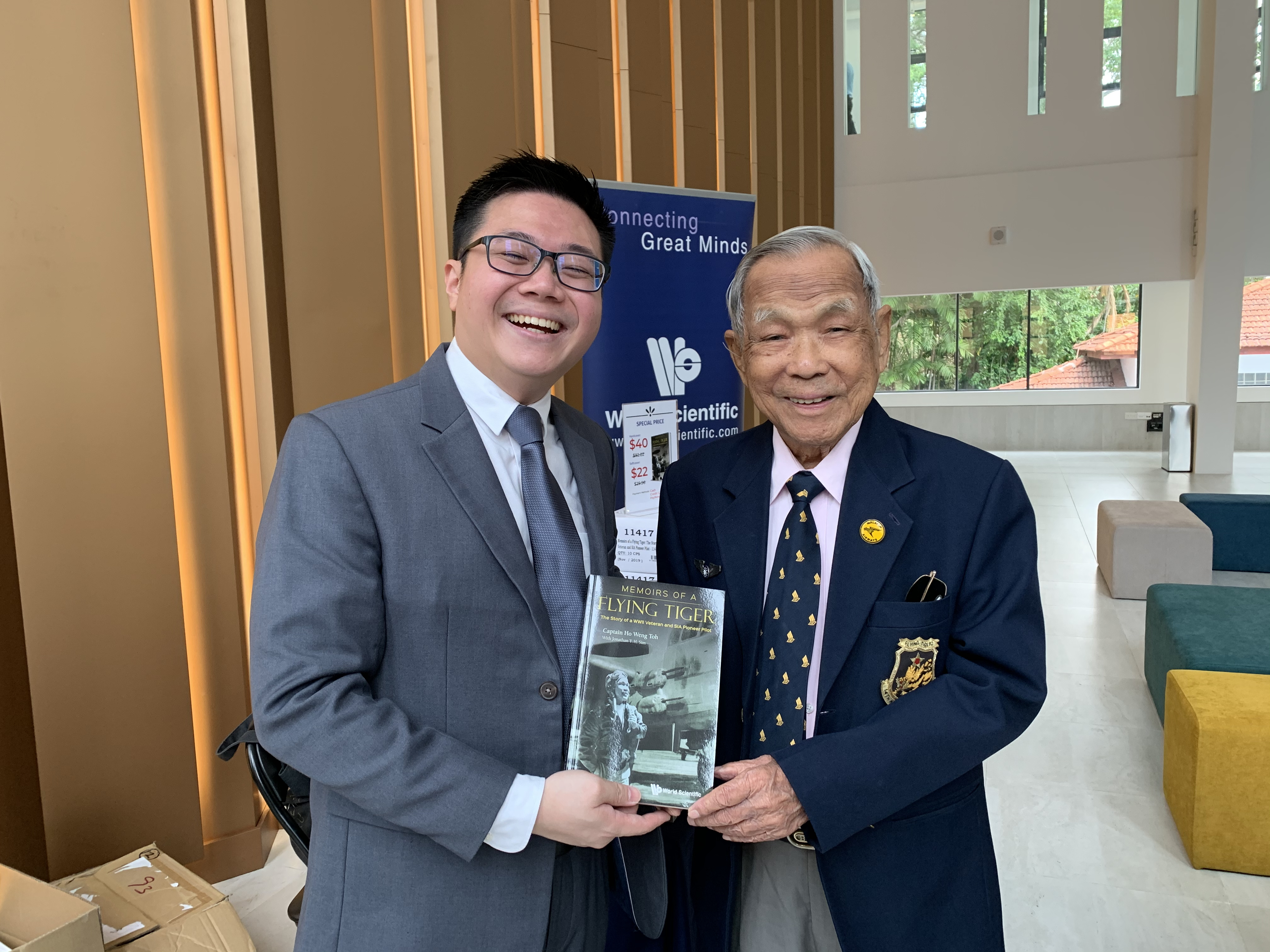
Today’s the launch of my new book! This book — “Memoirs of a Flying Tiger” — is an account of the exciting life of Captain Ho Weng Toh, a 99 year old World War 2 veteran who fought as a bomber pilot against the Japanese and later became the first of four pioneer local pilots for Malayan Airways (now Singapore Airlines). He went on to train the first 300 local pilots for Singapore Airlines, all of whom now hold senior positions in the aviation industry or have retired.

Co-authored the book with Captain Ho Weng Toh, a 99 year old World War 2 veteran and pioneer pilot of Singapore Airlines who trained the first 300 pilots for SIA.

This book is the fruit of nine months of labour (while I was simultaneously writing my Masters dissertation). More than just editing the original manuscript which he wrote, I had to comb through dozens of historical documents, conduct a great deal of historical research to ensure the authenticity of the chronology. And best of all, I had to interview Captain Ho and the people whom he worked with just to construct a coherent and engaging story, one that would accurately mirror the story-telling of Captain Ho’s own voice.

This has been an incredible journey and one that taught me that the path to greatness doesn’t necessarily entail accomplishing great things, but in being so warm and welcoming to people, especially those in one’s team, that they’re part of a family.

Captain Ho has since been my role model and an example of a human and humane leader worthy of emulation. I have been inspired to follow his example with the way I lead my team of tutors and my class of 800 students. The success of this module is largely thanks to the many life lessons I learnt from him.

It has been fun and I’m so grateful to have been given this beautiful opportunity.

Launching the book together with Captain Ho Weng Toh; Guest-of-Honour Ambassador-at-Large Prof. Tommy Koh; and Director of the National Archives of Singapore, Ms. Wendy Ang.

Captain Ho’s family gave me the honour to be the emcee for the launch, and asked me to give the opening remarks for the event. Here’s the transcript of what I said…

Opening Remarks of the Book Launch,
“Memoirs of a Flying Tiger,”
at the National Archives of Singapore
Tuesday, 19 November 2019

Delivering the Opening Remarks to Guest of Honour, Ambassador-at-Large, Prof. Tommy Koh and many distinguished guests and members of the media.

The Nobel laureate and father of transplant surgery, Alexis Carrel, once said: “Man cannot remake himself without suffering. For he is both the marble and the sculptor.”

I’ve had the privilege of working very closely with Captain Ho in the writing of this book. And in that process, I’ve heard him recount so many stories of his life: the ups and the downs, and especially the downs and how he handled them. What I can say is that Captain Ho is truly that man who has remade himself.

He is both the marble and the sculptor.

Captain Ho has dealt with the hardships of war, and the pain and anguish of losing friends and loved ones. While it is easy for people to fall into bitterness and despair over such events. Captain Ho held firm to the values and principles his father taught him. In particular, resilience and compassion. He rose up and out of these difficult events, sculpting himself to be more human and humane than ever before.

I have witnessed the fruits of his humanity on so many occasions through my interactions with the people whose lives were touched, changed, and impacted by him while he was a flight instructor in Singapore Airlines.

We’d like to think that people will remember us for accomplishing great things.

Yet, having spoken with the pilots whom Captain Ho trained and the many people he had worked with, there was one thing that stood out so vividly in their memories so many decades later: it was the little things that he did. His warmth, his kindness, the simple gestures and words that make one feel welcome and at home, as if they were a part of a family – his family.

I work very closely with young people, and I can tell you that apart from festive occasions like Chinese New Year or regular family gatherings, young people these days rarely talk to people a generation or two older than they are.

There is so much wisdom, experience, and insight that fails to be transmitted from one generation to the next. That’s partly because we now live in a time of innovation and disruption, and with it comes the idea that many old things are outdated and irrelevant to our lives. We have the technologies, the hardware, that makes us more advanced than ever. But as cliche as it may sound, we lack the HEARTware, for we have forgotten how to be human and humane. We have, in many ways, stopped learning the best practices of living well and of working harmoniously from the generations before us.

If anything, my experience with Captain Ho has shown that there is still so much that we can learn from people in his generation.

In a few months time, Captain Ho will be a hundred years ago. I’ve only spent nine months working closely with him on this book, and that’s not even 1% of his entire life!

Yet I’ve gained and learnt so much from him. In that nine months of labour, I’ve been reborn. My perspective and my life has changed, and I now do my best to follow his model example of leading my own teaching team like a family the way he did. Had I not met Captain Ho, it wouldn’t have occurred to me how important, how worthwhile, and how meaningful it is to run a team the way he did: like a family.

There is so much wisdom and insight that one can gain from Captain Ho. He has a century’s worth of it. And I believe we can gain many insights from his life stories in his book.

Man is both marble and sculptor, and here is that man, that most beautiful work of art, ready to share his life and his stories with us.

Thank you.

Why are Singaporean students so silent in the classroom? And what can we do about it?

One of the amazing things about being both a teacher and a student for almost two years is that it has given me a privileged perspective to understand why students behave the way they do in class.

This became very apparent to me when I discuss issues with my teaching colleagues: when we’re so busy teaching or preparing for class, it’s so easy to forget how a student would perceive the things we do or say, or the reasons for certain behaviours.

One unique insight I gained from this privileged position of being simultaneously teacher-and-student, is the underlying cultural motivations for why students hold back from fully engaging in class. They do this by either remaining silent, not participating in any activity, or if they do, they would moderate and reduce the quality of their work/performance.

This presents a great challenge, at least here in Singapore, to efforts in engaging students in the classroom, or even in any attempts at successful student-teacher partnerships (a kind of pedagogical approach where students are not regarded merely as consumers of a lesson, but as co-creators who partake in the design and even teaching of the lesson itself).

Unlike the successful experiences reported by many teachers in the West, students here in Singapore appear to be quieter, and less participative. Many typically describe local students as passive or even conformist. But these do not get to the heart of why students behave this way.

Looking back at my own student experience, and from speaking personally to my students, I have come to realise that much of the lack of participation stem from issues surrounding the notion of “face” or pride/reputation. Singaporean students generally do not participate in class discussions or engage in teacher-student partnerships for the following reasons:

(1) Students are afraid that speaking up or volunteering might cause embarrassment to their peers, thereby making them “lose face.” Volunteering for something, or speaking out (especially if one speaks well) can make one appear outstanding. But at the same time, it creates a stark contrast with other students, thereby making them look bad by comparison. Those who volunteer or participate are usually labelled by their peers as “market spoilers” (i.e. those who raise the bar) or “extras.”

(2) Students are also afraid that speaking up or volunteering with the teacher may cause their peers to resent them, thereby leading to negative social consequences outside of class. It’s one thing to embarrass one’s peers by volunteering or participating in class. But it is another issue altogether if one does so repeatedly. Not only is the student repeatedly causing one’s peers to “lose face,” but the student is seen as someone who has raised the bar so much, that that student is showing off his/her abilities. This leads to a lot of resentment from one’s peers. Such students tend to receive harsh labels like “show off” or “smart aleck,” and be treated badly by their peers outside of class.

(3) Yet another motivation for silence or not volunteering is the fear that once one has done so, one has revealed one’s “true abilities” to one’s peers. It is worth noting that the phrase, “true abilities,” was mentioned multiple times by a few of my students when they explained reasons for disliking participation in class/online forum.

The fear of revealing one’s true abilities can come in two forms: (a) One is worse than one’s peers, in which case, revealing one’s ability causes one to immediately “lose face” and to embarrass one’s self in front of others. A more severe form being that one is afraid to discover that one is bad as a consequence of speaking out or volunteering, thereby “losing face” just by attempting.

(b) One is better than one’s peers, in which case, one now has to grapple with the stress of maintaining one’s reputation of having such a high ability, and not lose out to others (which would be highly embarrassing). This is driven largely by a desire for self-preservation. By not revealing one’s high ability, one does not draw attention from potential enemies, and can continue leisurely learning at one’s own pace without having to compete with someone else and risk losing.

These are the three key motivations for students remaining silent and not participating in class or for any extra activities organised by the teacher, including student-teacher partnerships.

Of course, a silent classroom is never tolerated, and there will always be moments where students are made to speak up or present. Here, the same motivations are manifested differently, and this is something we need to be aware of, especially when we involve students to present in front of class, or in any efforts at student-teacher partnerships.

As the lack of participation is motivated by issues of “face,” forced participation similarly compels students to reduce the quality of their work (or at least their outward performance) when they are required to present to the rest of the class. Again, this is to avoid embarrassing one’s peers, or to avoid being labeled as a show off and sanctioned by one’s peers, and also to avoid revealing one’s true abilities (especially if one has higher abilities). The way students do this is that they will use the first forced participant as the benchmark and mimic the quality of the materials and level of showmanship.

Of course, there will be students who are ignorant or do not abide by these rules at all. One good thing about this is that in doing so, hey help to reveal the dynamics of the benchmarking efforts that the others had been doing. Throughout my years as a student, whenever someone outperforms beyond the tacit benchmark, I often hear others complaining along the lines of: “If I knew he/she was going to present like this, I would have done more.” Such admissions of “would have done more,” are admissions of how one had scaled back in one’s work, indicative of a deliberate lowering of quality.

Clearly, for there to be any successful and unmoderated participation, especially with regards to student-teacher partnerships, more must be done in order to overcome such barriers. The teacher cannot just rely on the usual enthusiastic students who volunteer. There are students who are enthusiastic but have no regard for issues of “face,” and there are also enthusiastic students who are inhibited by their worries of “face.”

One thing I’ve learnt from my own discussions with students is that the teacher is an important facilitator in this regard, one who has the power to shape an environment: from a hostile and competitive environment to one that is friendly and relaxed.

The more friendly, uncompetitive, and relaxed the class environment is, the less worried students are about losing “face” or embarrassing themselves (and others) in class. Of course, the teacher does not have complete control over the classroom atmosphere. The presence of intimidating or highly competitive students can still cause other students to worry.

Since becoming aware of these motivations, I have made extra efforts in ensuring that the environment is as friendly and relaxed as possible, so that students are least worried about “face” and embarrassment in a classroom setting. One thing I’ve done and found much success with is introducing the element of role playing in class. When students are given roles to perform, they are given the opportunity to step out of who they are, to become someone else for a moment. That someone else (the assigned role) is then allowed to make embarrassing mistakes and even to embarrass others (involved in the role play), without consequence to one’s own personality and identity or social sanction. Role playing liberates students from concerns about “face” and allows them to engage each other in an uninhibited manner.

More importantly, role playing is a form of play, an uncompetitive play that by itself makes the environment less competitive and hostile, thereby creating a fun and relaxed environment in which students can engage, participate, and forge bonds with each other and with the teacher. This encourages students to take on an increased role in their involvement in class, and encourages them to take on an increased stake in their own learning in the classroom.

A Meaningful Reflection Paper

The best moments in my teaching career come from reading meaningful reflection papers. This semester one student’s paper resonated very strongly with me. I’m so heartened that she has gained so much from my classes.

Here’s what she wrote:

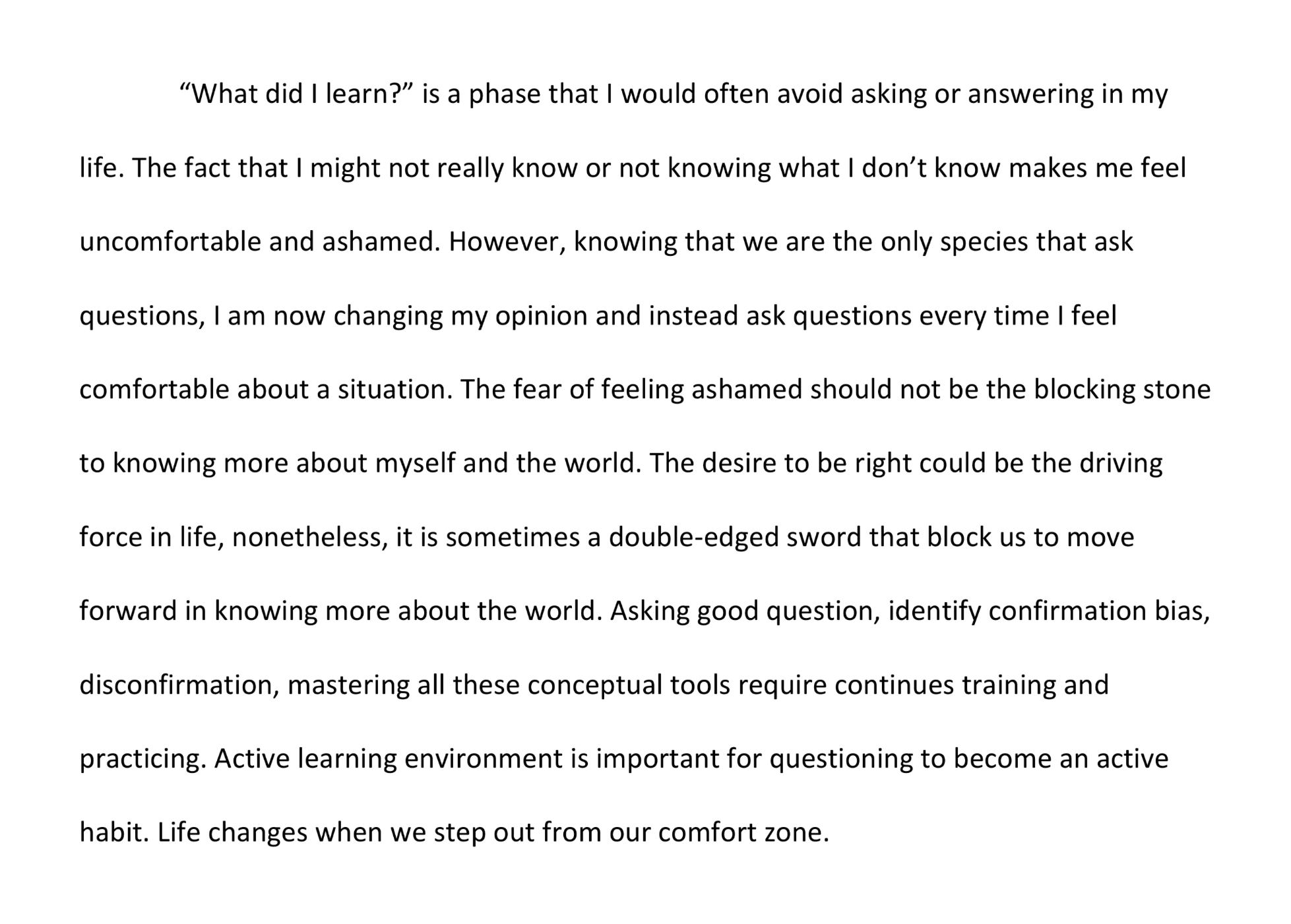
Screen Shot 2018-07-11 at 5.14.16 PM

“What did I learn?” is a phrase that I would often avoid asking or answering in my life. The fact that I might not really know or not knowing what I don’t know makes me feel uncomfortable and ashamed. However, knowing that we are the only species that ask questions, I am now changing my opinion and instead[, I now] ask questions every time I feel comfortable about a situation. The fear of feeling ashamed should not be the blocking stone to knowing more about myself and the world. The desire to be right could be the driving force in life, nonetheless, it is sometimes a double-edged sword that blocks us [from moving] forward in knowing more about the world. Asking good questions, identifying confirmation bias, disconfirmation, etc., mastering all these cocneptual tools require continuous training and practising. An active learning environment is important for questioning [in order for it] to become an active habit. Life changes when we step out from our comfort zone.

I think there’s something from this reflection that’s worth learning and remembering.

The Non-Theist Hiding in the Closet of Kierkegaard’s Philosophy

This paper, while flawed in a few ways, was a novel attempt in one of my Masters modules at proving that Kierkegaard hid a non-theistic conception behind his philosophical writings.


Søren Kierkegaard is widely regarded as a Christian philosopher. Many leading scholars tend to interpret his works through the lens of Christianity.[i] While some scholars have questioned whether Kierkegaard should be read as a Christian thinker, few have ventured further to question whether Kierkegaard even subscribed to a theistic conception of God at all. Yet this is the implicit assumption many scholars have taken by virtue of Kierkegaard’s apparent Christianity. Scholars such as C. Stephen Evans,[ii] and Zachary R. Manis,[iii] ground their ideas of a Divine Command Theory on the very assumption of a theistic conception underlying his philosophy. But Evans and Manis are not the only ones. Peter J. Mehl, too, assumes a theistic conception in Kierkegaard’s philosophy without justification:

“I am claiming … that Kierkegaard’s ideal of humanness is infiltrated by Christian theism even before he makes his case for the reality of God. The ideal of personhood as fully engaged autonomy, of complete rational responsible self-determination, is linked to Christian theism.”[iv]

And yet, it is this very assumption of theism that led Mehl to puzzle over Kierkegaard’s inability to see the connection between said personhood and theism. This is but one of many other examples of works presuming a theistic interpretation behind Kierkegaard’s Christianity, sometimes resulting in rather puzzling, and sometimes paradoxical consequences. However, the bigger problem, in my opinion, is that by assuming a theistic conception underlying Kierkergaard’s writings, many fail to appreciate or notice the non-theistic, non-Christian elements present in his philosophy.

In this paper, I argue that Kierkegaard does not subscribe to a theistic conception of God, but rather, to a non-theistic conception. By theism, I refer to the classical notion:

“God is the perfect being, which means or entails that God is, among other things, necessarily existent, eternal, changeless, almighty, all-knowing, supremely good, distinct from creation, and the creator of everything distinct from himself. God is also said to be absolutely simple, which means that the above-listed attributes are identical to God’s being and, more generally, that there is no ontological complexity in God.”[v]

I will begin this paper first, by casting doubts on a theistic interpretation, and then proceed to show evidence of a non-theistic conception in Kierkegaard’s writings. I will then proceed to outline two non-theistic notions that Kierkegaard might have possibly subscribed to: (1) atheism, and (2) panentheism. Due to the limits and scope of this paper, I will not be able to determine which of the two positions Kierkegaard might have held in his works. Nonetheless, I will discuss how atheism and panentheism might have possibly been related to each other. Along the way, I will anticipate possible objections and address them.


I. Theistic Silence

It is rather odd that Kierkegaard who writes in a Christian-like manner, makes absolutely no explicit mention about theism.[vi] This fact alone should give us pause. While it is indeed true that the absence of evidence is not the evidence of absence (which is not the point I am making here), the point I wish to highlight here is that one cannot simply assume theism in Kierkegaard’s works on the basis of his many references to Christianity.

Why is there no explicit mention of theism? Kierkegaard argues that God is beyond the limits of human reason, and it would be too presumptuous to assume that human reason is capable of discerning God’s nature, or that there is a necessary bond between God and Man that would allow us to discern by inspection, nor indirectly by means of analogy, of a theory of opposition and negation. Any form of speculation might seem to describe God, but it would instead describe “ourselves and our rational limitations.”[vii] Hence, we have no choice but to accept a God that would appear paradoxical and absurd to us. Since human reason cannot discern God’s nature in any way, we may postulate whatever qualities we like about God, such as the qualities of omnipotence or omniscience, or even the traditional Christian attributes. We could also postulate unconventional qualities to God, such as malicious hatred, and there would be no way we can use our reason to affirm or deny it.

Another reason for the silence is due to Kierkegaard’s emphasis on the subjective inwardness, which focuses on one’s own existence, on how the self “relates itself to itself.”[viii] Inwardness is concerned with the relations to objects, and not with the objects themselves. God is important to Kierkegaard’s philosophy. Without God, the individual would be in despair.[ix] However, it would be more accurate to say that it is not God per se that is of concern, but the God-relationship: “God is a subject to be related to, not an object to be studied or mediated on.”[x] It is not the absence of God in the individual’s life that would lead to his despair, but the failure of the individual to align himself with God, i.e. to relate himself to God, or to relate himself with God’s plan for the self: “The self is the conscious synthesis of infinitude and finitude that relates itself to itself, whose task is to become itself, which can be done only through the relationship to God.”[xi] Moreover, what gives the God-relationship its importance is not the objective existence of a God, but the possibility, the risk, of God’s non-existence (which, if true, despair is certain).[xii]

Given the strong emphasis on the importance of the God-relation, rather than on God, Kierkegaard’s philosophy would still hold up even if God does not objectively exist. It may seem strange to have a relationship with an objectively non-existent being, but as Kierkegaard explains, a relationship must have passion: “it is impossible in existing to think about existence without becoming passionate.”[xiii] For example, a hunter may falsely believe that there is a vicious beast behind the bushes. Objectively, there is no beast behind the bushes. But within the hunter’s subjectivity, the hunter has formed a relation with the beast, with a passionate fear of being attacked if he is not careful. And hence, the hunter lives and behaves as though there is a beast, for it is better for the hunter to assume a beast and act accordingly for his own safety. In the same way, the subjective belief of a God suffices to establish a God-relationship, for the self to relate itself to, for its own existential benefit.

Scholars presuming a theistic position in Kierkegaard would object to what I have said above, and usually argue that Kierkegaard does not dismiss the importance of the objective existence of God. Rather, he makes a distinction between the subjective truth that is “essentially related to existence” and the objective truth, and that he did not intend for the subjective truth to substitute or contend with objective truths.[xiv] This objection, however, misses the point. As I have mentioned earlier, God is beyond reason. We cannot rationally prove any quality of God’s nature, not even the existence of God![xv] And even if we accept that there can be objective truths about God, none of those truths of God would have any bearing on how the self relates to the God-relationship.


II. The Pantheism Problem

Interesting, despite the silence on theism, Kierkegaard has much to say about pantheism. His most significant passage on the issue involves a criticism he made on Schleiermacher:

“That pantheism constitutes a surmounted factor in religion, is the foundation for it, seems now to be acknowledged, and hereby also the error in Schleiermacher’s definition of religion as remaining in pantheism, in that he makes the extra-temporal fusion factor of the universal and the finite—into religion.”[xvi]

Here, it would seem that Kierkegaard is saying that pantheism is in fact “the foundation of religion,” but before we can conclude that Kierkegaard is indeed a pantheist, he adds the point that pantheism needs to be surmounted. To understand what this means, it would be useful to briefly outline what Kierkegaard was responding to when he criticised Schleiermacher in the passage above.

Schleiermacher was a strong supporter of Spinoza, a pantheist who argued that God is in all things, in the sense that God’s substance is in all that exists in nature. Schleiermacher took the argument further, defining religion in naturalistic terms. Since God’s substance is present in all things, “religion consists not primarily in knowledge of the divine or in actions that spring from duty, but in and through gefühl (feeling), the domain of pre-reflective, immediate experience.”[xvii] Religion, therefore, is “to know and have life in immediate feeling.”[xviii] In defining religion as such, Schleiermacher had transformed the understanding of religion from the ethical mode to the aesthetic mode.[xix]

Kierkegaard agreed with Schleiermacher that “immediate religious experience is the lifeblood of the various religions,”[xx] but he disagreed that faith belongs to the first immediacy: “that which Schleiermacher calls ‘religion’ … is at heart nothing other than the first immediate, the condition for everything—the vitale fluidum—the atmosphere that we, in spiritual sense, breathe in—and which, therefore, cannot be properly be indicated me with these words.”[xxi] The first immediacy is the basis of all experience. To equate faith or religious experience with it would be to pantheistically absorb everything into one.

This, according to Kierkegaard, is the error and the inevitable result of all – and not just Schleiermacher – who conceive of God purely in terms of eternity. In committing such an error, one would be under the “optical illusion” of pantheism,[xxii] dozing in “an oriental revery in the infinite, in which everything appears to be fiction – and one is reconciled as in a grand poem: the being of the whole world, the being of God, and my own being are poetry in which all the multiplicity, the wretch disparities of life, indigestible for human thought, are reconciled in a mistry, dreaming existence.”[xxiii] The other problem with dwelling in pantheism, was that by remaining within the view of eternity, pantheists like Spinoza, had evaded the difficulty of relating an eternal God outside of time, with a God that functions in time.[xxiv]

This is not to say that pantheism is wrong per se. Rather, when God is thought of in terms of eternity, God is regarded as the absolute standpoint, which happens to be the standpoint of pantheism.[xxv] But, this is not the error. Seeing God as the absolute standpoint is itself a crucial moment for understanding God: “The concept of Substance is the concept of the absolute Actuality, which contains all essence, all reality; if there were something outside God, different from God, God would indeed be limited. Therefore Ἓν καὶ Πᾶν (hen kai pan) [One and All]; only God is. Whatever in the world is reality, is only God.”[xxvi]

To remain here at this level, however, would be to dwell in pantheism – and that is the error committed by Schleiermacher and the other pantheists. It is thus essential to surmount pantheism. Not to reject pantheism completely, but to build on top of this conception and go beyond. What Schleiermacher got right, and what appealed strongly to Kierkegaard, was his approach to nature in wonder.[xxvii] If God is in all things, then one should be in wonder at being immersed in God’s presence, but not in the pantheistic sense of regarding religious experience within the realm of the first immediacy. Kierkegaard surmounts pantheism while preserving Schleiermacher’s wonder of God through nature, by arguing that it is in inwardness that one encounters God in all things. Writing under the pseudonym of Johannes de Silentio, Kierkegaard argues that faith is not the “first immediacy but a later one… [f]aith is not the esthetic or else faith has never existed because it has always existed.”[xxviii] The experience of God is not to be found in direct experience with the world, nor grasped through human understanding. It is through the inwardness of the subjectivity, that one is able to perceive God’s action in all things. Kierkegaard says:

“I observe nature in order to find God, and indeed I also see omnipotence and wisdom, but I see much else too that troubles and disturbs. The summa summarum of this is the objective uncertainty, but the inwardness becomes so great just because it embraces the objective uncertainty with all the passion of the infinite.”[xxix]

Schleiermacher had the passion, which Kierkegaard admired, but he lacked the inwardness to perceive both the light and the dark side of God in nature, the quintessential paradox required for exhausting reason in order to arrive at the higher immediacy of faith. “When reflection is totally exhausted, faith begins.”[xxx]

In brief, the aspects of pantheism which Kierkegaard agreed with are: (1) When one conceives of God from the viewpoint of eternity, one sees a God that exists in all things in a pantheistic manner. Consequently, (2) Kierkegaard grants that one can experience God in all things through immediate experience, but it would be incorrect to conclude with pantheists, like Schleiermacher, that God can be directly experienced in the first immediacy. God can only be encountered through the higher immediacy of faith, within the subjective inwardness.


III. God the Middle Term

In this section, I will discuss Kierkegaard’s conception of God as a “middle term,” a notion which explicitly demonstrates a non-theistic conception of God. This is highly significant especially since the idea is found in Works of Love, a work which Kierkegaard claims direct authorship, unlike his pseudonymous works where he could distance himself from the ideas expounded in those texts. And unlike the pseudonymous works where Kierkegaard felt a need for indirect communication, works with direct authorship were a means for him to communicate in a direct manner to “those who profess Christianity and know what it is but need to be encouraged or reassured.”[xxxi]

In Works of Love, Kierkegaard ascribes God the function of the middle term:

“Worldly wisdom is of the opinion that love is a relationship between person; Christianity teaches that love is a relationship between a person, God, a person, that is, that God is the middle term.”[xxxii]

There are two common ways of reading this passage. (1) The first way is to conceive of God as a third party in a love relationship. That means, in the case of A loves B, this relationship is parsed as:  A loves God, and God, in turn, loves B. But Kierkegaard shows that this is not the case:

“The merely human view of love can never go beyond mutuality: the lover is the beloved, and the beloved is the lover. Christianity teaches that such a love has not yet found its true object—God. The love relationship requires threeness: the lover, the beloved, the love—but the love is God. Therefore, to love another person is to help that person to love God, and to be loved is to be helped.”[xxxiii]

God is not a third party in the relationship, but love itself. (2) The second way is to conceive a love relationship in a relational manner. That means, in the case of A loves B, this relationship is parsed as: A relates to B, via God as the intermediary, i.e. A relates to God, and God relates to A. This, however, is problematic. For if we were to ask how A relates to God, we will have to answer the question by means of a fourth term, that A relates to God via M, i.e. A relates to M, and M relates to God. We can repeat the cycle ad nauseam, leading to an infinite regress.

What then, do we mean when we say that God is love? Kierkegaard seems to be suggesting a hermeneutical account,[xxxiv] where God/love as the middle term is to be understood as a logical metaphor. In logic, the middle term is the term occurring in both premises of a syllogistic argument, linking the two premises in order to arrive at a conclusion. But the middle term does not appear in the conclusion itself. The use of God as the middle term, provides a hermeneutical change of perspective, transforming a selfish love into a selfless love. In a selfish love, when I say, “I love you,” the “you” is conceived in my mind as a not-I, as another-I. So, when I say, “I love you,” I am essentially saying, “I love another-I,” that is, “I love I.” It is an I-I relationship. It is selfish for it leads me to express my love according to my understanding of myself. Whereas, by introducing God as the middle term of the relationship, I am, from God’s subjectivity, God’s you. So too is the person I am loving, for that person is also, in God’s subjectivity, God’s you. For the sake of illustration, if I were to parse it as a syllogistic argument, it might look something like this:

Premise 1: A loves God                       ->        You love God
Premise 2: God loves B                       ->        God loves you
–––––––––––––––––––––––––––––––––––––––––––––––––––––––––
Conclusion: Therefore, A loves B       ->        You love you

Parsed in this manner, the relationship is transformed into a selfless relationship, because it is now seen as a youyou relationship. But at the same time, with God as the reference point, it is not just a youyou relationship, but a (God’s-neighbour)-(God’s-neighbour) relationship. When I relate to my love relationship in this way, I subjectively perceive myself and the beloved as God’s neighbour, and thus express my love according to the understanding of myself (and the other) as God’s neighbour. As the middle term, God does not appear in the conclusion, yet, how one relates the self has been altered as a result of this mode of thinking.

However, when we begin to think of love in terms of actuality and possibility, we run into some interesting problems about the concept of God. Love is a possibility that can be actualised in this world. And all possibilities are grounded in some actuality, e.g. it is possible for A to love B, only if A and B are actualised in existence. Yet, all actual beings, and all possibilities can ultimately be traced back to the ultimate Actuality, God: “God is the actuality of the possible, and God’s actuality is the actuality of true love, the possibility of actual love is grounded in the actuality of true love.”[xxxv] So far, there are no problems when we conceive of God purely in terms of actuality outside of time. The problem begins when we try to conceive of the eternal God acting in time. In Works of Love, Kierkegaard goes on to elaborate that love hopes all things, and “to relate oneself expectantly to the possibility of the good is to hope… As soon, however, as the choice is made, the possible is changed, because the possibility of the good is the eternal.”[xxxvi] Yet, “when the eternal is in the temporal, it is in the future… or in possibility. The past is the actual, the future is the possible; eternally, the eternal is the eternal; in time, the eternal is the possible, the future.”[xxxvii] Here, we have “a modal and ontological gap between the necessary on the one hand, and the possible and actual on the other.”[xxxviii] God can never be actual, temporal, or existent! God can only be “that without whom nothing could or would be actual, temporal or existent.”[xxxix]

When Kierkegaard talked about God as a middle term, he was not just referring to the context of God as love. The implication of it has far reaching consequences. “God is neither a fact to be explained nor an explanation of facts.”[xl] For “nothing we can experience is God, but neither can we experience anything apart from God: there wouldn’t be anything to experience, or anyone to have an experience, without God.”[xli] This is reflected most clearly in Kierkegaard’s prayer at the beginning of Works of Love: “O Eternal Love, you who are everywhere present and never without witness where you are called upon.”[xlii]

God is therefore, in Kierkegaard’s conception, not a being, nor the first cause and explainer of facts, “but the infinite power of possibility,” the “eternal actuality of creative and transforming love,” and “the fundamental dynamic reality of love, without which nothing else could and would exist.”[xliii] As I had mentioned earlier, the problem with pantheism, was that by remaining within the viewpoint of eternity, it was unable to address the issue of an eternal God outside time, functioning within the temporal realm. God, as the middle term, could be seen as Kierkegaard’s solution to that problem, as a way in which an eternal God could operate in time. The consequence of such a solution, however, is that God ceases to be a being.

Yet, as a middle term, God is still the hermeneutical point of reference. In the context of love, we are to see ourselves and others as God’s neighbours, and relate ourselves as God’s neighbour to other neighbours of God. Similarly, all of creation, including ourselves, are not just mere facts of the world, but they too participate in God’s creative action, and thus we are to relate ourselves as a participant in God’s creative action, interacting with other participants of God’s creative action.

Thus far, I have shown that Kierkegaard subscribes, not to a theistic conception, but to a non-theistic conception of God, the question remains: what sort of non-theistic conception might Kierkegaard hold? I will discuss two possibilities: (1) atheism, and (2) panentheism. However, as it would be outside the scope of this paper to engage in extensive biographical research, I will not be able to determine whether Kierkegaard was indeed an atheist or panentheist.


IV. Kierkegaard the Atheist?

As I had mentioned earlier in Section I, since the God-relation is so essential to the existence of an individual, in the way one relates one’s self, to the point that God’s objective existence is inconsequential, it would be possible to interpret an atheistic conception in Kierkegaard’s philosophy, and consequently, a Kierkegaard’s atheistic approach to Christianity.

In Concluding Unscientific Postscript, Kierkegaard writes, under the pseudonymous author of Johannes Climacus, that God is “a postulate, but not in the otiose manner in which this word is commonly understood… The postulate is so far from being arbitrary that it is precisely a life-necessity. It is then not so much that God is a postulate, as that the existing individual’s postulation of God is a necessity.”[xliv] God, then can be regarded as an ethical fiction, which “seeks to enhance man’s sense of responsibility and ultimately deepens the moral [and/or existential] dimension of his experience.[xlv] One can have a God-relation with which the self can relate to, just by simply postulating the existence of a God.

Christianity too can be regarded as an ethical fiction as well, serving the instrumental purpose of the individual’s desire for eternal happiness, or in other words, the subjectivity. In Concluding Unscientific Postscript, Kierkegaard professes subjectivity for its own sake, as the final end. Subjectivity is the absolute: it is not justified by anything, but instead justifies everything. “There are many arguments in the Postscript to demonstrate that only by being in total subjectivity is he not deceiving himself in his life affirmation. The rest of the Postscript is concerned with ways of attaining a fuller subjectivity.”[xlvi] Christianity is seen as instrumental to the service of the subjectivity as the paradox of Christianity “thrusts the understanding away in the interest of inwardness in existing”;[xlvii] it “proposes to intensify subjectivity to the utmost.”[xlviii]

Elsewhere in the Postscript, Kierkegaard writes:

“I, Johannes Climacus… assume that for me… there awaits a highest good called an eternal happiness. I have heard that Christianity contracts to provide one with that good. And now I ask how do I enter the relation with this doctrine?”[xlix]

Just as how it is essential for the self to develop a God-relation, Climacus talks about the need to “establish a proper relationship” to Christianity. Like the God-relation, the Christian-relation is essential to the subjective inwardness. The objective truth of Christianity, on the other hand, is just as inconsequential as the objective existence of God.

Yet a puzzling question remains. If one takes an atheistic position and does not believe in the objective existence of God nor in the objective truth of Christianity, how can one be a Christian, or even profess belief in it? Evans rightly pointed out that ethical fictions only have their power over people unaware of its fictional nature, and for those aware of its fictional nature, “if the individual does not care whether his belief is objectively correct, then the objective uncertainty will hardly generate much passion.”[l] This is most poignant for Kierkegaard, who would have been quite well-aware of the ethical fictions if he did indeed conceive of God and Christianity as ethical fictions. It would not be possible for him at all to generate the infinite passion in his pursuit of Christianity.

One solution would be to argue that Kierkegaard was indeed an atheist who meant everything religious in an ironic manner. Was Kierkegaard such an atheist? While it is certainly not impossible to imagine, it is, however, quite implausible. Kierkegaard wrote with religious fervour, not just in his published works, but also in his private journals. It is hard to imagine why one would be so consistently ironic, even in the privacy of one’s own journals.

I propose an alternative view, and one that there certainly more philosophically interesting, in which Kierkegaard the possible atheist might have embraced Christianity in a way that would address Evan’s insights. As I mentioned earlier, Climacus’ pursuit of Christianity, was done primarily for the sake of his own subjectivity, for his eternal happiness, and not because of the truths of Christianity or any objective proof of the existence of God. Yet, in pursuing Christianity in this way, he contradicts his insistence on the need for an infinite distance between man and God: “Precisely because there is an absolute difference between God and man, man will express his own nature most adequately when he expresses this difference absolutely.”[li] To use God as an instrument is to treat God with familiarity. In which case, God cannot be the Absolute Other.[lii] Climacus would thus relate to God not as Absolute Other, a relation essential to his inwardness, but as a familiar. Therefore, in pursuing Christianity and God in this manner, Climacus cannot come close to attaining eternal happiness. Moreover, as Evans pointed out, viewing Christianity purely as an instrumental aid to eternal happiness does not suffice to produce the infinite passion that Climacus desired.

The only way to resolve the two problems above, would be to deny the primacy of the subjectivity and paradoxically embrace Christianity not instrumentally, but as an end-in-itself. This way, God could be preserved as the Absolute Other, a necessary relation for the subjectivity, and more importantly, would generate the necessary passions required. Climacus’ failure was that he could not do precisely that, and it was what prevented him from understanding and making the final movement of faith. It might have been possible that Kierkegaard succeeded where Climacus had failed. For Kierkegaard himself acknowledged that the Postscript was “the turning-point in [his] whole work as an author.”[liii] Soon after the completion of the Postscript, Kierkegaard abandoned the pseudonym, abandoned the “primacy of subjectivity and moved to total Christianity.”[liv] This would have required Kierkegaard to exhaust reason on his part, put aside his atheism, and make that leap into the higher immediacy of faith. This might explain the religious fervour in his writings, and it does take Kierkegaard’s insistence that “subjectivity is truth” to the highest level, that despite the underlying atheism, Kierkegaard is still able to live as if he were a true believer of Christianity.


V. Kierkegaard the Panentheist?

As I have discussed earlier in Section II, Kierkegaard did not reject pantheism, but saw that religion had to surmount it. Pantheists like Spinoza, evaded the difficulty of relating an eternal God outside of time, with a God operating in time,[lv] by remaining in the viewpoint of eternity. Kierkegaard was concerned with reconciling the power of human freedom that exists in time, with the power of a God outside time, in a way that would allow the divine to empower a person in his freedom.

The other option that Kierkegaard might have held, is panentheism, which “takes a middle position between a naturalistic pantheism and a supernatural theism,” it is the view that “God is so immanent within the world that this divine interpenetration means that all things are within God, while, on the other hand, affirming with traditional theism, that God transcends the realm of finite realities. God so penetrated the universe that everything is in God; but God stands in a free relation to the universe.”[lvi] If pantheism had to be surmounted without a complete rejection of its tenets, panentheism therefore, is a likely position that Kierkegaard might have subscribed to. In discussing the relation of omnipotence and love, Kierkegaard seemed to have expressed a panentheistic stance:

“The whole question of the relation of God’s omnipotence and goodness to evil … is solved quite simply in the following way. The highest thing after all that can be done for a being, higher than anything else one could do for it, is to make it free. The ability for doing precisely this belongs to omnipotence. This seems strange, since precisely omnipotence is supposed to make dependent. But if one is willing to think about omnipotence, one will see that precisely in this must lie in addition the determination to be able to take oneself back again in the expression of omnipotence in such a way that precisely therefore that which has come into existence by omnipotence can be independent. That is why one human being cannot make another human being completely free, because the one who has the power is actually imprisoned in having it, and therefore always still has a wrong relation to the one this human wants to liberate. Furthermore, in all finite power (talent, etc.) there is a finite self-love. Only omnipotence can take itself back while it gives away, and this relation is indeed precisely the independence of the recipient. God’s omnipotence is therefore God’s goodness. For goodness is to give away completely, but in such a way that by omnipotently taking itself back one makes the recipient independent. … This is the incomprehensible, that omnipotence … is able to bring forth the most frail of all things: an independent being who is directly over against omnipotence.”[lvii]

A truly omnipotent God creates beings independent from himself, “precisely as the expression of divine power.”[lviii] At the same time, this freedom is itself an expression of God’s love. God’s power is God’s love. In that gift of freedom to human beings, “God enables the divine power of the eternal, present within the innermost chamber of the self, to be understood as loving and thereby as relevant to the struggles of existing as a free creature within temporality.”[lix] Here, pantheism is surmounted, as the pantheistic power of divine Substance is united with the power of human freedom in time.

This brings us back to an earlier point made in Section III, about God as the middle term. Kierkegaard conceived of God as the middle term, as a solution to explain how an eternal God outside of time, could operate within time. This is consistent with the discussion above on panentheism. God the eternal divine power, brings actuality into possibility, through the free human action occurring in temporality. As the middle term, God cannot be discerned through first immediacy, nor understood as a fact nor an explanation of facts. “Nothing we can experience is God.”[lx] Yet, God, as middle term, as the hermeneutical point of reference, allows the subjective inwardness to experience of God through faith in the higher immediacy. And “neither can we experience anything apart from God: there wouldn’t be anything to experience, or anyone to have an experience, without God.”[lxi]


VI. Conclusion

In Sections I and II, I pointed out three reasons for doubting a theistic conception underlying Kierkegaard’s philosophy: (1) from his silence on theism since finite human reason is unable to discern any quality of God; (2) to the great significance he gives to inwardness that only the God-relationship matters, while the objective existence of God is inconsequential to his philosophy; and lastly (3) to his conception of God’s relation to the world and humans, while not pantheistic per se, is strongly rooted in a pantheistic outlook. These three points, I believe, should cast some doubt on the possibility of Kierkegaard subscribing to a theistic conception. But even if they do not succeed in casting doubt, points (1) and (2) should have at least demonstrated just how insignificant a theistic conception is to Kierkegaard’s philosophy.

In Section III, I demonstrated how Kierkegaard, by regarded God as a middle term, does not hold a theistic conception of God. God is not a being but “the infinite power of possibility,” the “eternal actuality of creative and transforming love,” and “the fundamental dynamic reality of love, without which nothing else could and would exist.”[lxii] God is neither a fact to be explained nor an explanation of facts, hidden from plain sight only to be recognised in the subjective inwardness. And perhaps, this might have been Kierkegaard’s solution to addressing the problem of an eternal God outside of time, operating within time.

In Sections IV and V, I discussed two possible non-theistic position that Kierkegaard might hold: atheism and panentheism. I showed how each position is related and coherent with the points raised in Section I to III. However, as it would be beyond the scope of this paper to engage in extensive biographical research, I am unable to determine whether Kierkegaard was an atheist, panentheist, or both. Nonetheless, I wish to conclude this paper with a brief discussion about the relation of atheism and panentheism. Instead of assuming, in a binary manner, that Kierkegaard held either one of these positions throughout his life, atheism and panentheism are, in fact, not mutually exclusive. And there are three possible ways in which we could explain the relationship between these two non-theistic positions in Kierkegaard’s philosophy.

(1) Firstly, the atheism we observe underlying Kierkegaard’s early works might not reflect the position Kierkegaard took. Instead, the atheist perspective which we find, was largely expressed by the pseudonymous author, Johannes Climacus. Climacus, did declare that he was not a Christian.[lxiii] And it is important to bear in mind that Kierkegaard made use of the pseudonymous authors so that he could keep their views distinct from his. Thus, it might be possible that Kierkegaard did not hold an atheistic position at all, but instead subscribed to the panentheistic perspective all along.

(2) A second possibility is that it might be entirely possible that Kierkegaard may have transitioned from an atheistic position to a panentheistic perspective. In my earlier discussion in Section IV on Kierkegaard’s atheism, Kierkegaard might have started out an atheist, but arrived at the conclusion, through Johannes Climacus, that the only way to fully achieve eternal happiness in the subjectivity is – paradoxically – to negate the primacy of the subjectivity, and to pursue Christianity not as a means but as an end-in-itself. To re-iterate, Kierkegaard did mention that the Postscript was, for him a sort of turning point.[lxiv] This might have led Kierkegaard to adopt a modified position, i.e. panentheism, not too far from his original atheistic position. After all, as discussed in Section II, we know that Kierkegaard agreed with certain tenets within pantheism. Panentheism would not be too big a leap for him.

(3) The third and final possibility is that given how the objective existence of God is inconsequential to his philosophy, and how we can never be able to use reason to affirm or deny the properties of God, it might thus be possible for Kierkegaard to have subsumed the panentheistic conception under his own atheistic view. That panentheism, just like God and Christianity, are no more than ethical fiction, postulated more as a means to aid one’s subjective inwardness.

Of course, given how it is, for Kierkegaard, that the objective existence of God is inconsequential, and that we can never truly know the nature of God, the panentheistic conception could be subsumed under the atheistic conception. That is to say, panentheism might have been postulated more as a means for the individual (or for Kierkegaard, at the very least) to be able to best relate himself to God, within the ethical fiction of Christianity.

While I am unable to conclusively determine which of these possibilities might be true for Kierkegaard, we can be certain that Kierkegaard never expressed himself as a theist. This alone should suffice for us to rethink our interpretation and understanding of Kierkegaard’s philosophy. The atheistic and panentheistic positions, which I have outlined above, provide a starting point for new reinterpretations of Kierkegaard in a non-theistic perspective.


Bibliography

Dalferth, Ingolf U. 2013. “Selfless Passion: Kierkegaard on True Love.” Kierkegaard Studies 2013 (1): 159–79.

Dalferth, Ingolf U. 2015. “The Middle Term: Kierkegaard and the Contemporary Debate about Explanatory Theism.” Kierkegaard Studies Yearbook 20 (1): 14–15.

Evans, C. Stephen. 1976. “Kierkegaard on Subjective Truth: Is God an Ethical Fiction?” International Journal for Philosophy of Religion 7 (1): 288–99.

Garelick, Herbert M. 1965. The Anti-Christianity of Kierkegaard. Dordrecht: Springer Netherlands.

Kierkegaard, Søren. 1939. The Point of View. Trans. Lowrie, Walter. Oxford: Oxford University Press.

Kierkegaard, Søren. 1941. Concluding Unscientific Postscript. Trans. Swenson, D. F. & Lowrie, W. Princeton: Princeton University Press.

Kierkegaard, Søren. 1968-70. Papirer. Ed. Niels Thulst. København: Gyldendal.

Kierkegaard, Søren. 1980. The Sickness Unto Death. Princeton, New Jersey: Princeton University Press.

Kierkegaard, Søren. 1995. Journals and Papers. Trans. Hong, Howard V. & Hong, Edna H. Virginia: Indiania University Press.

Kierkegaard, Søren. 1999. Works of Love. Ed. Perkins, Robert L. Macon: Mercer University Press.

Kierkegaard, Søren. 2002. Provocations. Farmington: Bruderhof Foundation, Inc.

Kierkegaard, Søren. 2006. Fear and Trembling. Trans. Walsh, Sylvia. Ed. Evans, C. Stephen. Cambridge: Cambridge University Press.

Kierkegaard, Søren. 2009. Concluding Unscientific Postscript. Ed. Hannay, Alastair. New York: Cambridge University Press.

Rogers, Chandler D. 2016. “Schleiermacher, Kierkegaard, and the Problem of First Immediacy.” International Journal for Philosophy of Religion 80 (3). Springer Netherlands: 259–78.

Runehov, Anne L. C., and Lluis Oviedo. 2013. Encyclopedia of Sciences and Religions. Dordrecht: Springer 2013.

Teo, Wesley K. H. 1973. “Self-Responsibility in Existentialism and Buddhism.” International Journal for Philosophy of Religion 4 (2): 80–91.

Thompson, Curtis L. 2002. “From Presupposing Pantheism’s Power to Potentiating Panentheism’s Personality: Seeking Parallels between Kierkegaard’s and Martensen’s Theological Anthropologies.” The Journal of Religion 82 (2): 225–51.


Notes

[i] Barrett lists scholars such as C. Stephen Evans, Hugh Pyper, Bradley Dewey, Andrew Burgess, Robert C. Roberts, Timothy Polk, David Cain, Abraham Khan, David Gouwens, and himself as scholars who interpret Kierkegaard through a Christian lens. See Barrett, C. Lee. 2013. “Kierkegaard as Theologian: A History of Countervailing Interpretations” in The Oxford Handbook of Kierkegaard. Eds. Lippitt, John & Pattison, George. New York: Oxford University Press.

[ii] See Evans, C. Stephen. 2004. Kierkegaard’s Ethic of Love: Divine Commands & Moral Obligations. New York: Oxford University Press.

[iii] See Manis, Zachary R. 2009. “Kierkegaard and Divine-Command Theory: Replies to Quinn and Evans.” Religious Studies 45 (3): 289-307.

[iv] Mehl, Peter J. 1992. “Despair’s Demand: An Appraisal of Kierkegaard’s Argument for God.” International Journal for Philosophy of Religion 32 (3): 167–82. p. 179.

[v] Anders, Kraal. 2013. “Theism, Classical.” In Encyclopedia of Sciences and Religions. Eds. Runehov, Anne L. C., & Lluis Oviedo. Dordrecht: Springer. p. 2239.

[vi] This was researched by searching for the terms, “theism” and “theist” in all of Kierkegaard’s works on my computer.

[vii] Cf. Garelick, Herbert M. The Anti-Christianity of Kierkegaard. p. 47.

[viii] Kierkegaard, Søren. The Sickness Unto Death. p. 13.

[ix] Ibid., p.16

[x] Kierkegaard, Søren. Provocations. p. 60.

[xi] Kierkegaard, Søren. The Sickness Unto Death. pp. 29-30.

[xii] Kierkegaard, Søren. Concluding Unscientific Postscript. Trans. Hannay p. 171.

[xiii] Ibid. p. 293.

[xiv] Evans, C. Stephen. Kierkegaard on Subjective Truth: Is God an Ethical Fiction? p. 292.

[xv] Kierkegaard argues, in Section III of Philosophical Fragments, that it is impossible to demonstrate the existence of God, if God does not exist, but on the other hand, it would be foolish to want to demonstrate the existence of God if God does exist. For a full treatment of the subject, see Stern, Kenneth. 1990. “Kierkegaard on Theistic Proof.” Religious Studies 26 (2): 219–26.

[xvi] Kierkegaard, Søren. Journals and Papers. Vol. 4. II A 91 n.d., 1837. #3849. p. 13.

[xvii] Rogers, Chandler D. Schleiermacher, Kierkegaard, and the Problem of First Immediacy. p. 262.

[xviii] Ibid.

[xix] Ibid.

[xx] Ibid. pp. 264-265.

[xxi] Ibid. p. 260. Translation modified from Kierkegaard, Søren. Journals and Papers. Vol. 2. I A 273 n.d., 1836. #1096. p. 3.

[xxii] Kierkegaard, Søren. 1995. Journals and Papers. Vol. 2. VIII A 482 n.d., 1847. #2004. p. 402.

[xxiii] Ibid. Vol. 1. II A 125 n.d., 1837. #1019. p. 448.

[xxiv] Thompson, Curtis L. From Presupposing Pantheism’s Power to Potentiating Panentheism’s Personality: Seeking Parallels between Kierkegaard’s and Martensen’s Theological Anthropologies p. 239.

[xxv] Kierkegaard, Søren. Papirer. XIII, II C 26-28. 5, n.

[xxvi] Ibid.

[xxvii] Rogers, Chandler D. Schleiermacher, Kierkegaard, and the Problem of First Immediacy. p. 275.

[xxviii] Kierkegaard, Søren. Fear and Trembling. pp. 71-72.

[xxix] Kierkegaard, Søren. Concluding Unscientific Postscript. Trans. Hannay. p. 171.

[xxx] Kierkegaard, Søren. Journals and Papers. Vol. 1. V A 28 n.d., 1844. #49. p. 20.

[xxxi] Dalferth, Ingolf U. Selfless Passion: Kierkegaard on True Love. p. 162.

[xxxii] Kierkegaard, Søren. Works of Love. pp. 106-107.

[xxxiii] Ibid. p. 121.

[xxxiv] Dalferth, Ingolf U. Selfless Passion: Kierkegaard on True Love. p. 173.

[xxxv] Ibid. p. 176.

[xxxvi] Kierkegaard, Søren. Works of Love. p. 249.

[xxxvii] Ibid.

[xxxviii] Dalferth, Ingolf U. Selfless Passion: Kierkegaard on True Love. p. 178.

[xxxix] Ibid.

[xl] Dalferth, Ingolf U. The Middle Term: Kierkegaard and the Contemporary Debate about Explanatory Theism. p. 86.

[xli] Ibid.

[xlii] Kierkegaard, Søren. Works of Love. p. 4.

[xliii] Dalferth, Ingolf U. The Middle Term: Kierkegaard and the Contemporary Debate about Explanatory Theism. pp. 88-89.

[xliv] Kierkegaard, Søren. Concluding Unscientific Postscript. Trans. Swenson, D. F. & Lowrie, W. p. 179, footnote.

[xlv] Teo, Wesley K. H. Self-Responsibility in Existentialism and Buddhism. p. 90.

[xlvi] Garelick, Herbert M. The Anti-Christianity of Kierkegaard. p. 62.

[xlvii] Kierkegaard, Søren. Concluding Unscientific Postscript. Trans. Swenson, D. F. & Lowrie, W. p. 195.

[xlviii] Ibid. p. 55.

[xlix] Kierkegaard, Søren. Concluding Unscientific Postscript. Trans. Hannay, Alastair. pp. 16-17.

[l] Evans, C. Stephen. Kierkegaard on Subjective Truth: Is God an Ethical Fiction? p. 294.

[li] Kierkegaard, Søren. Concluding Unscientific Postscript. Trans. Swenson, D. F. & Lowrie, W. p. 369.

[lii] Garelick, Herbert M. The Anti-Christianity of Kierkegaard. p. 65.

[liii] Kierkegaard, Søren. The Point of View. p. 41.

[liv] Garelick, Herbert M. The Anti-Christianity of Kierkegaard. p. 66.

[lv] Thompson, Curtis L. From Presupposing Pantheism’s Power to Potentiating Panentheism’s Personality: Seeking Parallels between Kierkegaard’s and Martensen’s Theological Anthropologies. p. 239.

[lvi] Ibid. p. 234.

[lvii] Kierkegaard, Søren. Journals and Papers. Vol. 2. VII A 181 n.d., 1846. #1251. pp. 62-63.

[lviii] Thompson, Curtis L. From Presupposing Pantheism’s Power to Potentiating Panentheism’s Personality: Seeking Parallels between Kierkegaard’s and Martensen’s Theological Anthropologies. p. 240.

[lix] Ibid.

[lx] Dalferth, Ingolf U. The Middle Term: Kierkegaard and the Contemporary Debate about Explanatory Theism. p. 86.

[lxi] Ibid.

[lxii] Ibid. pp. 88-89.

[lxiii] Kierkegaard, Søren. Concluding Unscientific Postscript. pp. 16-17.

[lxiv] Kierkegaard, Søren. The Point of View. p. 41.
Philosophy in the Real World

This is the transcript of a talk I gave to Secondary 4 students at Raffles’ Institution on 30 Sep 2016.


Hi, my name is Jonathan Sim. I am a philosopher and I work at Nanyang Technological University (NTU), Singapore.

Let’s discuss this question today: how is philosophy relevant in the real world?

You’ve taken classes in philosophy. And you might probably be wondering: what’s the point?

Some of you may say: “Sure, ethics might be useful, as it can help me decide what is right or wrong.” Or some of you may say: “Some aspects of logic might be useful: it helps me develop good reasoning skills.” Some of you may say: “Philosophy is really interesting but it won’t be able to feed me, or help me make money.” And some of you may even say: “I think it’s rubbish, I don’t need this.”

So, what practical use is philosophy in the real world?

What’s the point of asking whether or not I live inside a simulation, or whether human nature is good or bad? What’s the point of asking whether what I know is true, or whether the table in front of me exists?

How are all these relevant to the real world?

Sure, the philosophers in the past several centuries were able to contribute a lot to the world, but that’s because back then, the only subject taught in school was philosophy! But what about now? We have the sciences, and engineering, we have practical disciplines that train you to make a difference in the world. So why philosophy?

So let me share with you my experience working as a philosopher in NTU over the past three years. Allow me to share with you the many interesting ways that I’ve seen philosophy and philosophers in action in the real world.

My main project involves creating online videos on Chinese philosophy. Aside from that, I work very closely with a research centre, known as Para Limes (which means Beyond Boundaries). It was a special project initiated by the President of the University, the Nobel laureate, Prof. Bertil Anderson. The centre is driven very strongly by the conviction (which Prof. Anderson and many other Nobel laureates share) that the next world-changing breakthrough is to be found at the interface of disciplines, of academia, government and industries.

In other words, the next major breakthrough is to be found where various academic disciplines, government and industries meet and interact. This is a serious conviction, and the university makes it a point to bring in the top scientists, mathematicians, doctors, policy-makers, civil servants, ambassadors, Nobel laureates, and, philosophers. In fact, some of these people are on Time Magazine’s List of the 100 Most Influential People of the World.

I have had the honour to sit at table with them, to discuss many of these important issues. And it has been very insightful.

It’s very interesting how the latest scientific discoveries have opened up so many philosophical questions. Let me give you one example.

Recent medical research has found that our gut bacteria have an incredible influence on our neuro circuitry, on our thoughts, desires, and consequently, out actions. What we eat not only changes our gut bacteria for better or for worse, but it also changes who we are. Literally, we are what we eat! More interestingly, research has even found that you can cure a person with severe autism by transplanting bacteria through faeces. That’s right, human poop, from a healthy individual to one with autism, and voila, autism cured. That’s how much the bacteria inside us influences us as a person!

This has led many scientists to begin asking very philosophical questions as a result of their findings. Are we our gut bacteria? (Or how much of the gut bacteria counts as us?) Can we affect who we are by changing our diets? If so, then shouldn’t the issue of what we eat also count as a moral problem? This is where philosophers enter into many of these scientific research, helping them to make sense of the questions that arise from this.

Beyond the research, science can only tell us what is, it can only tell us facts about ourselves and of the world. But facts alone cannot directly translate into action. Science lacks the tools to prescribe what we should do in most situations.

In the example of gut bacteria, it forces us to really think hard about who we are and what we are. If diets change the way we behave and act, should we punish people who don’t eat properly as a way to prevent crime? Is it fair that wealthy people can afford to properly nourish their children? Should we create a class of super humans through a diet that will best enrich their gut bacteria? Should there be government policies to control what we eat?

This is where policy-makers turn to philosophers to answer the philosophical questions that arise from such scientific research. Do we have this going on here in Singapore? Yes. We have philosophers in the Centre for Biomedical Ethics, where philosophers and other specialists help to answer questions like this. Ok, they’re not working on that now, but they do deal with philosophical problems that arise in the course of research. The same is true elsewhere in the world.

Ethics aside, there are other important questions. What does it mean to be human, what does it mean to be me? How do I understand myself?

How we understand ourselves will affect a lot of how we live and interact with other human beings. To put it simply, there will be drastic changes to our lifestyles depending on how we answer these questions. Who’s interested in these answers? It’s not just the government, but businesses who want to sell the next big thing when the next cultural wave takes over. And they are seeking insights from philosophers to help them make the next business decision.

But perhaps, one of the more interesting revelations I had was to see many of these brilliant minds come to the agreement that the sciences and social sciences have hit their limits, that these disciplines have hit a brick wall. And that the problems they are dealing with require philosophical inputs to aid in their search for solutions. They echo: Science can only explain and describe, but it cannot prescribe action.

Scarily, in some areas of science, scientists are finding that their models have great powers of predictability, yet no one understands these computer models or why it works – it just does. There are many top academics and policy-makers who are very worried about that. How can we use what we don’t understand?

On top of that, the top economists, central bankers, and even government officials I’ve met are saying: all the economic theories that are taught at university are wrong, and we’re making too many false assumptions, we’re making too many bad policies!

In some of these discussions, they would turn to me, and half-jokingly ask: What does the philosopher have to say? They know that I’m quite new and wouldn’t have much to contribute, but they are indeed serious that philosophy is required to rise out of the difficulties they face.

So, what are philosophers doing elsewhere in the world?

I met the former director (now retired) of the Rathanal Institute, in the Netherlands, a political research think-tank. He was very proud to boast of his team of philosophers whom he employed to solve a variety of problems in the Netherlands, such as migration, unemployment, etc.

He recounted how his team of philosophers came to the aid in a legal trial against a man with mental illness who had been charged with murder. The philosophers argued in court about just how much responsibility he had for the crime. It was their philosophical input that helped the court decide just how culpable the man is.

I also had the opportunity to interact with people from the UN. They were interested in learning more about Chinese philosophy, so one of them spoke to me about it. Turns out, to my surprise, they publish and circulate official papers on philosophy to stimulate new ideas for policy and governance within the organisation. Yes, philosophy still plays a big role in influencing the ideas of policy-makers even today.

And I think we live in very interesting times. Our own civil service is starting to recognise this, and they are embracing philosophy and philosophers in their decisions now.

I met a philosopher from Germany who has been coming in and out of Singapore because the top ranks of our civil service have been consulting him. He is by far the most interesting person I have ever met. He has been using his research on space and time, and his other philosophical works to consult and advice world leaders. In fact, he was personally involved in carrying out the negotiations between the US and the Soviet Union, and facilitated the very process of nuclear disarmament between the two sides. He was also the personal advisor to Nelson Mandela after Mandela was freed from prison.

Here is a philosopher who means business and is actually using his research and philosophy to change the world and Singapore too.

Now, I’ve also met some civil servants here – with some background on philosophy exploring the different conceptions of time and space, on the metaphysics of the relations of economic entities, and more. All these with the purpose of rethinking and crafting better policies.


It is through these experiences that I’ve had with so many interesting people in my years at NTU that has left me a deep impression of just how important a role philosophy still has to play in society.

How will all these technologies change the way we think and perceive the world? How will all these advancementschange the way we behave towards one another? Will we change the way we think about ourselves? How will our society change? Is this a good change or a bad change?

Business people want inputs to these philosophical questions, not just because they’re unsure whether a technology is good or bad for society, but also to help them better understand the conceptual changes that will impact them and the work they do.

One example. Insurance has, from the very beginning, dealt with physical objects. From houses, to cars, to cargo, to horses and cows. If it means a lot to you and your business, you can insure it. But the insurance industry has a new problem, a philosophical problem. How do you insure digital content? If I copy a file from a computer to a hard disk, the file is still in the computer. There is no loss of data, maybe just a loss of earnings (and even that is debatable). It’s not like the traditional form of insurance where there’s an actual loss of something physical. So how do you conceive of non-physical goods in a way that is sensible to insure? Till now, the insurance industry has problems figuring out how best to insure digital content because they simply haven’t solved the philosophical problem of the ontological status of digital goods.

Let me give you another example. I met a director of an IT company. He says that he often encounters problems with making certain decisions. How do you choose if you none of the options are the best, and for that matter, they’re all just as bad?

Iney, menee, miney, moe? Or do you just flip a coin?

These issues may not require philosophical content, but they do require a certain amount of philosophical training to help you come to a sound conclusion. And this is the kind of skills that employers are looking for to help solve the tough problems they face. The director of the IT company? He told me: I wished I had philosophers in my team. We deal with these kinds of problems almost every day.

He’s not the only one who wants philosophers. Consulting firms like Cognizant, recognise the value of philosophical training to solve difficult problems. They specifically ask for philosophy graduates.

Now, to be clear, I’m not here to tell you to go study philosophy and pursue a philosophical career. I’m just telling you about the role of philosophers and philosophy in action out there in the real world, in government and politics.

It’s fine if you tell me: “Mr. Sim, I think philosophy is too abstract. I don’t like it.”

I’m cool with that. You are free to choose. It’s your life, not mine.

But don’t throw philosophy away, or dismiss it as something silly and useless just because it is too abstract for you, or if the things you learn seem to have no application to the world. Many of the things we study in school seem to have no application, but that’s only because we lack the creativity and imagination to see how they are relevant.

Many of us may not have the opportunity to see philosophy in action, but we shouldn’t mistake that to mean that it’s nont making a real impact on the world today. Philosophy is in action, often behind the scenes.

Let me end the discussion with something very real. So far we’ve talked about philosophy in governance and the private sector. What about one’s personal life?

As it is now, I am 29 years old and married. And I can tell you that as we get older, we carry more responsibilities. And sometimes this leads us to difficult situations, where we have to choose between options that are not ideal at all. These options may affect only you, or it may affect other people in your life, e.g. your parents, your partner, your children.

Soon, you will have to ask yourself difficult questions: what should I study after I graduate from Raffles Institution? What should I do with my life?

When you go out to work, you will have to deal with the same question: what should I do with my life? Maybe you have to ask questions like, should I leave this high paying job that’s making me miserable for a low paying job that might make me happier? Soon you’ll be confronted with questions like: what do I do with my time and my money?

These are real questions and they can be very painful and difficult to answer. Sometimes we don’t even know the answers, and that can be incredibly frustrating.

The philosophers themselves have tried and are still trying to answer these kinds of questions. I can tell you that their answers don’t always work for me. Nonetheless, the value lies in nlearning about their thoughts. These thinkers have given me a broader perspective to problems, and they have certainly helped me make better decisions. Moreover, my philosophical training has helped me to make painfully difficult yet sound decisions from time to time.

I have friends who appreciate the fact that I can think through these problems clearly for them, and they come to me to help clarify their thoughts and problems.

It’s fine if you don’t intend to do great things to change the world. It’s fine if you are passionate about other things in life and you’d rather focus your energy on them.

But the point I want to make is this: be sure to have a good dose of philosophy in your life. Whether it’s a big dose or a small dose, take it seriously. It will help you in your personal life and in your work.

And if you hope to do great things in the future, good for you. Philosophy will provide you with the skills and content to help you achieve it.

Insights on the Dynamic Digital Revolution: Hashtags and Personal Identity

This is the first of several scripts I have prepared for my upcoming panel discussion for the Asia Business Summit organised by the Institute of Asian Consumer Insight and Channel News Asia.

Question: The dynamic landscape of digital revolution is set to change a very large aspect of consumer lives, especially in Asia where consumers love technology and are quick to adapt to new gadgets. What are some trends and issue you can foresee happening in 5 years’ time?

One online trend that I’ve observed over the past few years is that a rapidly increasing number of us have started to hashtag our lives: our feelings, our experiences, our personal thoughts. But as we do this, one emerging phenomenon is that we too are beginning to describe ourselves with hashtags. We are beginning to hashtag our own identity, and we are thinking about ourselves in those terms and acting on such an understanding.

In the past, people described themselves with a certain richness. “I am so-and-so, I like to do this and that, my favourite colour, blah blah blah…”

Today, if you check out the many social media profiles on Instagram for example, people describe themselves with hashtags: Writer, blogger, traveller, foodie, photographer, etc. They don’t even bother starting the sentence with “I am a…” No, they go right straight into it.

There is a problem when hashtag ourselves.

Let me start by illustrating the problem with a question: When I say the sky is cloudy, what colour is the sky? Grey? I think most of you will say that. But can the sky be white or blue? Yes!

That’s the problem with language: it says too little and too much at the same time.

As we move into a hashtag mode of self-understanding, of self-identification, we lose track of the richness of understanding and defining who we really are. On its own, this hashtag identification is a minor issue. However, when we begin to measure our worth and success on social media, as defined by those hashtags, based on the number of likes and followers, we fall prey to the terrors of performativity.

When you impose performance measures on people, what happens? We change our behaviours and our perceptions. Performance measures were designed precisely to engineer specific behavioural outcomes, or performance outcomes. Yet, one of the unintended effects is that it can and does change the way we behave in ways beyond the performance goals. James G. March, the sociologist and founder of organisational theory, notes that such performance indicators can produce a culture of distrust and competition rather than cooperation. People, at the mercy of such performance indicators, can live entire lives just working to achieve those goals annd neglect every other aspect that’s as important (but not defined in those performance measures).

The more obsess we are by those metrics, the more we think of ourselves solely in those terms. This makes us behave no differently from a machine.

As we think increasingly of ourselves as hashtags, we come to a reduced, and impoverished understanding of who we are. And this is further reinforced by the very fact that social media platforms are the means by which we present ourselves to the digital world. The likes and follows we receive are a measure of how the world responds to us. It’s our performance measure. And many young people (and not so young ones too) are falling prey to the terrors of such online performance measures.

If I define and present myself online as a foodie, for example, the online reactions I receive are a measure of how good a foodie I am. This traps us in the awful terror of performativity that forces us to work harder at whatever hashtag we used in our identification.

And it doesn’t help that social media services, in their bit to recommend related posts, will aid in reinforcing those hashtags, those perceptions of what we like, and who we are.

But am I more than a foodie, or a photographer, or writer, etc.? Yes.

I am a human being with a myriad passions and interests, likes and dislikes, and more. But it’s easy for us to forget all that when we’ve reduced our identities into a few hashtags.

Training my Left Hand to Write

I seem to have injured my right hand – once again – from writing too much.

I can’t tell if it’s a muscular problem or if there’s some issue with the nerves. I experience pain, numbness, and weakness in my right hand all at the same time. It’s a strange feeling to have. I don’t know how to explain the sensation (or lack of it).

It got so bad that I couldn’t hold a pair of chopsticks last week. I could still hold a pen, but it was difficult trying to control the movement.

Last week, I decided to see a doctor about it. The doctor thinks that it has something to do with the nerves in my neck. That’s scary. I did an x-ray but the report hasn’t come back yet. I’ll know the answer soon.

I figured I should learn to write with my left-hander just in case my right hand doesn’t recover, or if treatment to fix my right hand is beyond what I can afford. It’s probably a useful skill to be ambidextrous anyway.

One of the first things I did last week was to train myself to use chopsticks with my left hand. That has worked out quite well. It’s still not perfect. I mean, I can’t pick up noodles as easily as before, but it works sufficiently well for me to finish a bowl of noodles.

But the success of chopstick-use has inspired me to try using my left-hand for other things.

I’m now training my left-hand to use the mouse. This hasn’t been going as well as I hoped. It really takes a lot of patience. The problem is that my left hand isn’t as agile and flexible as my right hand. I move the mouse pointer slower than my right hand, and even so, I still end up clicking the wrong things every now and then.

One thing I realised from this experience is that my mouse is not ergonomic at all. Just a short period of use and my left hand would cramp. Perhaps that is why my right hand is now in this sad situation. Ironically, the mouse I bought had an ergonomic design. I’m trying to find an ergonomic solution, but so far the ones I’ve seen are really ugly. Do you have a mouse to recommend?

I have also tried learning to write with my left hand. Capital letters are fine. They look like the writing of a 3 year old, but it’ll do for now, I guess. I still have a lot of difficulty writing out small letters. I think the problem lies in the fact that there are more curved lines in small letters.

As they say, practice makes perfect.

Oh well, wish me luck!

Delicious and Creamy Yoghurt that’s Made in Singapore!

I’m a great fan of yoghurt.

Whether it’s yoghurt in a tub, or fro-yo in a cup, I simply can’t resist.

Now, I’m trying to eat yoghurt regularly for health reasons at the moment.

But here’s a problem: I realised a lot of the big yoghurt brands sold in supermarkets are full of sugar – lots and lots of unnecessary sugar. That’s not healthy at all!

The only sugar-free yoghurt we found in supermarkets was Greek yoghurt (not to be confused with Greek-styled yoghurt). But Greek yoghurt is quite an acquired taste. I found it difficult to consume it on its own. It’s incredibly sour, and the only way is to add other ingredients such as honey, muesli, etc.

Imagine just how pleasantly surprised I was to learn that someone’s making creamy, sugar-free yoghurt in Singapore!

The folks from Alvas Dairy Pte. Ltd., contacted me last week after reading my blog. They have been producing natural set yoghurt for almost 10 years.

It’s called: Alvas Yoghurt.

I was intrigued. I’ve not heard or seen this Alvas Yoghurt before. How is it that I’ve not seen it in supermarkets?

They went on to explain that their product is made “without preservatives, flavorings, sugar and we produce it everyday,” right here in Singapore!

Upon seeing that, I lit up with great excitement. I didn’t know we had a company freshly making yoghurt here in Singapore.

Best of all, this is a sugar-free yoghurt! A healthier option, for sure. But would it taste better than Greek yoghurt?

I accepted the free sample, a 500ml tub. (Disclaimer: I only received one 500ml tub, and nothing else – there is no commission or monetary compensation for this review.)

img_0280-1200x900
Alvas Yoghurt (500ml tub)

At first sight, I must say that the packaging isn’t very attractive nor is it very appealing (it even has grammatical errors on it at the back).

If I saw this on supermarket shelves, I wouldn’t give it a second look. Perhaps this is why I never noticed the Alvas brand in supermarkets at all.

Looks aside, the more important question is: how does it taste?

First, it is incredibly thick and creamy. It’s thicker and creamier than Greek yoghurt and several other brands of yoghurt I’ve tried.

img_0275-1200x675
Look how thick and creamy it is!

Secondly, as a natural yoghurt, it was a little tart and sour, but thankfully not as sour as Greek yoghurt. After the first bite, the sourness faded away and I was able to taste the yoghurt’s natural sweetness.

The more I ate, the more my eyes opened with amazement: This is incredible yoghurt!

Creamy, thick, and tasty! These are the qualities that made me love it.

Knowing that it’s sugar-free, and that it has no preservatives or flavourings, simply blows my mind.

How is it possible that I get to enjoy something so guilty yet healthy? Wow… For once I get to eat my cake (or in this case, yoghurt) and have it too.

Some reviewers online mentioned that the secret to such guilty, yet healthy pleasures, has to do with the use of milk solids in the yoghurt. Sure, there is fat in the milk solids, but there’s much less fat (and sugar) compared to what many other brands of yoghurt are using.

It was such a joy eating this. I loved it so much, I finished the 500ml tub in 3 days!

I must admit that I had initially pre-judged the yoghurt based on its unappealing packaging. I didn’t have high hopes or expectations for it. (If there’s one thing that needs to be improved, it certainly is the packaging design.) But my negative perception of it disappeared upon tasting it.

img_0272-1200x675
If you have a sweet tooth, a healthier alternative is to add real honey to Alvas Yoghurt. This way, you can take advantage of the health benefits of honey and yoghurt at the same time. Look how incredibly delicious this looks!

I learnt that Alvas Yoghurt is currently only sold at all Sheng Siong supermarkets and at many small provision shops.

The 200ml cups can be found at all Sheng Siong supermarkets at the amazingly low price of SGD$1.20!

alvasyogurt200ml-1200x675
Don’t let the boring packaging fool you. Inside each cup is incredibly creamy and delicious yoghurt made fresh here in Singapore!

At this time of writing, the 500ml tubs cost SGD$2.80, while the 1L tubs cost SGD$5.40. This is still much cheaper than the other major brands which costs at least SGD$7 for 1kg of yoghurt (still less than 1L). But not all Sheng Siong supermarkets keep stock of these tubs.

The experience with Alvas Yoghurt has been so great, and it is so healthy and affordable, thatI decided to switch to Alvas Yoghurt for my daily yoghurt consumption.

Here’s a photo of my fridge:

img_0276-1200x743
I bought two new tubs yesterday!

I mentioned before that I love to support local businesses. Here is one local business whose products bring me so much joy, that it is my pleasure to support them with my wallet and my stomach!

An Experiment in Film-Making: The Ocean of Human Existence

Last week, after months of procrastination, I finally tried my hand at film-making.

In this past year, I’ve watched quite a number of breath-taking documentaries and online courses, and I have been quite inspired to make my own videos.

Those who know me would know that I’ve been working on the production of online course videos for some time. However, I’ve not had much experience with narrating or speaking in front of a camera. But most important of all, I’ve not had the experience of writing a script, which I think, is so central to film-making.

I think it would be worthwhile to gain the experience.

I decided to start small, so as to learn from the mistakes and problems that arise along the way.

I must say that the experience of writing a script is very different from writing a blog article. It took me several days to ponder about how I should present the content. The biggest difference is having to imagine what sort of scenes would complement the words of the narrative.

It is challenging, but overall, the experience has been fun!

20160329_094112000_ios
If you’re curious about the equipment, I’m using the Sony HDR-MV1 as my primary video camera, and the Olympus Pen E-PL6 as my secondary camera.

I’ve named this short film, “The Ocean of Human Existence.”

This film is based on the advice I received from a senior of mine back in my undergraduate days. His advice is, by far, the most beautiful words of wisdom I’ve ever heard. Back then, I was at a low, overwhelmed and stressed out with many issues in life, but upon hearing his advice, I felt enlightened, liberated from all the cares and burdens of this world.

This has been my guiding principle ever since.

Of course, the first time you encounter such a message, it might sound rather depressing. But there is something truly liberating about it if spend time thinking about it.

This film is meant to be serious, yet peppered with a dash of light-hearted fun. A nihilistic attitude, you could say, which is quite fitting for the message.

Without further ado, I present you… My first film!

If you enjoyed this video, please thumbs-up this video on YouTube and share it with your friends!


Transcript

Is it true that everything we do matters in life?
Is it true that we have to get things right every step of the way?
That one wrong move or failure would totally wreck our lives plans?

Is it really true?

Perhaps we think too highly of ourselves.
Perhaps we give ourselves far too much credit for all the successes in life.
Perhaps we don’t really have the power to change the course of our lives.
Perhaps we don’t have the power to change the world.
Perhaps we don’t even have the power to make things right.

Perhaps.

Life is like pissing into the ocean of human existence.
Nothing we do matters.

No matter how much you pee into the ocean, the ocean will not turn yellow.
It is only when the world pees with you at the same time that the ocean turns yellow.
Our actions are successful only because favourable conditions are present.

There is an ancient Chinese proverb:
When you drink water, remember the source.
We are where we are today not because of our own efforts alone.

No.

We are who we are, and where we are today
because of the fortunate and unfortunate circumstances
that are beyond anyone’s control.

We are who we are, and where we are today
because of the people around us,
who shaped us, who helped us, who guided us, who taught us.

We are who we are, and where we are today
because we have been pissing into the ocean of human existence
both in good times and bad; with people we love and people we hate.

But, the ocean remains clear.
Nothing we do matters.

We continue to live.
And we continue to piss.

How to Make Your Own Swiss Army Inspired Key Holder

I’ve always hated the idea of keychains. They make noise when you run, it’s bulky, and worse of all, the keys scratch everything in my bag.

Then I learnt of a key holder that’s designed like a Swiss Army Knife. You can insert keys on both ends of the key holder and unfold each one out just as how you would unfold a blade from a Swiss Army knife.

It’s a pretty cool idea. The keys don’t scatter all over the place, and they certainly won’t scratch your things.

But there is one problem with this design. It looks too much like a Swiss Army knife!

You have no idea how nervous people get whenever I’m in the lift with them, taking out what looks like a swiss army knife from my bag and grasping it in my hand. For the next couple of seconds, the atmosphere gets really tense in the lift. People would just run out the moment the lift door opened, out of fear for their lives.

I since stopped carrying the KeySmart key holder to avoid any misunderstanding.

Since then, I set out to make my own. I loved how the keys were held tightly in place, and covered, so that it would scratch the items in my bag. But I needed one that didn’t look like a swiss army knife.

Here’s what I made in the end:

20160328_060446000_ios
This is the key holder that I made for myself.

Turns out, this is really easy to make.

Here’s what you need:

20160328_060611000_ios

1. A strip of leather, or any other lovely material that’s not flimsy. (You could always recycle a worn leather bag)


2. A screw rivet. The length of the rivet depends on how many keys you wish to insert. I got one that’s about 1cm long from ArtFriend.

3. Keys, they should all be flat at the head.

Assembly:

Step 1: Cut the leather strip to an appropriate size. I cut mine 16cm x 3cm.

Step 2: Punch two holes on each end of the leather strip. I punched the holes about 1.5cm away from each end.

For symmetry, you should fold the strip into half and mark out the position of the two holes, to ensure that the strip is aligned later.

Step 3: Insert one end of the screw rivet into the first hole, and insert the keys.

20160328_060811000_ios
Step 3 would look like this.

Step 4: Fold the leather strip over, insert the other side of the screw rivet, and screw the two ends of the rivet together tightly.

20160328_060941000_ios
Voila! You’re done!

You now have an elegant leather, Swiss Army-inspired key holder!

I’ve been using this for almost a year, and it has been great.

If you have a lot of material on hand, feel free to explore other designs.

If you have very sturdy materials, you may consider making a double-sided key holder as well.

Have fun!

A Worrying Trend Arising Among Religions in Singapore

Allow me to share something that has been bothering me for some time now.

If you’ve been visiting Christian or Buddhist bookshops here in Singapore, and if you’ve been paying attention, you’d notice that over the past few years, there’s been a drop in the selection of intellectual books and a sharp rise in devotional materials.

Here are two examples:

Novena Church (currently closed for renovation) has a bookshop, which for many years, used to sell a wide variety of books. Years ago, they used to have a good mix. You could find intellectual books dealing with the doctrines of the faith or ethical issues. And that was balanced with a variety of devotional books and devotional items (statues, prayer beads, etc.).

However, as the years went by, the selection of intellectual books dwindled until there was not a single book on doctrine or ethics at all. In the two years before the Church closed for renovation, the bookshop sold nothing but devotional materials.

This trend is present in many other Christian bookshops.

But this trend isn’t just confined to Christianity. Buddhism seems to have the same problem too.

Years ago, there used to be a huge Buddhist bookshop housed in the Buddha Tooth Relic Temple in Chinatown. It was so huge that it occupied an entire floor. I loved to visit that bookshop because of the incredible selection of Buddhist philosophical books. They had a wide variety – and a good balance – of intellectual and devotional materials.

That bookshop, however, closed down, and a small souvenir shop was opened at a corner of the temple selling nothing but devotional books and items (prayer beads, etc.).

I asked a very intellectual Buddhist friend if he noticed a similar pattern in other Buddhist bookshops. He agreed and commented that many Buddhist circles were intensifying their devotional practices, paying little or no attention to the intellectual aspects.

This too is the trend in many Christian circles too.

The demise of intellectual books in religious bookshops has been a worrying indicator for me. The demand for intellectual reading material has dried up, while the appetite for devotional materials has increased sharply in recent years.

And this is a problem not confined to a single religion.

Let me state this to be clear: I am not against devotional practices.

Devotional practices are important in the context of religion. I believe that there must be a healthy balance of both the devotional and the intellectual aspects of religion. Devotional practices help to cultivate the heart, just as how the intellectual aspects help to cultivate the mind.

What bothers me is the sharp drop of religious intellectualism here in Singapore while religious devotion is increasing at a rapid rate.

Of course, I know some atheists and secular humanists might be laughing. Religious intellectualism sounds like a paradox. How can you be intellectual if you are religious?

To some degree, one can be intellectual and religious. At least to be able to justify, with reason, certain tenets of one’s religious beliefs, or of one’s ethical principles.

The slow death of intellectualism, which I’m seeing in Buddhism and Christianity here in Singapore is a worrying trend. Buddhism and Christianity are two of the biggest religions here in Singapore. That this is a trend affecting at least two big religions is disturbing for it points to greater problems slowly simmering in society.

Karl Marx wrote that religion is an “opiate of the masses,” in the sense that people flock to it seeking relief because they are in great pain. The spike in devotion and piety is a symptom of societal stresses. People are alienated from themselves and their work. One of the many outlets from the misery of such a fast-paced, high-stress society and the existential agonies is religious devotion, where they find spiritual and emotional relief. An oasis of calm and peace in a world of madness.

Marx isn’t saying that religious devotion is bad. Religious devotion brings relief from a life of constant pain and agony. That more and more people are flocking to it is a sign that the stresses of modern life is taking a huge toll on people, more than what they are able to bear.

Will we soon be reaching a critical point of high stress in our society that Singapore society breaks down?

That is one of my worries.

To reiterate my point: devotion is useful in cultivating a good heart. What bothers me is the death of intellectualism the rise of devotionalism, and its consequences on society.

Many do not have a good understanding of their own religious beliefs, teachings, or ethical positions. For example, there are many out there who are so fired up about their relationship with God, or with their rituals, but they know nothing about their religion’s teachings or scriptures.

Those who do have some knowledge of these issues, however, do not really know the justifications or rationale behind them.

With good intentions, and with a zeal cultivated by devotion and piety, we are witnessing a decline of religion.

Religion has turned into a soccer match. People take sides depending on their own initial biases. Sometimes the fights occur within one’s own religion.

What I am seeing in real life and on social media are people parroting material they’ve read without really thinking whether what they say is true or problematic.

Worse still, in the name of defending one’s religion (or one’s position on a religious matter), people are parroting terribly irrational answers, the kind of answers that deride the opponent (“Oooo… BURN!”), stirring up their team mates to cheer for them, like a striker scoring a goal.

This can and does lead to extremism.

But I’m not just talking about religious extremism in the kind of fundamentalism of ideas (that happens too). Rather, I’m concerned about extremism involving devotional practices, and its consequences.

Fuelled by religious zeal, one can get too carried away with certain practices or ideas about practices, taking them to an extreme level with dire consequences on others.

Yes, sinners should atone, but to what extent? Of causing bodily harm to themselves? Should we begin forcing certain sinners to atone publicly in certain ways? Yes, modesty is important to the cultivation of virtue and holiness, but to what extent? Of covering up from head to toe? Of imposing the covering up onto everyone else?

The danger begins when people uncritically attach values or high lofty ideals onto specific actions or items, judging those who do not practice those actions or carry those items as having rejected those set of values.

The danger begins when people uncritically think that they have achieved the spiritual goal by doing a certain set of actions, or carrying certain items, thinking that they have no further need to cultivate themselves (they have attained the religious ideal, what more is there to do?), and thus behave in a self-righteous manner.

The danger begins when people in their good intentions and zeal begin to impose – quite uncritically – certain norms onto others (and their community) without realising the consequences of their actions.

The REAL danger is when no one is willing to listen to any opposing voices that find it necessary to examine and critique what’s being done in the midst of all that religious zeal.

The path of dialogue and communication closed, there will only be greater misunderstanding and lack of trust among different parties. Society will thus become increasingly polarised and fragmented.

With the slow death of intellectualism, comes a decline in critical voices and critical examination. Religious circles thus become echo chambers, breeding extremism fuelled only by religious zeal and good intentions.

As the famous saying goes, “the road to hell is paved with good intentions.”

The Morning Ritual of Pen and Paper

Have you ever found yourself in the situation, where you start out your day with some thoughts about what you’re going to do, but the moment you switch on your computer, you suddenly find that you’ve forgotten what exactly you were supposed to do.

And so you sit there feeling rather lost and confused.

Do you get that? Does it happen a lot to you?

I get that a lot. It is as if my computer monitor emits amnesia rays that wipe out one’s short-term memory immediately upon exposure. And then I waste the next hour or so trying to reconstruct or remember everything that was on my mind, with a certain feeling of confusion and helplessness, like a lost child in a crowded marketplace.

It’s terribly frustrating.

Not too long ago, I read an article about developing a good habit of starting the day by transferring everything from one’s mind onto paper.

I think, this should be done before turning on one’s computer.

The author recommended spending at least 10-20 minutes, writing everything that comes to one’s mind, without worrying about organising or structuring the contents of one’s thoughts. It can be in the form of bullet points, mind maps or even prose.

What matters is that you are able to flush everything out of your head, onto paper.

I’ve been experimenting with this for some time now, and I must say that it really helps me out a lot!

As a morning routine and ritual, I now start the day, making myself a cup of coffee, and return to my desk with the computer still turned off. I’ll put my phone aside far away from me, take out my journal and begin writing away.

Nothing like a good pen and paper to make the writing process a lot more pleasurable.

At the end of this writing exercise, I’ll switch on my computer, and type out everything I wrote, categorising them as tasks to do for the day (or week), or as notes for future reference (and for ease of searching).

If I find myself feeling lost and confused due to the amnesia rays coming from my computer monitor (no, I don’t seriously think there’s amnesia rays coming out of my screen – I’m just joking), I can always refer to the notes I wrote in the morning, and in a matter of minutes, I’m back in action.

I’ve since extended my pen-and-paper only exercise from 20 minutes to an entire hour each day. It seems to me that I write and develop ideas better this way too.

My hour-long ritual of pen and paper now involves writing lengthy pages of ideas (and sometimes blog posts like this).

Yes, there are many distractions on the computer. But I think the presence of the backspace button really alters the way one thinks. The temptation to hit the backspace (or delete) button brings about constant and abrupt halts to one’s thoughts. Ideas don’t flow smoothly from one’s mind to the keyboard.

Whereas, with just a pen and paper, not only are the distractions minimised, but the very absence of the backspace button compels one to chew on an idea first before transferring it to paper.

And when the idea is properly developed, the idea flows from one’s mind onto paper as smoothly as the ink flows from my pen.

Sure, this sounds like I’m re-discovering the invention of fire. But for someone who’s been overly reliant on technology, and have placed great faith for years in the power of technology to do away with the traditional methods, it is truly amazing and bewildering to realise that till now, nothing quite beats the good ol’ pen and paper.

Isn’t it ironic that despite our great advances in technology, no technological solution out there functions quite as well as pen and paper?

How I Recently Upgraded My 5 Year Old Macbook Air To Last For The Next Couple Of Years

I’ll be furthering my studies in August this year. And though my trusty Macbook Air has been with me for about 5 years now, I don’t see a point in buying a brand new laptop.

Despite its old age, it still works performs very well. I can still edit videos and photos, write papers, and watch videos. I don’t really play games, so there’s really no need for me to get better hardware.

However, the life of a graduate student will be more active than that of one stuck in an office. This change of lifestyle will bring a fresh set of challenges which my old laptop may not be able to handle.

As it is, I’ve been struggling with 3 minor problems. But these three problems with be exacerbated when I’m on the move. And I do prefer to work on the go as I tend to think and work better in a library or cafe than when I’m at home.


Problem #1: The Lack of Disk Space

This has been a problem that I’ve been struggling with for some time. My Macbook Air has a miserable storage space of 128GB. For five years, I’ve been plagued with this problem. I’ve tried ways to work around it but with little success. For example, I’ve had a 1TB external hard disk plugged in whenever I have to work with huge files.

That works quite well when I’m in the office.

BUT, I tend to work on the go, i.e. on the bus or train (and sometimes on the bed). And the external hard disk tends to get disconnected, or drops onto the floor in the process.

Last month, I tried searching the Internet (once again) for a solution.

And as it turns out, the great thing about having an old laptop is that you can get upgradable parts for cheap. In the past, a 1TB SSD (solid state drive, i.e. a hard disk with no mechanical parts), would cost almost SGD$1k. But now it only costs SGD$600.

I figured, it makes a lot more sense to simply upgrade the storage than to buy a new laptop.

Without much hesitation, I placed an online order for the OWC 1TB SSD, and it arrived in 3 days.

Installation turned out to be a breeze. The website I ordered from had instructions on how to install it.

All I had to do was do unscrew the base, unplug the battery, replace the SSD board, reconnect the battery, and screw the base back. Voila! I was done in less than a minute!

screen-shot-2016-03-17-at-9-33-13-pm
The new SSD is the blue colour board in the middle with the sticker. This photo isn’t mine. I got too excited installing the SSD that I forgot to take photos. Screen shot of video taken from http://eshop.macsales.com/item/Other%20World%20Computing/SSDA116K960/.

I reinstalled Mac OS X, and in less than an hour, my Macbook Air was as good as new.

screen-shot-2016-02-23-at-11-56-41-am
My Macbook Air now has 1TB of disk space!

Very nice…

So that’s Problem #1 solved.

But here’s the funny thing. The problem about fixing problems is that once you get started, you can’t just stop.

I felt a great need to find solutions to other problems.

There’s a certain sense of urgency now, as I’m in the final months of being employed on a full-time basis. At least I’ll have the money to make costly purchases to keep my laptop going strong and well for the next few years. I don’t think I’ll have that much financial flexibility when I switch to a full-time studies.

Problem #2: A Charger Cable That’s Going to Break

The next problem I needed to fix was the fact that the power cable on my Macbook’s Magsafe Charger was going to break. The cable is fraying very badly, and in time to come, it’ll just snap off.

Sure, the solution is simple: buy a replacement! The problem? The original Apple 45W Magsafe Power Charger costs SGD$100+!!! No way am I going to pay so much for a charger.

I did a simple search on the Internet and was very pleasantly surprised to find  third-party Macbook chargers selling for only SGD$28!

What a deal! I bought one to test.

Here’s the original and the third-party charger, side by side:

20160317_121946000_ios-1200x675
Can you tell which is the original Apple Magsafe charger?

They look very similar.

Thankfully, the third-party one works pretty well. I’ve been using this for a few days now, and there’s no problems at all. It works as well as the original.

If anything, the third-party charger has a slight design modification to ensure the cable doesn’t fray and break as easily as the original Apple one. So, if you are looking for a charger replacement that will last longer than Apple’s, this might be worth getting.

I’m happy.

So, problem #2 solved!


Problem #3: Not Enough Power Sockets Outside

This is truly a first-world problem.

As I mentioned earlier, I work better (and think better) when I’m outside, be it at the library, cafe, bus or train.

Having been a student before, I am well aware of the difficulty of find a power socket to charge my laptop.

Don’t get me wrong. My Macbook Air’s battery still works great despite its age (there’s no immediate need to replace the battery). I can work non-stop on it for 3 hours. 2 hours if I turn on Wifi. 1+ hour if I’m listening to music while I work.

The problem is that I tend to work longer than 3 hours. I can spend a whole day out, and that can be quite problematic when all the power sockets at the library or cafe are used (or unavailable).

I end up wasting time and mental energy frantically trying to find a power socket to keep my laptop going.

After searching for weeks, I finally found this solution:

20160317_121032000_ios
Behold the battery pack!

It’s the Romoss eUSB sofun 9 portable laptop external battery, capable of holding 23400 mAh worth of charge. That’s FIVE times the battery capacity of my Macbook Air!

I got this brand in particular because it is one of the few laptop battery packs that have a cable that’s compatible with the Macbook’s Magsafe connector. (I had to top-up a little bit more for this cable.)

20160317_121539000_ios-1200x672
The special eUSB to Magsafe cable.

Wow… If it can hold five times more charge than my Macbook Air battery, then theoretically, with this, I could work for about 15 hours (no Wifi) non-stop, or 10 hours (with Wifi), or even 5 hours (with music playing as well).

In real world terms, this battery pack can really keep my Macbook going.

This is incredible! I’m no longer bound to a power socket anymore!

Problem #3 fixed!

And with that, I think my 5 year old laptop is now ready for the nomadic life of a graduate student, who wanders from place to place, from library to library, cafe to canteen, bus to train, to research and write.

I’ve more than enough disk space and power to keep me going.

I hope that with this, my Macbook will be capable of lasting for another 3-5 years.

Soap Making Workshop

A few weeks ago, I attended a soap-making activity with a few colleagues as part of our annual staff bonding.

Many of us were under the impression that we would learn how to make soap itself.

However, it turned out that it was a workshop on how to make your own custom-shaped soap bars. -_-”

It started out with everyone queuing for a cup full of melted soap base. You can purchase this melted soap base as a block or as a bag of flakes, which you melt using the double-boil method. I’m told you can’t just double-boil any random bar of soap. Commercial soaps cannot melt.

Anyway, after we received our cup full of melted soap, we proceeded to the next station. There, we were asked to add skin-safe colouring and some essential oils to give the soap a pleasant smell. There were lavender, lemon, and lemon grass oils.

Once we were done stirring, we were instructed to pour the liquid soap into any of the molds to get the desired shapes. These were ordinary chocolate and baking molds.

20151125_123158
Here’s the mold I used.

20151125_124206
My more artistically-inclined colleagues were able to get pretty colours from mixing.

20151125_124221
Molds of all shapes and sizes to get the shape you want.

That’s pretty much it!

Now, we had to wait for the soap to solidify.

Many of us went for a second round, this time experimenting with making soaps with different layers of colours. To do that, we had to wait for the first layer in the mold to harden a little bit before we could add the next layer of melted soap.

After a long wait, it was time to remove the soap bars from the mold.

Thus far, the activity had been rather boring. But that soon changed to a period of intense excitement.

Who knew that removing soap bars from the mold could be so exciting?

The excitement came from seeing just how pretty the final product looked. It looked absolutely nothing like what we’ve seen in the earlier stages. Even the mold didn’t look that interesting in the beginning.

But it’s not just the pretty shapes that we got. The colours played a huge role in making the soap bars very pretty.

Here’s mine:

20151125_125507
Behold my soap bar! It’s a pink Twitter bird!


Here’s what my colleagues made:

20151125_125511
Beautiful snow flake


20151125_125531
Sweet-looking dolphins


Here’s the result of experimenting with two layers of colour:

20151125_130513
Soap made with a green and orange layer.


They’re all so pretty!

Wow… Incredible. The unveiling part was really magical. Everyone’s just so amazed by the way the soap looked.

Here’s a look at the soaps we made:

20151125_131205
All the beautiful soaps!


20151125_131153
Top view of the soaps


We all agreed that these soaps would make great gifts for Christmas.

I was tempted to make some of these myself at home. But it turns out that the soap base isn’t cheap. As I mentioned earlier, you can’t just melt any random soap bar that you find from the supermarket. It has to be a certain type of soap base. To my horror, these soap base costs a bomb. I haven’t found a cheaper alternative yet.

Anyway, I went home to try it out. Turns out this organic soap was indeed very nice to use. It was very gentle on the skin and it was neither too drying nor too moisturising. Very nice.

It was fun.

Thoughts About the Ethical and Societal Implications of Hi-Tech Development

Tomorrow is a big day for me. I’ve been invited to speak for a conference jointly organised by the Financial Times and Nanyang Technological University’s (NTU) Institute on Asian Consumer Insight.

screen-shot-2015-10-07-at-8-38-06-pm
More information about the event can be found here: https://live.ft.com/Events/2015/FT-ACI-Smarter-World-Summit

I’ve been asked specifically to talk about philosophical issues related to artificial intelligence, robots, home automation, and other emerging technologies of the future.

screen-shot-2015-10-07-at-8-53-21-pm
Screenshot of the panel discussion I’m in. The event description says: “As we move into an era of driverless cars, virtual financial advisers, and robo-waiters and waitresses, the business environment – and more broadly, society in general – is changing at an incredible pace. What will the jobs of the future look like, and how should firms be preparing to adapt? For B2C firms, how do different customer segments generally react to adopting new technologies? Is there an optimum way to phase in technological changes? What can be done to minimise any adverse impacts new technological developments might have on society?”

I’m really excited, but I’m also very nervous because it’s a panel discussion with questions thrown at me. I’d be a lot less nervous if it were a talk, where I can prepare and plan in advance all that I want to say.

I can only anticipate what people will ask me. So, in this blog post, I’ll write all the things that I’ve prepared to say for tomorrow. I can only hope, with fingers crossed, that they will ask me questions along these lines. (This post is very raw, but I will come back to edit it after the event)

1. What is technology?

It’s easy to forget that technology is a tool that humans use as a means to fulfill a human purpose. It is designed by humans ultimately for humans, by exploiting either natural or social phenomena to achieve that function. There are two sides to technology: the “hardware,” referring to the physical things that will exploit the phenomena; and there’s the “software,” or the concept/logic that arranges and organises the “hardware” to fulfil that particular purpose. On the most basic level, it is the humans and our minds that function as the “software” of technology, manually controlling these tools to achieve what we want. On the more sophisticated level, it is the computer code that controls the computer system(s) to achieve a desired human effect.

On another level, we can understand technology as the collection of devices and practices that shape our culture. Technology is pervasive. It is present in our homes and in our work. It is what we use nowadays to get from place to place, and it is what we use to communicate with people. It is involved in giving us the food we eat, and the water we drink. Technology is everywhere, used in almost every single aspect of our lives to fulfil our human purposes. Technology is an essential component of human society and culture. We create the technologies that shape our culture. And it is this culture, which in turn, shapes the way we think, perceive, value, act, and respond to the people around us. Technology changes lives, for better or for worse, whether big or small. The very introduction of any piece of technology into a community will forever alter the path by which the community’s culture develops.

Technology is a tool which has the power, not only to help us achieve our needs and wants, but it has the power to shape our needs and wants, and how we understand ourselves and our role in the world. There is always a feedback loop between technology and humans.

2. Can technology save the world?

(I’m using the term, “save the world,” in particular because of the salvation narrative used to portray technology by some organisations or peoples. By saving the world, I’m referring to complex human/societal problems, or global challenges that confront nations from East to West, e.g. solving global warming, famine, political crisis, wars, etc.)

It’s interesting how many proponents of technology speak about technology as if technology (in the broadest sense of modern technology) can save the world, can solve some of the most pressing problems of the world, can make the world a better place for ourselves and for our future generations.

Some may cite the example of the atomic bomb as both a tool useful for international peace. It was what made Japan surrender, and it is what keeps the balance of power around the world. But some historians have pointed out that this is not true. It was other human factors, other human concerns, that led Japan to surrender. The Japanese were still more than ready to continue fighting even after the atomic bomb was dropped on them. This is one of many other examples of history where technology, no matter how great or horrifying it may be, does not save the world.

And of course, technology cannot and will not save the world. It is but a tool. And as tools, its effectiveness is dependent on the people using it. Tools are only instrumental to solving problems. Human problems, with all its complexities and complications, will remain human problems regardless of the amount of technology we throw at it. It would be naive to assume that technology – as a tool – will save the world.

But if we consider the impact technology has on culture, with its power to transform cultures, perceptions, thinking, and values, we may get a glimpse by which technology is the facilitator to “saving the world,’ or more accurately, in playing an instrumental and effective role for humans to resolve human/societal problems.

Let us consider the example of a bridge. We can build a bridge to connect one town to another town separated by a river. But in doing so, the bridge – like a catalyst – generates new means and opportunities for human interaction and for the exchange of ideas and cultures. The bridge is an instrumental means that becomes part of other human objectives. Over time, the interaction between the two towns will lead to transformations of their communities, transformations of their overall cultural outlook, ideas, production and economy.

Other influential technologies have the power to transform cultures as well. Of course, technology can transform culture for better or for worse, depending on how and what the technology facilitates and is instrumental for. But this is perhaps, for us, a clue by which we can understand the world-saving potential of technology – of its impact on culture as a whole, as an indirect means for achieving a “world-saving” effect.

3. Problems arising from technology are mainly human problems

One of the things we don’t expect from technology is that it generates more human problems than technical problems.

Why is it that more human problems come about? It goes back to the impact technology has on culture. As mentioned earlier, depending on how a piece of technology functions as an instrumental means for other broader human purposes, that technology can transform culture for better or for worse. Of course, this is seeing the situation too simply. The changes are better in some ways, and worse in other ways. Smartphones have created opportunities for us to interact with one another in so many wonderful ways, but it has also facilitated human laziness in so many other ways.

We need to recognise that many of the technological problems people are complaining about are actually human problems underlying these complaints. These are problems that will not be solved with more technology. A lazy person, for example, will continue to be lazy and exercise his laziness over all the technological tools in his possession (this I speak from experience). No amount of productivity tools will solve the problem.

The solutions are to be found in social, political and even ethical means. But perhaps part of the difficulty that we are facing now is that the rate of technological development is so fast, that our cultures are transforming faster than we can make sense of it, or to even identify the set of problems and solutions to them. This is perhaps something that we need to be aware of as a first step towards a more tangible solution.

4. Technology changes expectations

If we look at the history of technology, inventions like the cleaning appliances and computers promised to free up our time to pursue leisure or other meaningful activities. Instead, the complete opposite happened.

Appliances like the vacuum cleaner were supposed to reduce the time and effort required to clean the house. But it led to increased expectations of cleanliness. If you have a cleaning machine that cleans more effectively, how is it that your house is dirty? And with greater advances in cleaning technologies, the expectations continued to rise. What is interesting is that the concept of the housewife as one who looks after all the cooking and cleaning of the house, is a very modern conception born as a result of such cleaning appliances. Before that, women were working from their homes, involved in farming or textiles, while they tended to cooking, cleaning and child raising. But it was the increased expectation of a clean house, that made them so busy with cleaning, so busy trying to live up to the new expectations of a clean house, that they became too busy to work.

The same thing goes with computers. Before computers became the mainstream tool of productivity, they were marketed as a more efficient and productive means for work. You could save time working, so that you can devote more time for leisure or other meaningful activity. In fact, John M. Keynes predicted that in the future, we would only work 15 hours a week because technological advancements would have made our work easier. But all these didn’t happen. Why? Because our expectations of work had changed. If one employee could do the same amount of work in the less amount of time, it didn’t make sense for the employer to hire 3 employees. He could fire the other two, and let that one employee do the work of 3 people. And of course, if you could do the same work in a shorter time, you could also do the same work at a much higher quality in a short time too.

Machines are, of course, almost flawless in its operation and highly efficient, able to work long hours (or 24/7 even) without needing time to rest. That we use these systems so regularly at work and at home, it’s easy for such machine-thinking to leak into the way we perceive ourselves and others. Not only are we expecting people to do more work in the same amount of time, we have a tendency to demand that we work like machines.

This thinking is so prevalent that we find ourselves expressing it in our conversations from time to time. Here’s one:

“It’s so easy to forget that we’re not machines, that we need to rest.”

Sounds familiar?

We see this machine-like requirement present sometimes in our hiring processes. We want people who are productive, efficient, least prone to error, etc. In short, we want someone as perfect as a machine!

It is interesting that future, emerging technologies are promising the same promises as the technologies before them – that we will be more productive and save time, that we will have more time for leisure and other meaningful activity. But history has shown time and again, that this is not the case because our expectations change, what we expect of ourselves and others have changed.

The real issue we need to consider is how AI, automation, etc., will change our expectations. Will it become more and more unrealistic? Has our society, perhaps, increased expectations more than our technology and people can currently support it? I’m saying this because in many big cities, and big organisations, the expectation to work long overtime hours has increased tremendously.

More importantly, we will humans expect ourselves to behave more and more like machines, and have less room for us to express our humanity? No room for error, for slowness, etc.? Are we creating a meritocracy based on machine-like perfection?

So, the issue we need to consider is: when we introduce new efficient and time-saving technologies, do we need to be aware of the way we market them? Is our marketing changing expectations faster than what is sustainable by technological progress and human capacity? Should we consider tampering expectations?

5. If all you have is a hammer, it is tempting to treat everything as nails

Abraham Maslow wrote:

“I suppose it is tempting, if the only tool you have is a hammer, to treat everything as if it were a nail.”

It is tempting to assume that every problem has a technological solution. And just as how hammering non-nails can be damaging to those non-nail issues, there are problems that arise from such an approach.

Part of the problem stems from the whole problem-solving approach. While it is useful for developing technologies to solve physical problems, it is trickier when it comes to human problems, to social problems. Human problems are complex and multi-dimensional. To solve the problem in a way that can be addressed by technology requires, first of all, that the problem be defined in a way that can suit a technological solution. This approach by reduces the complexity and richness of human problems. So while technology can be developed to addressed the defined problem, it ignores all related issues.

Here is an analogy to highlight another problem. A plumper is able to repair my toilet plumping because he has an idea/understanding of what a working plumping is. But what about societal/human issues? Can one develop a comprehensive idea/understanding of what the end solution is or should be? It is not possible. What we can envision is limited, and while we may develop a solution in that direction, it once again ignores everything else. This can and will lead to a lot of unforeseen consequences.

The problem of course, is that with this attitude of treating everything as nails, when things go wrong, the temptation is to invest more money on more technological solutions.

The underlying issue is this: Technology cannot save the world, nor can it solve all problems. It is a tool. The narrative we have about technology’s potential is highly problematic. Human problems must still be resolved by humans, by communities, and by a rich understanding of what it means to be human and the ways humans can flourish where they are.

We should reframe our problem-solving narrative to: humans can make a difference with the assistance of technology. It is not technology alone as if it has super miraculous powers, but humanity assisted by technology, humans using technology to bring out the best of other humans.

I think, it is essential to ponder on the complexities of humanity with close collaboration with the humanities and social sciences. This can and will lead us to richer understandings of what problems are, and how we can go about resolving them, and where applicable, with technology.

6. How far does the technological/robotic revolution have to go?

I will make a very provocative claim here, the point of which is to make you pause to ponder the extreme opposite view, so that we might find a balance in your own way.

Technological/robotic revolution can take a rest. There’s no need for it to go any further.

Bertrand Russell, after his long tenure of teaching in China, returned to the UK with a deep reflection about the problems of the West. He wrote – and this really resonates with me:

Our Western civilization is built upon assumptions, which, to a psychologist, are rationalizings of excessive energy. Our industrialism, our militarism, our love of progress, our missionary zeal, our imperialism, our passion for dominating and organizing, all spring from a superflux of the itch for activity. The creed of efficiency for its own sake, without regard for the ends to which it is directed, has become somewhat discredited in Europe since the war, which would have never taken place if the Western nations had been slightly more indolent. But in America this creed is still almost universally accepted; so it is in Japan, and so it is by the Bolsheviks, who have been aiming fundamentally at the Americanization of Russia. Russia, like China, may be described as an artist nation; but unlike China it has been governed, since the time of Peter the Great, by men who wished to introduce all the good and evil of the West. In former days, I might have had no doubt that such men were in the right. Some (though not many) of the Chinese returned students resemble them in the belief that Western push and hustle are the most desirable things on earth. I cannot now take this view. The evils produced in China by indolence seem to me far less disastrous, from the point of view of mankind at large, than those produced throughout the world by the domineering cocksureness of Europe and America. The Great War showed that something is wrong with our civilization; experience of Russia and China has made me believe that those countries can help to show us what it is that is wrong. The Chinese have discovered, and have practised for many centuries, a way of life which, if it could be adopted by all the world, would make all the world happy. We Europeans have not. Our way of life demands strife, exploitation, restless change, discontent and destruction. Efficiency directed to destruction can only end in annihilation, and it is to this consummation that our civilization is tending, if it cannot learn some of that wisdom for which it despises the East.

(Bertrand Russell, The Problem of China, Ch. 1)

From a philosophical point of view, it is precisely because we have a linear conception of time and a linear narrative of progress in understanding and control of nature/universe that we assume that there should be a need for greater progress and development in our technologies.

Should things get better? Sure, why not. Should things be more convenient? Sure, why not. But why do we need things to get better, to be more convenient?

Why the discontent? Why do we not learn to accept things the way they are? I’m not saying this is what we should be doing, but I’m saying we should at least stop and ponder on this question.

Modern science and technology has given us the facade that we are in full control of our lives and destinies, and as long as we can arrange live in a certain way, we can achieve happiness. But it is interesting that this is a view that is fairly recent! But if you go back a few more centuries, you’d find that the philosophers of East and West have said that happiness/contentment can be achieved anytime, even now.

7. What is the potential of AI to replace jobs that we currently consider could never be done by a machine or an algorithm?

The way AI is progressing, I believe AI could very soon replace many low-level jobs.

But of course, the issue is whether companies are willing to invest huge sums of money on these AI systems. In some sectors, mass foreign labour is still cheaper than investing in new technologies that require far less manpower. There is just little or no incentive to switch over.

In this respect, the technology may be there, but there are other social/economic/political factors that would stand in the way of such adoption.

8. Who is responsible if a driverless car kills someone? What if an investment decision by a virtual financial adviser goes wrong?How can humans best adapt to ensure that machines are serving them and not the other way around?

One problem with the way the question is framed (“How can humans best adapt to ensure that machines are serving them and not the other way around?”) is that we speak of machines as if they have agency to control us. This in itself highlights a particular outlook that we have. It’s always so easy to push all responsibility to the machines.

In the recent Volkswagon robot accident that killed one man, the prevalent discourse was that the man was killed by a machine, the time has come where the machines are out to get us.

We can also talk about simple day-to-day activities. You try to do make a special arrangement with a particular organisation, and the first thing y0u hear is: “Sorry, I can’t do that, the system won’t allow it.”

Surprisingly, many of us are willing to accept this excuse, as if machines have full control. Or rather, it’s because we have difficulty taming these machines that we feel that the machines are in control.

It is precisely because we are so ready to give up all responsibility to the machines that we feel this way.

It is also this narrative that makes us feel that there isn’t anyone responsible if a driverless car kills someone, or if a virtual adviser gives the wrong financial advice.

What I want is to turn our attention to the developers. I’m not saying that we should hold them all accountable for everything.

Rather, these debates are problem today because of the way we have framed it. I think we need to have a more design-oriented, design-focused conception of safety and responsibility.

It’s not yet in our culture to develop responsible coding or responsible developing. I think what is essential is a paradigm of ethical design and ethical development, one that ensures not only that safety is given priority in development, but that the technologies are empowering. There are a good number of badly designed technologies that are so dehumanising, too focused on the function that it strips/robs the person of his/her humanity, and it leaves them feeling alienated or disenfranchised. And of course, in many ways, this leaves us feeling enslaved by technology because there isn’t much that we can do. It’s really about the design. Good design is humanising, and leaves people feeling empowered to embrace human goods. This includes robots too. We can design robots in ways that can be empowering and humanising to humans. It’s a question of whether or not we include these considerations into the design process, rather than focusing purely on function.

9. Is some of the Elon Musk, Stephen Hawking stuff about machines killing us etc., overdone?

For context, Elon Musk said:

“I don’t think anyone realizes how quickly artificial intelligence is advancing. Particularly if [the machine is] involved in recursive self-improvement . . . and its utility function is something that’s detrimental to humanity, then it will have a very bad effect. … If its [function] is just something like getting rid of e-mail spam and it determines the best way of getting rid of spam is getting rid of humans…

(Read more here)

Stephen Hawking said:

“The development of full artificial intelligence could spell the end of the human race… It would take off on its own, and re-design itself at an ever increasing rate… Humans, who are limited by slow biological evolution, couldn’t compete, and would be superseded.”

(Read more here)

A joke question that we should ponder is: If full self-improving AI technology is so scary, why are we even developing it? Why not spare the human race by not doing it?

I don’t have much to say in answer to this question. Here’s what I’ll say:

Of course, it is natural to fear what we do not know. After all, we will not be in control of self-improving AI technology, so we cannot predict what it’ll do to us, either directly or indirectly.

A few things underlying Musk’s view of AI (and that of many Hollywood movies). (1) One, is that humans are so bad that a more intelligent AI would need to eliminate us. And (2), that a more intelligent AI would see that we are a threat to its existence or to the survival of the planet, and thus must be eliminated.

I think a lot of these are projections of our insecurities. That someone or something better than us will take over and get rid of us. It is not necessarily the case, and it might be possible to forge friendships with them. Of course, some of us may prefer to see the whole thing as a power struggle. In which case, the Chinese perspective might be worthwhile: always keep your friends close, but always keep your enemies closer. A friendship and cooperation, even with the most intelligent being will always be worthwhile.

Hawking’s concern is more credible as he presents such AI beings as competition to our own evolution. If this is how AI materialises in the future, then it is a credible threat. Of course, this assumes that AI would compete with us and our niche for the same things, thereby competition would lead to our elimination.

But above and beyond all these, we really need to turn our attention to the design and development phase. That a large aspect missing from this is a concept of ethical/responsible development and design. Safety has never been a top priority in the history of inventions, until accidents occur. Perhaps it’s time we factor such considerations in our development stages.

10. How should we organise our working lives if lots of work we currently do is taken care of by machines? Will there always be new work created just as old work is destroyed, will we have to work shorter hours, or will it mean that some people work long hours (and are paid well) and others struggle to find work at all. In other words, will increasing mechanisation increase inequality?

I once attended a talk where the projection is that 15 years from now, if nothing changes, unemployment will be very high because the rate of technological development is so rapid, that people will not only lose their jobs because they are replaced by machines, but also because people do not have the time to learn new skills in such a short period of time to operate the new systems. Possibly the younger generation will have a better edge in learning these new systems much faster than us.

Of course, there are many other political, economic and social factors at play, that could prevent the widespread adoption of such automation, as evident in some sectors today, that still rely on mass labour because its still significantly cheaper.

But let’s assume that there is widespread adoption. As I mentioned earlier, expectations will increase, and so if history is a good gauge of what the future might be like, there will be new work created, but expectations of work will be greater than before. People will be expected to do the work of yet more people in a short period of time.

The Six Lessons I Learnt This Week

The past seven days has been nothing but an intense learning journey for me.

From my thoughts and experiences on my 24-hour plane ride, the materials I read, to the discussions I’ve had with people both in and outside a recent international workshop, I have been overwhelmed by just so many insights and interesting lessons on so many issues covering so many different aspects of life.

So allow me to share with you six of the most interesting lessons I’ve learnt over the past week. I’ll list them here in the order of light-hearted interesting facts, to heavier philosophical insights.


1. Chopsticks

It turns out that the Chinese invented chopsticks because, unlike eating with a fork or spoon, chopsticks allow you to experience the fullness of flavour when you taste your food. The presence of the fork or spoon in your mouth affects the way the food interacts with your tastebuds, thus the taste does not present itself in it’s fullness. Hence, the reason why the Chinese invented something so counter-intuitive to use, and it has since been the preferred utensil for eating.

(After I heard this, I felt like I should try to eat everything with chopsticks just to experience the difference)


2. Intra-mouth Cooking

A Japanese explained to me that many Japanese dishes require you to do the final mixing in your mouth. E.g. you dip a piece of food into a sauce, and put it into your mouth. Or you mix the liquids from two (or more) cups into your mouth. It’s part of a Japanese philosophy (of food), which sees the mouth as the final point where the flavours are harmonised within the mouth of the consumer.

This has been something I’ve long thought about in the Chinese philosophy of cooking, that harmony is not just about the harmony produced in the dishes alone, since one must be able to taste and perceive that harmony within the field of one’s own subjective experience. But it seems that the Japanese have taken it a step further in their understanding of cooking, and made it more explicit. The final touch lies in how much sauce you add to the dish, harmonising the amount of sauce and its flavours with the piece of food, and most importantly, with yourself.


3. Sakura Cherry Blossoms as the Image of the Beauty of Corruption/Decay

When the Japanese sakura flowers (cherry blossoms) blossom, they beautify the trees. But this process of beauty does not end there. Beauty continues to persist as the sakura flowers corrupt and decay, shedding petals onto the ground, beautifying the land on which it grows.

This image of beauty persisting before and during corruption/decay is a very strong image that informs many of the Japanese’s outlook of the negativity of corruption and decay. I like how the Japanese use this image of the sakura flower as a framework for seeing beauty in corruption and decay in many other situations and aspects of life. For would, for us, appear as horrifying ugliness, is seen through a sakura “lens”, and the ugliness is viewed instead as beauty that continues to persists in another form.


4. What Makes Your Life Good?

It’s interesting how for so many centuries, philosophers have asked: What makes a life good? And then they prescribe it as a universal prescription for all to follow. And it’s interesting how in many ways, many of us have lived our lives following after certain abstract models of what the good life is about, e.g. lots of wealth, honour or power, etc.

But a more interesting project would be to reframe the question, and instead ask people: What makes your life good? What makes your life good enough that you’d continue living like this?

This question was inspired by a person who was so intrigued when he saw how happy people were despite living in the slums. He had never seen happiness to such a degree anywhere else. Perhaps we’re mistaken in some ways on our ideas of happiness or at least what would count as a good life, subjectively.

Perhaps we should really examine the lives of many people and ask them, what makes their life good, and that might inform us on the things in life we should value and cherish instead. Perhaps this might lead to a more interesting formulation of the good life.

(If you are willing, please share with me what makes your life good in the comments below. I’d like to hear.)


5. “I know each other so much less well now.”

A few days ago, someone said: “I know each other so much less well now.” The context was that if a meeting goes well, then people will come to realise just how little they know each other. He was suggesting that future meetings should be structured in such a way that by the end of the event, we’d all realise just how little we know about each other.

I think it’s a good quote and one that serves an essential reminder that we can never fully know a person too well.

One of the big obstacles in a relationship with another human being is to think you know him/her so well. And then when conflict arises, you realise how little you know of that person, and then proceed to revise your view of that person as having all these bad traits as the underlying characteristic. And voila, we conclude that we know all that we need to know about him/her.

The person is then judged and condemned for good (as someone who stays forever in this way, as this pathetic person). Strange how we always think we know a person so well.

Stranger still that we always assume that we know ourselves so well, as if our character and person remains the same over the years.

Yes, every good meeting with people should always leave us realising how little we know about each other (and maybe, how little we know ourselves too). I think that should be a good goal to seek. Not every single time we meet up with people, though. That might be too exhausting. But every once in a while would be nice.


6. “Beauty will save the world”

Not fear, not violence, not any technocratic revolutions. “Beauty will save the world.” This was a quote by Dostoevsky. In the novel, The Idiot, the protagonist, a naive prince undergoes tremendous suffering. Yet, it was in his state of ignorance and naiveté, that he comes to a clear realisation of reality:

“What matter though it be only disease, an abnormal tension of the brain, if when I recall and analyze the moment, it seems to have been one of harmony and beauty in the highest degree—an instant of deepest sensation, overflowing with unbounded joy and rapture, ecstatic devotion, and completest life?”

And thus the conclusion that beauty will indeed save the world.

It is beauty that draws a person to curiosity and to love. It is beauty that removes fear of the unknown to have reverence for the mysterious. It is beauty that lifts up the human spirit from the darkness of pessimism and cynicism, and raises it to the heights of hope. It is beauty that unites the hearts and minds of people. And it is beauty that will bring people together to make a change.

It is such a beautiful idea and ideal.

Truly, “beauty will save the world.”

The Third Object and its Power to Transform the Mundane

As some of you may know, I’m in Arizona now for two consecutive conferences. The Fiancée couldn’t come along with me, so she got me to bring Piglet, and to take interesting photos of Piglet doing things while I’m in Arizona – all for the fun of amusing her while I’m away.

It seems like this is becoming a tradition for us. Last year, I went to China and did the same thing. A few months back, The Fiancée went to Hong Kong and did likewise.

Here are some photos of Piglet travelling to the United States. (I have something very interesting to say after the photos, so stay tuned!)

psx_20150922_184103
Piglet is ready to fly! As you can see, Piglet is a Citizen of Singapore!

psx_20150922_184159
Piglet reading the safety information card. Safety first!

psx_20150922_184459
Piglet fights jet lag with coffee!

psx_20150922_185833
Piglet looking out the window, saying: “The sky is so blue and beautiful. But I wished it were pink like me!”

psx_20150922_190042
What’s this? Pretzels on the plane? Piglet is pleased!

psx_20150922_190505
This little Piglet goes, “Om nom nom,” all the way to Arizona

Isn’t Piglet cute?

Anyway, what’s interesting about these photos is that Piglet functions as a “Third Object,” which mediates the content of the picture to the viewer, either to make things interesting (as in the examples above), or to function as a short-cut (or metaphor) to facilitate explanation without having to digress into a long story. (The first and second objects refer to the subject (viewer) and the object of interest in the photo.)

I could easily take photos of all these things without Piglet, and you’d be left with boring images of a passport, safety information card, remote control, seatbelt, and food. Without Piglet, those objects will be mundane, boring, uninteresting. You may look at it once, but you’ll forget about it. You probably wouldn’t be interested enough to find out what’s going on with the picture.

(Of course, I could stand in there and have photos of myself with those things, but then it would seem like I’m a narcissistic selfie freak. But of course, I’m not as cute or interesting as Piglet, so I’ll blend in with the rest of the mundane boring things, and the pictures will remain boring.)

Piglet’s presence in these images above mediates a certain significance and value to the viewer. Piglet – as the Third Object – effectively makes you want to stop and look at the passport. Sure, it’s a passport, but it’s a Piglet with a passport. You’re curiosity is piqued (pardon the pun). You want to know why Piglet is holding the passport, and why that passport is significant at all. In fact, it probably compelled you to read the captions as you want to make sense of it.  And though the images and captions revolved around my travel, Piglet – as the third object – mediates that and suddenly makes my boring 24 hour flight appear as though it was a fun-filled adventure of a pig in the air.

I have effectively communicated my boring 24-hour journey to you in a way that is exciting.

That’s the power of the Third Object, the power of Piglet.

But this particular soft toy of Piglet has another interesting dimension. As you can see, Piglet has no mouth. Though Piglet has eyebrows, these brows are very subtle. It increases the efficacy of Piglet as the Third Object.

How?

Because characters without any mouth or eyebrows cannot effectively convey any particular emotion. This emptiness allows the viewer to impose his/her own emotions onto such characters, thus adding a richer dimension to the character. Hello Kitty is a famous example as to why it’s so popular. People can relate with Hello Kitty because she has no mouth, no eyebrows. And so it seems that Hello Kitty is always feeling what you are feeling. She can relate to you, sympathise with you, and in many ways, understand what you are going through.

Something similar is happening here with Piglet. The lack of a mouth and the non-obvious eyebrows allow the viewer to impose their own emotions onto Piglet. As the mediating Third Object, the viewer doesn’t just see a passport or a packet of peanuts, but the viewer also perceives the added dimension of emotion. Piglet looks excited, Piglet looks happy, etc. Whatever expressions or feelings you are perceiving Piglet to have – all that is coming from you – and that’s only possible because Piglet has no expression!

It’s very Buddhist, by the way. Because something is empty, it can be filled with everything.

This is why many people have commented that Piglet is so expressive in these photos. Great job Piglet! Great job!

So yes, that’s the power of the Third Object. Why not give it a try? It’ll certainly make your photos look very interesting.

What does Xunzi have to say about rituals and social justice?

This post will be a follow up to my previous post (see Investigating the Relationship between Ritual Propriety and Social Justice in the Early Confucian Tradition), where I will explore the relationship between li (ritual/ritual propriety) and social justice as found in the works of Xunzi, another pre-Qin Confucian philosopher.

I begin my exploration by focusing on Chapter 19 of The Xunzi (yes, the text is named after the author).

The chapter starts with an exposition on the origins of li:

How did ritual principles arise? I say that men are born with desires which, if not satisfied, cannot but lead men to seek to satisfy them. If in seeking to satisfy their desires men observe no measure and apportion things without limits, then it would be impossible for them not to contend over the means to satisfy their desires. Such contention leads to disorder. Disorder leads to poverty. The Ancient Kings abhorred such disorder; so they established the regulations contained within ritual and moral principles in order to apportion things, to nurture the desires of men, and to supply the means for their satisfaction. They so fashioned their regulations that desires should not want for the things which satisfy them and good would not be exhausted by the desires. In this way the two of them, desires and goods, sustained each other over the course of time. This is the origin of ritual principles. (Xunzi 19.1a, trans. John Knoblock)

One of the requirements for a just society is a well-ordered society. In the case of Xunzi and the other early Confucian thinkers, society is ordered and regulated by means of rituals (li).

The passage above describes three major purposes of rituals:

  1. Apportion things
  2. Nuture the desires of men
  3. Supply the means for their satisfaction

So, not only do rituals work in deciding who gets how much, rituals also ensure that people are able to receive the resources they need. But more importantly, rituals function to regulate (and educate) the desires of the people so that they do not desire more than they require. In not desiring more than they need, they will not place a strain on the limited resources meant for others. It seems, therefore, that this would guarantee that everyone receives a fair share of the necessary goods they require. Of course, an interesting question to ask is: would this actually guarantee that everyone will receive a fair share of goods, or sufficient resources to live decently?

To this question, Xunzi says:

Rites employ valuables and ordinary objects to make offerings, use distinctions between noble and base to create forms, vary the quantity according to differences of station, and elaborate or simplify to render each its due. (Xunzi 19.3, trans. Knoblock)

Those of higher rank, like rulers and ministers, should receive not just more resources, but also more elaborate and refined goods. It is interesting that the punchline of this statement is that it is the ritually appropriate way “to render each its due.” This is something that may make some people feel uncomfortable. Why should people of higher rank deserve more than those of lower rank? What is the basis for them to receive a greater share?

There are two reasons for this. (1) These are people who hold office and thus shoulder the burden of looking after the state. While they may be working as hard as everyone else, the responsibility is greater, and thus they deserve a greater share. (2) The second reason is more interesting. Xunzi recognises the pedagogical powers in the visual display of li in teaching the people to distinguish those with power and rank. People behave very differently towards a person wearing t-shirt and shorts, compared to a person wearing a suit and a tie. The outward appearances matter. If a person of authority were to dress in a very undignified manner, he would not receive the same respect or be able to exercise his authority effectively. If instead, such a person of authority were to dress in a way more refined than the masses, or be publicly conferred elaborate/refined goods, people will see and learn that this is an important person, whose respect is due by virtue of his position and the authority and burden he shoulders on behalf of the people. Hence, what is due to people of authority isn’t so much the material goods per se. No, the material goods are instrumental to aiding such people to effectively exercise their authority. What is due to them is the respect.

And if you are worried about abuses of power and authority, Xunzi has this to say:

Thus, the gentleman could make the elaborate forms of ritual more florid or make its simplified forms leaner, but he dwells in the mean of its mean course. Whether he walks or runs, dashes after or hurries about, moves with urgency or runs quickly hither and thither, he does not depart from ritual, for it is “the outer boundary of his proper dwelling.” (Xunzi 19.3, trans. Knoblock)

If necessary, rituals should vary in elaborateness or simplicity depending on the circumstances. While some elaborate and refined goods are required for those of high rank, it does not mean that they indulge in these things. Rather, the amount of what they have should be adjusted accordingly (to the economic situation), always following the principle of moderation, of staying within the middle way proper to their rank and position.

Is there a way to ensure this moderation in people? According to Xunzi, yes there is!

Rites trim what is too long, stretch out what is too short, eliminate excess, remedy deficiency, and extend cultivated forms that express love and respect so that they increase and complete the beauty of conduct according to one’s duty. … Elegant adornment, music, and happiness are what sustain tranquility and serve auspicious occasions. Gross ugliness, weeping, and sorrow are what sustain anxiety and serve inauspicious occasions. Hence, their utilization of elegant adornment does not go so far as to be sensuous or seductive, nor gross ugliness so far as to produce emaciation or self-neglect. Their use of music and happiness does not go so far as to be wayward and abandoned or indolent and rude, nor do weeping and sorrow go so far as to produce despondency or injury to life. Such is the middle course of ritual.

Thus, the changes of emotion and of manner should be sufficient to distinguish the auspicious from the inauspicious and to make clear that the rank is high or low and that the relation is near or distant, but with this they stop. Any practice that exceeds these goals is evil, and although such practices may be difficult to accomplish, the gentleman disdains them. (Xunzi 19.5b, trans. Knoblock)

The various rituals, in the form of ceremonies or etiquette, are meant to teach us how to appropriately express our emotions and intentions. They are meant to teach us what is the appropriate use of materials, and how much of it to use in various circumstances. In this way, we learn to render the respect and resources/goods due to others, never shortchanging them. Or if one is the recipient, to know how much to expect so as not to be shortchanged by others.

And of course, social relations aren’t just merely about showing respect, expressing emotions, and redistributing material goods. No. There’s more. Though the context for this passage is about funerals, what Xunzi says is relevant to li in all social interactions:

Use of these [ritual] forms ornaments social relations. (Xunzi 19.4a, trans. Knoblock)

There is a certain aesthetic quality in social relations!

Sure, you may drink coffee simply because you need to stay awake, but you can enjoy coffee for its aesthetic qualities, savouring its acidic and nutty qualities with every sip. You can do the same with tea and wine too. There is a certain aesthetic appreciation and enjoyment in one’s interaction, in one’s tasting of the beverage. In the same way, social relations aren’t just there to be engaged with on a purely functional level. In our daily life, we can enjoy friendship, or the company of colleagues or strangers.

Rituals add form which emphasize the aesthetic value of social relations, informing us to enjoy, or at the very least, to appreciate, the relationship we have with the other when engaged in social interaction. Hence, when dealing with those higher and lower than us, wealthy or less well-off than us, the rites give us structure and form by which we are able to “ornament” the relation, to arrive at that enjoyment of the relationship.

While this may not be directly related to social justice per se, I think this is valuable in the sense that at the very least, li compels us (or rather, requires us) to treat the other with greater respect and appreciation. We aren’t just dealing with “the poor” or “the disadvantaged” as if they are an abstract concept, devoid of real personhood or character. To be engaged in social justice with those who are less well-off in a ritually-appropriate manner means that we have to enter into an aesthetic social relation.

Doil Kim, in his PhD Dissertation, on Xunzi’s Ethical Thought and Moral Psychology (2011), wrote about the significance of discrimination (辨 bian). According to Xunzi, humans have the advanced capacity for discrimination that goes beyond basic sensory capabilities (p.89), able to differentiate between the different types of relationships we can have with others, to the extent that we can even distinguish the different relationships we may have with the same person (e.g. the same person could be both your colleague and best friend).

Discrimination is essential because it helps us to determine different modes of responding to people. How intimate should our response be? We treat people around with with different degrees of love, intimacy and respect. To be able to distinguish who’s who in relation to you is essential in picking out the right mode of interaction and engagement. More importantly for Xunzi, is whether “we can develop love and respect on the basis of the capacity in ways that enable them to interact with one another in accordance with the spirit of ren (benevolence) and yi (rightness)” (p.96). The relationship determines how we respond to a person. The rites give us structure not only for interacting with that person, but also the structure to develop love and respect in an appropriate manner. It is not about simply helping the disadvantaged. There are some who help the disadvantaged in ways that make the less well-off feel undignified or ashamed of who they are, thus stripping them of whatever remaining human dignity they may have. Good intentions, benevolence, and compassion must be expressed through a structure that respects, dignifies, and empowers them. Rituals provide that form, thus ornamenting the social relationship between rich and poor, advantaged and disadvantaged.

There are another two interesting concepts in the Xunzi that’s both relevant and interesting in bringing out the richness of rituals in the context of social justice. The two concepts are: rang (讓 deference) and ci (辭 declination), and they are both present in many rituals.

Rang refers to “the action of offering honor or something desirable to other people” (p.98). It is not any kind of offering, but an offering of something that the recipient also desires to attain (p.102). As there is a desire in us often to desire more (goods or honour), the principle of rang compels us to defer the desire for more to the other, so that the other may share or have more of we desire. The ruler should defer his own desires so as not to frustrate the people and deprive them of their dues; and similarly the people should defer their own desires so as to give to the ruler more of what is due to him. Ritual propriety demands that the principle of rang be practised by both parties so that both may exercise self-moderation. It is never a one-sided requirement, unless propriety has been violated.

Ci on the other hand, refers to “the act of declining an offer or a treatment that would be suitable only for a person of a higher social status,” or “inappropriate to one’s social status” (p.108). It can be properly understood as “the kind of deferential declination based on a proper self-recognition of one’s own social status” (p.108). In the context of rituals, ci demands that we recognise that we may not be so worthy of whatever it is that we receive. This is not to be confused with humility. Humility would be to say that one is too unworthy to receive this (for reasons of moral failing or otherwise). Rather, in this case, ci is about recognising that it may not be appropriate for us to receive, for doing so would be pretending to be someone we are not. The appropriate recipient may be someone of a higher status, but it may also be for someone of a lower status. This is important because it brings to mind the recognition that we are not entitled to it, nor do we deserved; instead calling us to ponder on who might be the more deserving recipient. Once again, ritual propriety demands that the principle of ci be practised by both sides, so that both parties will think less of themselves as being entitled to something, and instead think who might be the more worthy, deserving recipient.

These are the two principles at play in many rituals.

In Chapter 20 of the Xunzi, there is a description of a village wine ceremony:

With the exchange of three bows between host and guest, they reach the steps, and after the guest has thrice deferred, the host takes the guest up to his place. Bowing deeply, he presents the wine up in pledge. There follow many episodes of polite refusals and deferring between host and chief guest… (Xunzi 20.5, trans. Knoblock)

In this ritual, both the host and chief guest are expected “to offer to give way to the other (rang) three times, so that the other will go ahead and step up to the main hall first”, and they are also simultaneously expected “to show their reluctance or hesitation to immediately accept the other’s offer by making polite verbal refusals (ci) and giving way to the other (rang) three times” (p.114).

By means of rang (deference), both parties are required to focus on the social status of the other, acknowledging the other to be better than one’s self either in terms of rank, social standing, or moral achievement. This prevents one from being distracted by one’s superiority of the other, and so be willing to give way, and offer the best to that other.

By means of ci (declination), both parties are required to consider that they may be treated inappropriately, in the sense that they are receiving treatment that is far too good for one’s own position/status (to be treated like a king, when one is not, and thus to decline it) At the same time, it compels each party to consider if they are also treating the other inappropriately too. If one is not worthy of such grand treatment, perhaps the other is the one who truly deserves such grand treatment, thus one must not disrespect the other and instead treat the other grandly as well.

Kim concludes:

[This] code of conduct presents the vision of an ideal society in which every person tries to deal with the other person in a transaction by habitually focusing on a higher or better social status that may be ascribed to the person; and, ever person is always careful about a possible overestimation of his or her own social status. In these ways, everyone can be treated properly, and there is no need to make a demand to others for one’s own due. (p.115)

Since the principles of rang and ci are present in the concept of li, what we have here are the dynamics embedded within rituals for social justice. In which case, a ritually-ordered state, i.e. a state governed by li, would compel people, both rich and poor, young and old, superior or inferior, to look out for each other, to constantly ponder on the needs of others, and to distribute it to those who are in need.

Yet, it seems that this sort of utopia might work only for a family or a small community, like a village. In a small community, it is still relatively easy to look out for one another and their needs. On the surface, this doesn’t seem possible to implement in a big city. One can only act in this way towards one’s small network of friends and family in the city. This might even be impossible to implement on a state level.

If this is the case, then maybe we will need to adapt the principles of rang and ci within li, and reconstruct it to fit a contemporary theory of Confucian social justice.

Another interesting question is: if a modern reconstruction is possible, how do proceed to the next stage, to frame this as policy, stirring the people to action?

Well, it’s something I’ll need to contemplate further, but I think it is, nonetheless, a very interesting idea!