A hot cup of toffee nut latte on a cold rainy day

I love how Christmas is coming. Every year Starbucks will offer its special Christmas brew. I look forward to it every year.

A cup of toffee nut latte with its fragrant smell and taste brings me so much happiness. And especially on a cold rainy day, this drink is the perfect beverage to compliment the lovely chilly weather. MMMmmm…

I’ll be honest and say that I don’t particularly like the drink so much anymore now. I guess as one grows with age, one outgrows one’s liking for sweet drinks.

So why do I still drink it? Mainly, for the nostalgia, but also as an annual reminder for what it now represents.

This was the drink that has accompanied me for so many cold and rainy nights back in my undergraduate days, where at the end of the semester (well, at the end of every Semester 1) I’d spend several, almost-consecutive nights in a row, working overnight on campus to write papers after papers, until the sun rose at about 6+am (no kidding!).

It was the drink that in many ways, stayed beside me, sitting with me, keeping me up, keeping me going. The fact that it was a seasonal brew made it all the more special. It also, in a way, gave me something to look forward to at the time when assignments are aplenty, and where stress is high.

Now that I have graduated and don’t need undergo such academic toiling, this drink brings me lovely memories of the those times where I stayed up to write papers. While in some ways, I hated the experience, I still loved it for the kind of peace and quiet that I enjoyed. There’s something really wonderful about sitting in a dim room in the middle of the night, with a small desk lamp over your head, with another one or two other students working in the study room. Maybe it’s the combination of the lack of sleep, stress and the caffeine, but the experience of solitude as you think and write is magical… But I digress.

More significantly, this drink stands as a symbol of the silent companion who stands by your side, cheering you, giving you (mental) strength to keep going, to keep thinking, to keep writing. That you’re never alone even as you’re writing at 4am in the middle of the night, where everyone else is asleep.

That companion, who transforms and gives new meaning and understanding to the experience of the toil and suffering of work; transforming toil into toil-AND-pleasure, adding an element of joy – sips of joy full of flavour, stimulating your senses as if setting off a series of fireworks in your mind – with every small sip I took, as I wrote my papers with frustration.

Toil transformed into toil-and-pleasure.

It is a hopeful drink. It serves as a reminder of those moments, and how I overcame those moments year after year till graduation, with this simple seasonal drink.

To drink it once again, today, on a cold rainy day in December. A timely reminder. A comforting thought. A heartening sip.

Waking Up After September Ends

“Wake me up when September ends…”

Well, ok, it’s October now. Gosh… I actually can’t believe I haven’t been blogging for slightly more than two months. It felt like eternity.

I’ve been so ridiculously crazy over the past two months. Somehow, when the semester began, I found myself flooded with a never-ending stream of activity. It was exhausting and stressful, but it was amazing.

The past 2 months have so far, been the greatest high points of my life and career here in NTU.

I never would have imagined so many amazing events to have happened in two months, but it did! And now that the high tide of activity has subsided, I can breathe a little easy now, recollect, and can’t help but feel like the past two months were nothing but the most amazing beautiful dream that I’ve had.

So, what did I do?

I spent the entire month of August writing a paper for an academic journal. It’s my first paper for an academic journal. I’m pretty excited about it. It’s not the previous post (if you’re wondering, the previous one had too many problems and too little textual material available to make a solid case; I had to write a different paper). In many ways, it was reminiscent of my undergraduate days. In some ways, it was nostalgic.

Anyway, the editor got back to me. The reviewers’ comments were: It was very very interesting. They loved it! But, major revisions required. Oh dear…

In addition, I participated in a small workshop that involved several directors of research centres around the world (including the UN), discussing issues about East-West boundaries, and problems in science and policy making. It was inspiring to sit in a room filled with one of the most brilliant minds in the world. I want to be like them! They spoke elegantly, conducted themselves in the most gentlemanly manner, and most of all, they were full of brilliant ideas and insights.

Those were the mast amazing 3 days of my life. I grew a lot and I came out a changed person.

Not too long after that, in September, I had to fly to China alone, on my own, for the very first time in my life. I made two trips, each trip lasting a week. If you did not know, I’m involved in the production of a massively open online course (MOOC) in Confucian Philosophy. A MOOC is an online course complete with video lessons, online readings, and online quizzes and assignments, which can earn you a lovely certificate by the administering university.

I won’t be the one conducting the lessons in front of the camera. Rather, I’m the one who does all the behind-the-scenes stuff, such as going to China to get government clearance to film lessons in historical sites in China, among many other matters.

Anyway, the birthday of Confucius was coming up, and we wanted to film the Grand Ritual to Confucius at the Confucius Temple in his hometown in Qufu. But that’s not the only thing we wanted to film. There’s a lot more, but I won’t spoil it for you – at least not now. Anyway, all these things required administrative clearance from the Chinese authorities. It was a learning experience, as China has a very different work culture.

But perhaps the greatest eye opener and learning experience was to experience Confucianism as it was lived and practiced by the people of Qufu. Perhaps, it’s because Qufu is the hometown of Confucius that Confucianism is strongly practised till this day (I can’t make the claim for all of China since I’ve only been to this small town). Imagine this: everywhere you go, you are met with the most sincere, authentic, and friendly people ever. Doesn’t matter where I go (and no, it wasn’t special treatment because I was a foreigner, they all thought I was a local – they were very surprised when I told them I was from Singapore). Human affection and close relationships are the number one priority. Everything that is done is done for the sake of deepening the friendship. Even if you are doing business or working, the close friendship is of utmost importance.

It is no wonder the first line in the Analects is so strongly featured in Qufu:

有朋自遠方來,不亦樂乎?

For a friend to come [visit you] from afar, is this not a great joy?

Analects 1.1

I guess you could say I returned from China a convert, a strong fervent believer of the teachings of Confucius.

It was so refreshing to meet sincere people interested more in friendships than in being able to suck something out from you. It’s a tragedy because nowadays in Singapore, there are just far too many pretentious people who lie that they’re interested in being friends, but actually want to gain something from the friendship. (Seriously, I’m ok if you just say point blank that you want something from me – I don’t like this kind of hypocritical bullshit where you can’t voice your true intentions, but have to keep going around in circles.)

That was a wonderful experience.

Anyway, the second week, my professor and the filming crew came down to China, and it was, for me, a really stressful week as I encountered administrative hiccups here and there. The Chinese authorities do not operate as efficiently as the Singapore civil service. So I had to run around China, making phone calls to various offices just to find alternative solutions or to fix the problem. It was the most stressful week. On the bright side, I was able to pamper myself with delicious foods while I was there, so I was quite happy.

I just came back from China last week, and spent the past couple of days recuperating from the two months of madness. I think I’m now properly rested, which means I should be able to work very efficiently and I can return to blogging regularly. Yay!

So stay tuned for more!

The Concept of Harmony in the Medical Context of the Zhou Dynasty

[This is a draft of a paper that I am in the midst of writing]

Medicine in the Zhou Dynasty is particularly interesting in the history of Chinese medicine as it was the period where the first attempts were made to describe the phenomena of illness and disease in naturalistic terms, primarily, in terms of the flow of qi (氣 vapour). At its infancy, Zhou medical theory was still simple and was not complicated by the incorporation of Yin-Yang and Five Phases Theory – concepts that we strongly associate with Chinese medicine today. During the Shang Dynasty (just before the Zhou Dynasty), the phenomenon of illnesses and diseases was understood in terms of punishments met out by ancestral spirits (or evil spirits) who were offended or upset by the inflicted person. Diagnosis, therefore, consisted of determining which ancestor (or evil spirit) had been offended, and the reason for the offence. Similarly, treatment was done and understood in terms of appeasing the offended ancestral spirit or exorcising an evil spirit.

Nonetheless, the medical worldview in the Zhou dynasty was still in its primitive form and had not developed into the familiar complex medical theories that we find in the Huangdi Neijing Suwen. [The Huangdi Neijing Suwen is a medical text compiled during the early part of the Han dynasty. Some scholars have claimed that parts of the text were written during the late Zhou period. This may be true, but it does not change the fact that much of the Zhou dynasty’s worldview of medicine was still in its primitive form.] Moreover, the medical worldview during the Zhou was still very much influenced by the medical worldview of the Shang. Much of the Zhou’s medical ideas and practice, therefore, involved magico-religious elements, including the use of spells, incantations, and magical/tantric arts for treatment: a far cry from the traditional Chinese medical treatments found from the Han period till our contemporary times.

In this post, I will reconstruct the philosophical concept of harmony underlying the Zhou Dynasty medical worldview. To do this, I will first outline the historical understanding of how medical harmony is achieved, based primarily on the Neiye (The Inner Traning), but supported by content from excavated medical texts from the Mawangdui tomb and minor medical prescriptions by Mozi. I have intentionally refrained from making references to the Huangdi Neijing Suwen as I wish to avoid imposing later Han (and post-Han) Dynasty categories and ideas on what is essentially a Zhou medical worldview.

Before I begin, I would like to draw a distinction between the state of harmony, and the process of harmonising. Often, harmony is understood more as a state that one arrives at. However, due to the unique nature of classical Chinese where the same word can be used both as a noun or as a verb, harmony as it appears in the form of 和 he in classical texts, is used both as a state (noun) as well as a process (verb).

The Neiye defines medical harmony as the harmony between qi (氣 vital essence) and xing (形 body/bodily form) (Neiye21). When a state of harmony is achieved, such a person will have vitality (生 sheng, or life). But how is this harmony achieved? The Neiye tells us that if we try to “examine the Way of harmonising” qi and xing, the “essentials are not visible, its signs are not numerous.” (Neiye 21)

Why are there no clear indicators for harmony? I argue that harmony, as a state, is a moving target that varies from individual to individual. It is not an independent, objective state that can be clearly defined. To further complicate matters, it is not easy to pick out clear signs as the process itself involves an interaction between qi and xing, both of which mutually interact and mutually affect each other.

The medical texts excavated from the Mawangdui tomb tells us that bodily health is dependent upon the flow and direction of qi. Qi “should flow in a downward direction,” and it is most beneficial to the lower part of the body. Since qi“follows warmth and departs from coolness,” the sage, as a “model of good hygiene,” thus keeps his head cold and his feet warm to ensure that qi flows in the right direction. However, this also means that the rate qi flow and its direction/movement is sensitive to changes in the weather and the seasons. If one is not cautious, one may fall ill as a result of the irregular flow of qi within the body, either in the form of a surplus flow or a deficient flow of qi, or qi flowing in the wrong direction.

To help regulate the influence of the external environment on the body, just as how the sage makes the effort to keep his head cold and his feet warm, philosophers such as Mozi, have prescribed having adequate shelter and wearing seasonal-appropriate clothes to alter the effects of the external environment to be in harmony with the body. [Mozi Chapter 1] But should such preventive methods fail, medical treatment acts so as to regulate the flow and direction of qi within to body, by redistributing qi using “therapies designed to remove surplus and correct insufficiency.” (Harper, 1998)

The body too has the ability to control the flow of qi within it. What we do with our bodies – in eating, acting, and even with our mental states – will have an effect on qi and its flow within the body. “Over-filling yourself with food will impair your vital energy and cause your body to deteriorate,” while “over-restricting your consumption causes the bones to wither and the blood to congeal.” (Neiye 23)

Fortunately, one can do something with one’s body (both the physical body and the heart-mind) to correct this imbalance:

“When full, move quickly; when hungry, neglect your thoughts; when old, forget worry. If when full you don’t move quickly, vital energy will not circulate to your limbs. If when hungry you don’t neglect your thoughts of food, when you finally eat you will not stop. If when old you don’t forget your worries, the fount of your vital energy will rapidly drain out.” (Neiye 23)

The Neiye places a great emphasis on the role of the xin (heart-mind) in regulating qi in the body. The xin (心 heart-mind),when disturbed or disrupted by strong emotions or desires, such as “sorrow, happiness, joy, anger, desire, and profit-seeking” (Neiye 3), can ruin the delicate harmony between the body and qi. It is for this reason that the Neiye strongly prescribes the use of breathing exercises (or meditation) to help maintain calmness and keep one’s desires and emotions in check. It is in such a state of calm and serenity that “harmony will naturally develop.” (Neiye 3) [Personally, I prefer to translate the phrase “和乃自成” as: harmony will come to its completion by its own accord.]

As I have shown above, both qi and the body mutally affect and mutually influence each other. The point where both qiand the body are said to be in the state of harmony, is therefore constantly moving depending on the external conditions affecting the body, and what one does with the body. In the context of life, health and vitality, it is simply not enough to just acquire the state of harmony once, as this state can easily be lost through changes in the weather, or changes in one’s mood or activity. A true state of medical harmony, in this case, would involve a constant process of harmonising these two variables. The sage would be one who has cultivated himself/herself in such a way whereby this process is almost self-maintained. But this process of harmonising is a delicate one. Doing something to (and/or with) the body will affect the flow of qi within the body, and doing something externally to manipulate the internal flow of qi will also affect the body. Monitoring the changes and trying to balance these two constantly changing variables is not easy.

Thankfully, there are some signs that help to indicate that a harmony between qi flow and the body has been attained: “their skin will be ample and smooth, their eyes and ears will be acute and clear, their muscles will be supple and their bones will be strong”, they will “perceive things with great clarity,” (Neiye 16) and their minds and senses will be calmed and well-ordered (Neiye 14), and thus will well-ordered words issue forth from their mouths (Neiye 10).

I will now attempt to reconstruct the philosophical concept of harmony in the Zhou Dynasty medical context.

This concept of harmony can be likened to a game of tug-of-war, where the two variables, qi flow and the body, are like two players standing at each end of the rope. As both players pull, they will inevitably move each other. But there will be a point where both are pulling each other with the same amount of force that there is no resultant movement between the two. This state would be the state of harmony as it was understood in the Zhou medical context: where the total (resultant) sum of the two vector forces (i.e. the variables, qi flow and the body) is zero. It is important to highlight here that the two variables are still active, just like how the two players playing tug-of-war are still pulling each other. The person performing the act of harmonising is still at work, monitoring and regulating both the external conditions that affect qi flow and the body. Conceivably, this model of harmony could accommodate more than two variables/forces, as long as the point of harmony is that point where the total (resultant) force is zero.

However, this model of harmony is very delicate and fragile. A slight change in (or to) just one variable is enough to destroy the entire state of harmony. The total (resultant) sum of the forces will cease to be zero, and one must attempt to re-harmonise the variables at play. In which case, a long-term state of harmony is, in fact, a continual process of harmonising: it is a continual process of monitoring and regulating the variables involves to ensure that the opposing forces are made to result in a zero-sum sitaution.

As a final note, I should point out that, I have deliberately refrained from describing concept of harmony as an “equilibrium,” even though it is very tempting to refer to it as such. The problem with the term, “equilibrium,” is that it is ambiguous and vague as the term, “harmony.” We think we know what it means, and in some ways we do have a general sense of it, however, just like the term, “harmony,” the term “equilibrium” can be construed and understood in many ways. For example, equilibrium can be construed to refer to a zero-sum state where the two variables/forces cease to exert a force/influence/reaction on each other (e.g. chemical equilibrium in titration). The concept of medical harmony, which I have explained above, does not fit this type of equilibrium. Another example of equilibrium is one that refers to a zero-sum state where the two variables/forces are still continually exerting a force/influence on each other (e.g. equilibrium of forces in physics). This type of equilibrium, on the surface, seems to be a good match with the concept of medical harmony, as the variables (qi and the body), are still continually acting and influencing each other.

References

  • The Nei-Yeh (Inner Training), trans. Harold Roth (New York: Columbia University Press, 1999)
  • Motse: The Neglected Rival of Confucius, trans. Yi-pao Mei (London: Probsthain, 1934)
  • Paul Unschuld, Medicine in China: A History of Ideas (Berkeley: University of California Press, 2010)
  • Donald Harper, Early Chinese Medical Literature: The Mawangdui Medical Manuscripts (London: Kegan Paul International, 1998)

Complexity Science and Chinese Philosophy

I’m currently involved in a project that is attempting to bridge Complexity Science with Chinese Philosophy. I’m really excited about it!

When I first heard about “Complexity Science”, I was quite puzzled. What on earth is that? Well, complexity science is a relatively new field in the sciences that attempts to study complex systems and phenomena from a non-reductionist manner. It acknowledges that many things are not as simple as a linear, one-cause to one-effect, kind of picture, and attempts to study phenomena in its complexity, as something that is embedded and therefore, related to many other complex processes.

The standard reductionist approach in the sciences are incapable of allowing us to really understand what is going on because such an approach abstracts – takes the subject out of its context – and studies the subject in isolation. This is a huge problem. Certain phenomena arise only because a variety of conditions happen to be in a particular way at that point in time. If you were to tweak just one of these conditions, another type of phenomenon would arise (or maybe even nothing at all). And to complicate matters further, some of these conditions are inter-dependent on each other and on other complex conditions as well.

It is therefore not so easy as to simply change one or two conditions in order to get the desired effect.

Thus far, much of science has been studying such complexities from a reductionist approach. But the linear casual findings are strictly limited to the subject (and experimenters) operating under a fixed set of conditions. Such theories are incapable of saying (or for that matter, predicting) anything more about the subject in a different set of conditions. And hence the need for the study of complexity to try to resolve these issues.

Though this field is still relatively new, attempts have already been made at trying to study complex systems and their phenomena in the fields of physics, engineering, life science, economics, sociology and psychology.

So… How does Chinese Philosophy come into play here?

The problem that science encounters with the study of complexity is this: as a discipline that is deeply rooted in a Western philosophical framework, which is too firmly grounded in the concepts of linear causality and truth as an abstract universal, research in complexity cannot help but tend towards the very problems of reductionism that it is trying very hard to stay away from.

The Chinese philosophical framework, on the other hand, has been comfortable with complexity. In fact, the kind of proto-science that the Chinese has had for thousands of years, has been operating on the very model of complexity itself, with minimal reduction required (or even none at all). The concept of how everything is contextual, inter-dependent and inter-related to everything else has been present even before Confucius, and it has been the very framework by which ancient Chinese thinkers, both the philosophers and naturalists, have been operating on for a long time. It is certainly not essential or primary for such philosophers and naturalists to study phenomena in an abstracted manner. No, rather, their approach has been to study phenomena as they are: embedded within larger complex systems.

But perhaps what allows the Chinese to engage in complexity well is that since the earliest of times, they have acknowledged their proto-scientific abilities as a craft – an art that must be cultivated over a long period of time. For example, in Chinese medicine, the medical theories are many, complex, and inter-related. But what allows the physician to properly diagnose and treat his patients is the fact that the physician has mastered the art of dealing with complexity, of understanding how each factor is related to every other factor, how changing one factor affects many others, and how to counter-balance the unintended effects that arise when doing just one thing, while at the same time seeing the patient and his/her illness in the context of his/her environment. And for that matter, how to deal with one or many factors in order to get results in one or many other areas.

The physician regards the patient as a patient in the context of his environment, family, work, life, etc. Illness is a phenomenon that arises due to a combination of several factors, and thus treatment is not simply in terms of administering A to cure B. Rather, because every action results in several other effects (that also have an effect on other aspects of the body), the physician prescribes several remedies – each ingredient or method with its own effects, some of which are meant to counter-act the unintended effects due to other ingredients/methods, some of which are meant to counter-act with the external environment in which the patient is embedded in, and the rest of which are meant to deal directly with the problem.

The ability to understand and manage such a level of complexity is itself, an art/craft/skill.

Of course, science as an art/craft/skill has always been present in the Western tradition of science. But, perhaps because of the primacy of truth and reason above other things in the Western tradition, science as a craft is rarely talked about in modern science. The focus has been on scientific principles, theories, laws, and methods: as if the ability to diagnose problems, hypothesize or perform successful experiments would fall nicely into place once the scientist understands these things well. But if we were to take all things being equal, what makes one scientist better than another would really fall upon the scientist’s art/craft to hypothesize, craft the experiment, and even to do it. It takes years of laboratory experience to slowly and silently acquire such skills, but little is said about it, as if these skills were unimportant. But at the heart of these skills is the ability to balance complex situations in such a way as to acquire a fixed and constant environment for which the subject operates. This is the focus that is often forgotten.

There are two primary objectives to this project to bridge complexity science with Chinese Philosophy:

(1) To develop a lexicon (based, hopefully on the language of existing complexity theory) that can bridge modern (complexity) science with other cultures (perhaps Chinese thought as the initial starting point). When I say, “home,” for example, people from different cultures may have different conceptions of what counts as a home, and yet there is still a basic understanding common to all these various conceptions that allow these people to still effectively communicate with one another. This is the kind of lexicon that we are looking to develop – a common language that can bridge East and West, as well as to bridge modern science and other philosophical/cultural frameworks so as to shed new light on potentially new approaches to the study of complexity.

More importantly, this lexicon is meant to be action-guiding. It is meant to prescribe how research in complexity should be undertaken: its methods, assumptions, goals, ideals, etc., but in a way broad enough to give researchers the room to freely explore and proceed as they deem fit. Yet, just specific enough to guide and instruct researchers on new means and practices (inspired/borrowed from other philosophical/cultural frameworks, starting with Chinese philosophy) to study and manage complexity and complex phenomena in a non-reductionist manner.

(2) To document practices/exercises/methods useful for developing the very art/craft/skill necessary for dealing with complexity from a modern scientific approach, drawing ideas and inspiration from a Chinese perspective (philosophical/medicinal/proto-scientific). The art/craft/skill of dealing with complexity is one that will probably be taught and cultivated in ways similar to martial arts or even the training of physicians of Chinese medicine. It is a kind of training that will teach the researcher, first of all, how to think and perceive phenomena in a non-reductionist manner, and how to weigh several inter-related, inter-dependent factors at the same time when attempting to analyse or theorise on complex systems.

On the surface, this objective may sound like an attempt at developing a martial arts school for complexity researchers. But really, what this objective aims to do is to draw light on the importance of cultivating a high degree of ability in scientific research/experimentation as an art/craft/skill, as this aspect is often neglected. In addition to drawing inspiration from a Chinese perspective, we should also aim at collecting the best practices from complexity researchers, who from their own experience have already developed some kind of art/craft/skill at handling such complexities. These practices (from both East and West) should then be promoted among other complexity researchers as means for forming in them the ability to perceive and analyse complex systems from a non-reductionist manner.

In this way, the second objective links us back to the first objective. For in the end, the practices/exercises/methods that are documented should use the common lexicon that will be able to best guide researchers from across cultures.

This is a really exciting project. I wonder how far we can go with this.

The Consummation and End of My Undergraduate Life (and What is to Come)

I’ve finally graduated!

After four exhausting years of toil, of literally blood (having gone to the hospital thrice and getting needles injected all over my body), sweat, and coffee, I’ve survived university and graduated!

Well, as some of you know, I’ve been pretty busy  finishing my Honours Thesis in my last and final semester.

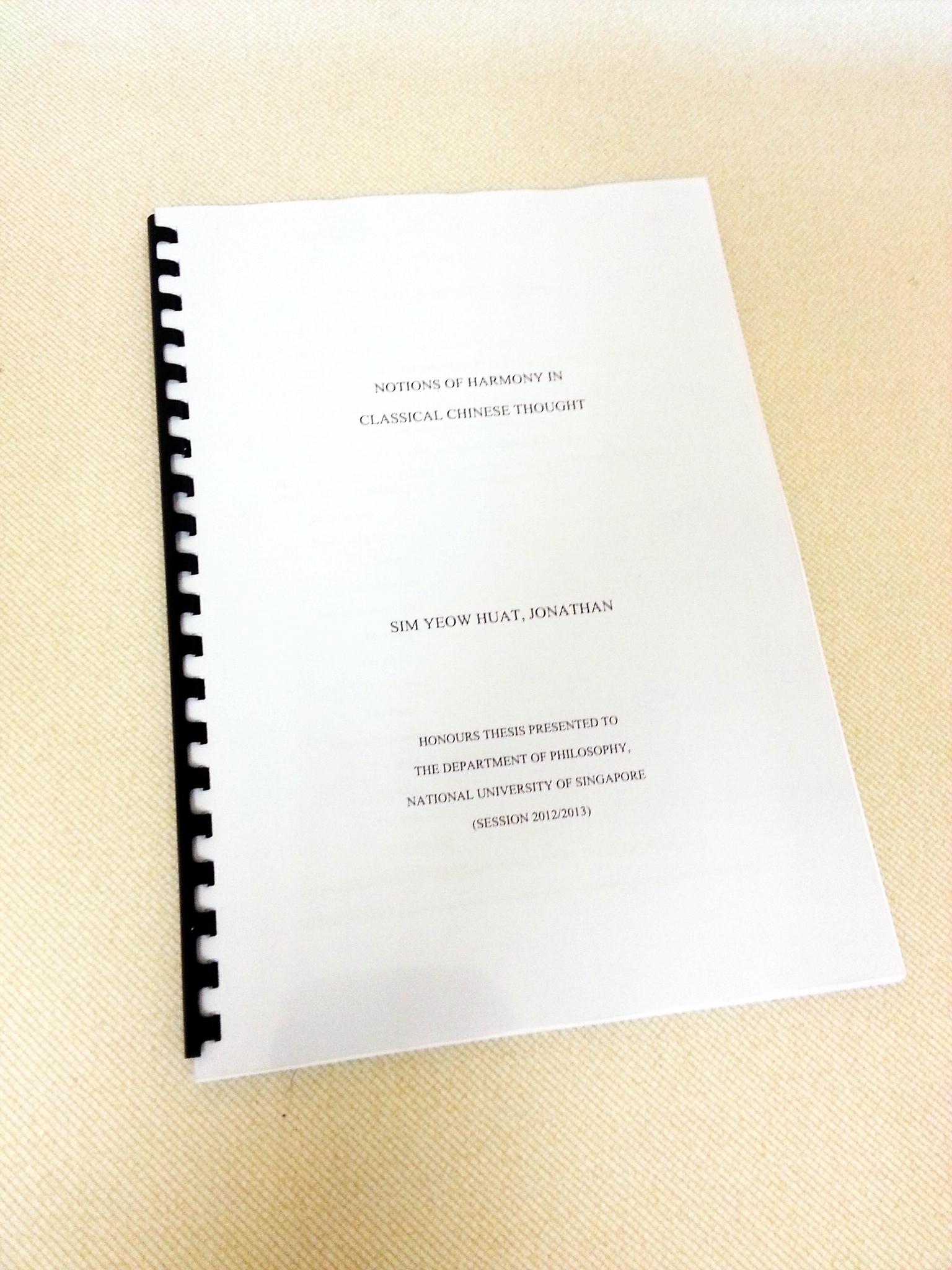
My thesis was entitled, “Notions of Harmony in Classical Chinese Thought.” In it, I set out to investigate and reconstruct all the various notions of harmony that could be found in the Analects, Mozi, Daodejing, Mencius, Zhuangzi, and the Xunzi. The problem with much of the scholarship on harmony is that scholars have often assumed harmony to be more or less the same idea across thinkers throughout Chinese history. My project was to demonstrate that this is not so. (If you are interested in reading it, please leave me a comment, and I’ll e-mail it to you!)

The final week before the Thesis submission deadline was extremely stressful as I was up almost every night until 3-4am trying my best to edit and polish up the paper.

Friday, 26 April 2013 was the thesis submission deadline and thankfully, I managed to finish my thesis by then.

That day was, for me, a very momentous occasion – it was the big day where after one entire year of researching and writing, the time has finally come for the paper to be printed and submitted! Wow… You know, I never thought it would ever have been possible to write such a lengthy paper. My thesis was approximately 12000 words, and it consisted of 42 pages! That’s right! 42! The number, the answer to life, the universe, and everything!

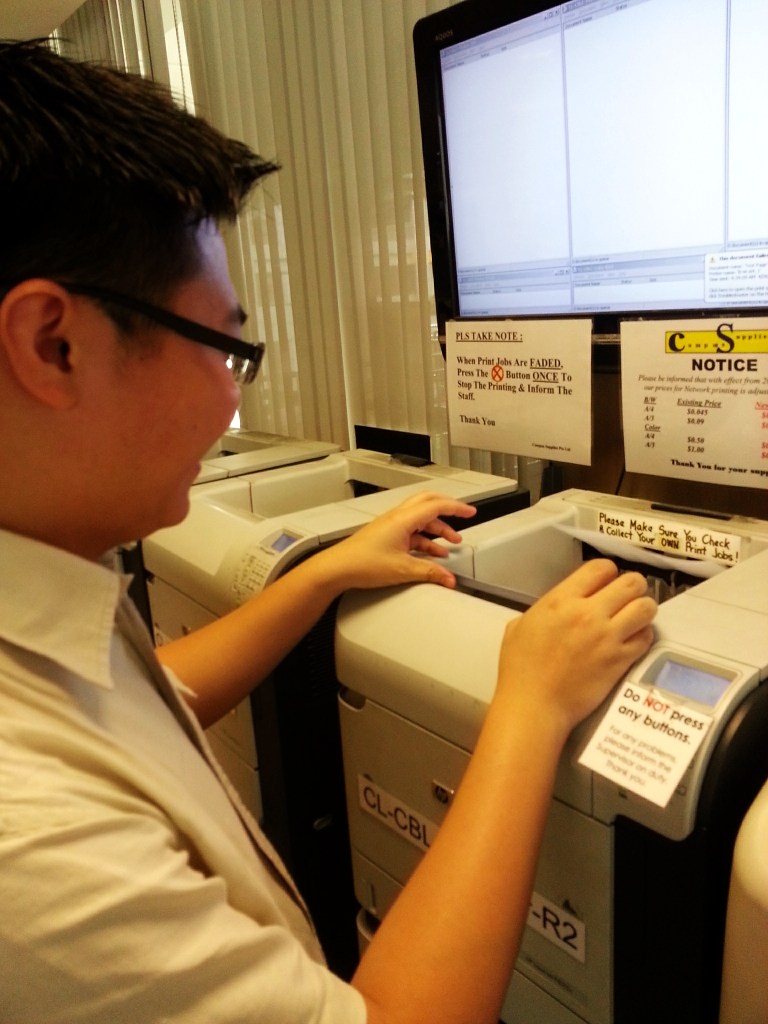
Somehow, the entire day felt like a momentous victory! I met a friend at the library who was more than happy to help me photograph the momentous occasion while I printed my thesis:

Waiting anxiously for my thesis to be printed - all 41 pages of it!
Waiting anxiously for my thesis to be printed – all 41 pages of it!


Proudly displaying the printed thesis! Notice the disheveled hair from the many overnight editing/writing marathons.


The finished product: complete with binding!

The finished product: complete with binding!


It was somewhat unfortunate that I didn’t have the time to bind my paper into a hardcover book (which was the tradition for submitting theses). Oh well, I didn’t have the luxury of time to do it. But that’s ok. Hardcover isn’t a submission requirement.

With the Honours Thesis out of the way, I felt a huge burden lifted from my shoulders.

But I could not heave a sigh of relief yet as I still had exams to study and sit for. And so, after a day of rest, it was back to the books.

Unfortunately, the exams didn’t end on a very happy note. My last exam was an engineering module (for the life of me, I still don’t understand why on earth did I decide to do an engineering module). It wasn’t an introductory module either (I really have no idea why I put myself through such pains). Anyway, it was the last exam of my undergraduate life, but the paper was so difficult, I was faced with a very real possibility of failing the paper. I counted the marks of the questions where I think I would have gotten right, and I only had just enough to pass. If bell-curve moderation was not in my favour, there was the very very real possibility that I would have failed this paper, and worse of all, I would have to repeat a semester. Gosh… It was a very horrible feeling to have while walking out of the exam hall.

But no matter. A few days after that traumatic experience of the final exam, I was out of the country for a holiday to Penang (I’ll write more about it later). Then it was off to Kuala Lumpur to run some errands and enjoy a bit of holiday by the side. The Girlfriend’s grandmother came down to Singapore some time back and discovered the wonders of the Internet, specifically YouTube, and she wanted to have this amazing Internet in her home. So I volunteered to go down to KL and help buy and set up a computer and an Internet connection. And after Kuala Lumpur, I was off to Bangkok. These three places were amazing in their own way, and I think I’ve grown and learnt a lot while I was there. (But I’ll keep all those thoughts for another blog entry here).

Let me just fast forward by about 2 months to the last seven days leading up to my graduation ceremony.

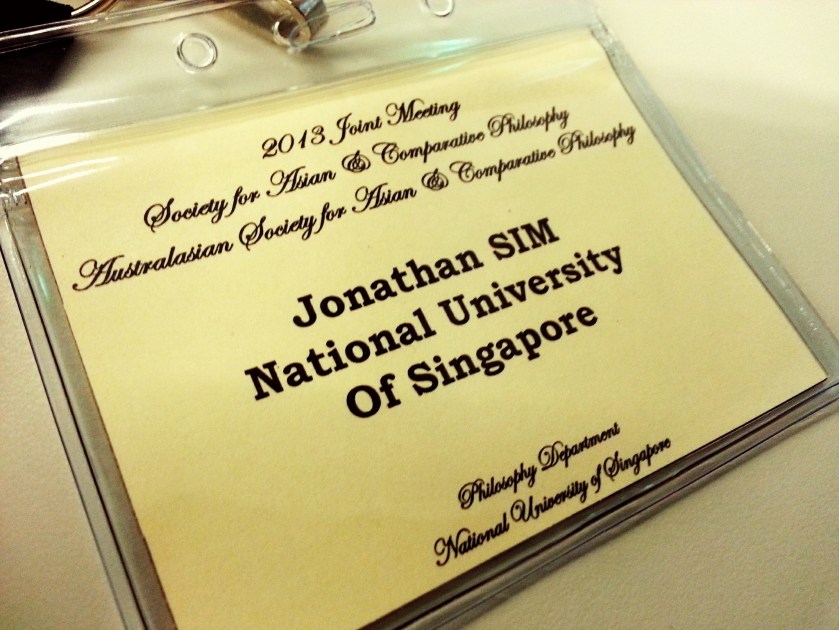
Gosh… It was quite an exciting week! I was given the opportunity to present a section of my Honours Thesis at an international philosophy conference. It was the 2013 Joint Meeting of the Society of Asian Comparative Philosophy (SACP) and the Australasia Society of Asian Comparative Philosophy (ASACP).

Name tag for the conference. It's such an honour and privilege for an undergraduate/fresh graduate like me to be present wearing this name tag amidst a crowd of about a hundred professors and PhD students all over the world, and to present a paper just like them!
Name tag for the conference. It’s such an honour and privilege for an undergraduate/fresh graduate like me to be present wearing this name tag amidst a crowd of about a hundred professors and PhD students all over the world, and to present a paper just like them!


Not only was I busy helping out with some of the logistic matters, I was also rushing to edit and present my paper for the event. It had been two months since I last wrote papers. It felt good to be writing a paper once again. I had a cup of coffee by my side, soft piano music playing in the background, and I was all ready to write my paper all the way into the midst of the night. So for three consecutive nights, there I was sitting before my computer, typing away until 3am. It was tiring, but it felt so good to be engaging in this paper writing ritual. There’s something so comforting and wonderful about the experience.

Monday, 8 July 2013. At last, it was the day of the Conference. I had to present my paper on the first day, in the afternoon before many academics, some of whom were really really BIG names in the area of Chinese Philosophy. It was intimidating, but nonetheless, a huge honour!

The paper I presented was entitled, “Reconciling Culinary and Musical Models in Classical Chinese Thought.” There’s been some sort of academic debate where there is disagreement as to whether the culinary and musical models of harmony have merged into a single unified notion or remain as two separate models in classical Chinese thought. In my paper, I attempted to present a new way of looking at the relation of the two models and how they can be reconciled together into a single theory despite remaining as two separate yet distinct models.

Did you notice the Dao (道) on my laptop? It's a MacBook Air. I took a piece of card and cut out the Chinese character and pasted it over the Apple logo. It's perfect for a Chinese philosophy conference!
Did you notice the Dao (道) on my laptop? It’s a MacBook Air. I took a piece of card and cut out the Chinese character and pasted it over the Apple logo. It’s perfect for a Chinese philosophy conference!


The cup of coffee on the left was meant to keep me going throughout my paper presentation. I was running on only three hours of sleep.


It turns out that my paper presentation was a huge success! Everybody present enjoyed it and they found the contents very interesting!

The biggest WOW experienced I had was during another panel’s Q&A session. One professor (Prof. Alan K. L. Chan), who is quite a big name in Chinese philosophy replied my question saying that he actually had read my Honours Thesis during his flight to Singapore, and he found it (to quote him), “an enjoyable read” and that it “was very interesting.” Immediately after that, the people sitting on my left and right turned to me asking if I could send my thesis to them.

WOW! If writing an Honours Thesis is meant to make one feel honoured, I think it’s working! I felt so honoured at that moment. Wow…

Anyway, the conference was really amazing. I had the chance to meet so many amazing people. It was also pretty amazing to finally see the faces of people whose books and papers I’ve read and cited in my papers. To be standing amongst the greats in Chinese philosophy from around the world… Woah… All I can say is that it was very inspiring and really awesome to see a bunch of people who are just so passionate about what they’re doing. It was lovely.

The conference went on for three whole days! On the fourth day, Thursday, 11 July 2013, it was finally the day of my graduation ceremony!

Four years of hard work has finally led up to this epic moment:

Notice the Chinese calligraphy necktie?


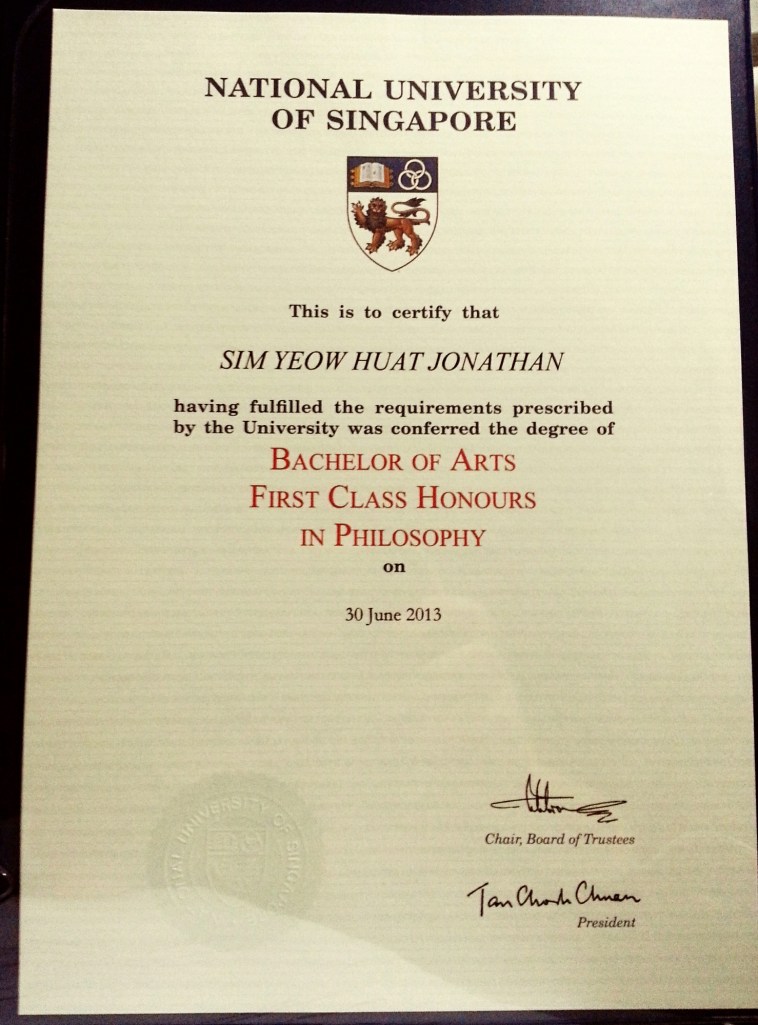
Let me now present you with the fruit of my labour – the fruit that took four years of coffee, blood and sweat (no tears thankfully):

OMG!!! First Class Honours!!! I never thought that this day would have been possible!


You know, it’s crazy… Ever since my first year in university, I never thought that it would be possible for me – a person who came from the science stream and who initially majored in Computer Engineering – to be able to get this.

But with lots of hard work and the encouragement and support from The Girlfriend, the wonderful professors in the NUS Philosophy Department, and all my other friends both online and offline, I was able to endure and persevere all the way till the end.

So what’s next? Well, if you asked me this question two months ago, I would have only been able to shrug my shoulders and sheepishly reply, “I don’t know.”

But since last month, I’ve slowly come to realise that my true calling is in academia, and especially in (Chinese) Philosophy. In the past months, I’ve been looking through job ads after job ads, and I was never really interested in what was on offer. The greatest tragedy perhaps, was the constant thought of never having to pursue philosophy once again. Every time I contemplated that thought, a part of me dies. It was painful.

It was only at a recent farewell party for a professor that I realised that I should do whatever I can to pursue philosophy. There and then, we were having a fantastic time discussing philosophical issues. My heart was on fire once again after quite a period of dreaded boredom. The pursuit of wisdom has left me thirsting yet for more.

The pursuit of philosophy is an arduous process. It is mentally and even physically exhausting staying up late just to research, think, and write. But it is a process that I value so greatly. These four years of my philosophical pursuits have transformed me in many wonderful ways. And I wish to continue to be transformed, and shaped by the pursuit of wisdom, just as how it has transformed and shaped the professors in the Philosophy Department here in NUS. I’ve interacted with many of them, and all I can say is that I feel like I’ve been interacting with wise exemplary sages.

I want to be as wise and awe-inspiring as they are, and continue to pass on this most splendid and awesome tradition.

But in the mean time, I’ll take a year’s break from study to work. I intend to focus on publishing at least one paper in an academic journal. That would help me get a better chance of securing full funding for a PhD scholarship. And by next year, I shall be off to some other country to pursue my studies in Chinese Philosophy.

It looks like I have a really exciting life waiting for me in the years to come. I look forward to that as I take life one step at a time.

Impending Deadline

I’ve not been updating this blog for a while. I’ve been quite busy writing my Honours dissertation.

I’m just happy to say that it’s almost done. All it needs is several rounds of editing before I can declare it as the greatest accomplishment of my life.

Anyway, there’s four days left before the submission deadline. I hope to get over and done with this as soon as possible because I still have exams to study for.

Here are the books that are currently stacked up next to me:

This is only half of my final bibliography. The rest of the books are in the library. I don’t drive, so it’s very difficult to carry huge heaps of books in my bag pack.

The dissertation is currently 45 pages long. My current word count is 13,147 words. I need to keep everything below 12,000 words. That’s the word limit. It’s a strict limit, so I don’t have the luxury of exceeding it a little. I’ll need to find some ways to shave off those excess words without affecting the presentation of the paper.

Yup! That’s how life has been thus far. I’m crossing my fingers, hoping that I can finish this by tonight.

Wish me luck!

The “Irrationality” of Decision Making

Here’s something interesting about making decisions – at the heart of the decisions we make, there’s some level of irrationality going on.

The best way to illustrate this is by using the example of Newcomb’s Paradox.

Imagine this scenario: There are two boxes – one transparent, and one opaque. You’re supposed to choose either (1) the opaque box OR (2) both boxes. The transparent box contains $1000. But we do not know how much money is inside the opaque box. Now, there’s this magical person known as The Predictor. The Predictor can predict with a 99.999999…% accuracy on which choice you’ll make. If he predicts that you’ll choose option (1), the opaque box, then he’ll put $1million in it, and you’ll get $1million. If he predicts that you’ll go with option (2), of taking both boxes, he’ll put nothing inside, and you’ll get only $1000 at the end of the day.

So will you choose to take only the opaque box or would you choose to take both boxes?

Chances are, if you chose to take the opaque box only, you’d think that people who chose to take both boxes are crazy. Since you’ll probably get $1million, why bother with two boxes where it’s highly likely that you’ll get only $1000?

Yet, those who think that it is perfectly rational to choose both boxes will think that it’s crazy to choose only one box and risk losing all of one’s money.

So who’s crazy and who’s rational?

Well, before I say anything more, I think it’s very very interesting that a study was conducted and people are generally split 50-50 over which option to choose from.

So back to the question: who’s crazy and who’s rational?

Well, if you chose to take only the opaque box, chances are you made your decision using the Expected Value principle. The expected value is calculated using the formula:

Expected Value = Expected Gain x Probability of Acquiring It

Using the Expected Value principle, there are four possible scenarios:

  1. Choose opaque box & $1m put: Get $1m. Expected value = $1m * 99.99…% = 999,999.999…
  2. Choose opaque box & nothing put: Get $0. Expected value = $0 * 0.000001 % = 0
  3. Choose both boxes & $1m put: Get $1.001m. Expected value = $1.001m * 0.0000001% = 0.00000001
  4. Choose both boxes & nothing put: $1000. Expected value = $1000 * 99.99…% = 999.9999…

From the above four scenarios, only scenario one yields the highest expected value. And so, it makes sense, from this point of view, that one ought to choose only the opaque box. This decision is well justified.

Yet, on the other hand, those who choose both boxes have a well-justified decision too. They are operating on the Dominance principle, or what I like to call, the kiasu (Singlish for ‘scared to lose’) principle.

Anyway, the Dominance principle weighs which decision will yield the best result in all possible cases.

There are four possible scenarios that we can construct:

  1. Choose 2 boxes & no money put: Get $1000 (Probability 100%)
  2. Choose 2 boxes & put $1m: Get $1.001million (Probability 0.0001%)
  3. Choose opaque box & no money put: Get $0, i.e. LOSE $1000 (Probability 0.0001%)
  4. Choose opaque box & money put in: Get $1.001million (Probability 99.999%)

In which case, choosing both boxes will yield the best result since:

  1. Choose both boxes and $1m put, get $1.001m > Choose only opaque box, get $1m
  2. Choose both boxes and nothing put, get $1000 > Choosing only opaque box, lose $1000.

From this perspective, it makes sense to choose two boxes instead of one.

The Newcomb’s Paradox is a paradox because in such a situation, people arrive at two different solutions, each justified with a different principle.

But what justifies the use of one principle? Or what justifies choosing one principle over the other?

At this level, reason begins to break down. The two principles above give weight and value to two completely different things. One places value on the expected value while the other places value on which choice yields the best outcomes in every foreseeable case.

But how do you justify which should be given greater weight? In most cases, attempts to justify one value over another already assumes the superiority (or inferiority) of one value. So that wouldn’t be a fair assessment. For example, if I say that it’s better to favour the best outcome in all possible cases rather than the expected value because I will always get some money at the end regardless of the outcome, then I’m implicitly already giving greater value to ‘the best outcome in all possible cases’.

For this reason, a sincere neutral assessment will not be able to answer which principle to choose. That’s why people are divided 50-50 over this issue. We can’t rationally justify why we ought to value one thing over the other.

This is where some level of “irrationality” comes in. We choose one principle over the other for non-rational reasons – gut feeling, our upbringing, our cultural/intellectual context, etc. These things shape us to develop a positive bias for one, and a negative bias for the other.

On the broader picture, we all value different things for different reasons. And even if we can agree that we value a set of things, people rank the things they value differently. I value quiet walks, while others may value loud parties.  I value philosophical discussions more than discussions on sports; while others may value discussions on sports more than philosophical discussions.

We may judge others as being worse than us for valuing some things more than we do. But, as I have mentioned earlier, such judgements are unfair judgements because we are judging them from the perspective of our own order of value. And yet, there really is no means for us to justify why one thing should be valued more than another without already assuming the superiority of one value. Why? Because of some level of irrationality going on in the background that makes us favour one value more than another.

So, the next time someone seems to have made an apparently irrational decision, if that person is capable of rationally justifying the decision – even if you still do not agree with it – that’s because we’re making our decisions while placing value on different things or value something more than others, and there’s really no way of properly justifying why we choose to value one thing over another because of non-rational factors.

Death as the Ultimate Climax of Life

One of the best lessons I’ve learnt from one of the professors here in NUS is about the Chinese view on death.

In Chinese culture, there are two words used to describe death: (1) 死 (si) which simply means termination of life; and (2) 終 (zhong) consummation/finale. Of course, zhong also holds the same meaning as si, which is why it is taboo in Chinese culture to give someone a clock as a gift (to give a clock is to 送鐘 songzhong which sounds exactly like 送終 songzhong, which means to send someone off to the grave).

But what’s so unique about the word 終 zhong is the emphasis on death as the consummation, the very climax of life; it is where you wrap up your story with the most awesome ending possible.

Interestingly, I found the perfect illustration of this idea from a movie, entitled “It’s a Great Great World (大世界 Dashijie).” It’s a Singapore production, with several short stories about life in Singapore during the 1940s, revolving around an amusement park known as the Great World. The last story was the most touching and emotionally powerful story I’ve ever come across. It’s beautiful.

The story goes like this: There was a wedding banquet in a Chinese restaurant. Unfortunately, that night, the Japanese were invading Singapore. Their planes were dropping bombs all over the island. The wedding guests weren’t aware of it and they thought that it was merely fireworks outside (it was an amusement park after all). The chef and his assistants decided that most of them would probably not live to see another day, or if they did, life as they knew it wouldn’t be the same forever. So, that night, they decided to cook all the food in the kitchen and give them the best wedding dinner ever. What was beautiful was how the chef and his assistants poured out their entire heart and soul in preparing every good meal to ensure that everyone had the best time ever. The acting was beautiful as it looked as if they were performing their last dance.

The father of the bride was the one who was going to pay for the bill. He was quite upset when he saw all the expensive dishes being served. He stormed into the kitchen wanting to complain, but learnt about the Japanese invasion from the chef. Immediately, as a good father, he went out and made sure everyone dined happily and had the best night of their lives so that they would remember that night.

This is by far, the most beautiful illustration of wrapping up one’s life. It climaxes in the biggest, boldest, and most courageous effort to showcase the best that one could do even in the face of death – to die with dignity, to spread happiness to others, and to give all that one could ever give in one’s final moments. Everything that one has experienced in one’s life leads up to that one final moment – death.

It is like the final dance in a performance (or an action movie). Everything right from the beginning leads up to that final moment where it climaxes with the greatest showcase the dancers could perform before the curtains come to a close.

Admittedly, it is difficult since many of us do dread the thought of death. Perhaps we dread it because we think of death merely as the termination of life. But I think when we begin to see death as the ultimate climax, the ultimate wrapping up of one’s life, where the multitude of one’s personal experiences lead up to that one final performance, I think the idea of death becomes very ennobling and empowering.

I really like how the Chinese (especially Confucian thought) emphasises the importance of dying with dignity. Every one and every thing dies. But as humans, we have the option of choosing to die with the greatest dignity as a human being.

I remember watching “Confucius: The Movie” and the one scene that really struck me was this: One of Confucius’ disciples was in a state invaded by a foreign state. Unfortunately, he was fatally wounded by arrows.

In that situation, the best way for him to wrap up his life was to ensure that he passed on orderly and not in a chaotic manner. All the lessons and values in life that he learnt and experienced led up to that one moment. It would have been a shame to cast away all those years simply because of pain. And so, he made it a point to endure the pain and conducted himself in the greatest possible performance that would consummate all that he learnt in life: he picked up his hat, slowly put it back onto his head, adjusted it so that it was in proper order; he re-adjusted his clothes and his belt to ensure that they were tidy, and slowly yet reverently fell to his knees, closed his eyes with gratitude for all that he has experienced and learnt in life. And there he passed on.

In that short yet simple final performance of his life, he showed great mastery over himself and that he was not a slave to his passions. He showed that as a human person, there are things more important than pain and death, and that it is possible to continue being civil and human despite feeling great pain.

That is what death should be about – dying properly, honourably, and as a consummation of all of the lessons, values, and experiences in life in that final performance of life.

These deaths are beautiful because they show us the beauty and strength of humanity, which we don’t see too often these days. It happens here and there – most of them quietly without much publicity. But I think, whenever we encounter such beautiful deaths, we gain the inspiration not just to live, but to live well, so that we too may go just as beautifully.

Lunch with Dr. Vivian Balakrishnan

Wow… This has got to be one of the most exciting events before the year ends! A few days ago, I received a comment on my blog by Dr. Balakrishnan, saying how he enjoyed reading my blog and would like to have lunch with me. (Dear Dr. Balakrishnan, if you’re reading this, hello!) For those who don’t know who he is, Dr. Balakrishnan is the current minister of Environment and Water Resources.

Wow… A minister enjoys reading my blog! What a surprise and an honour!

For the days leading up to our lunch, I’ve been wondering why he’d like to have lunch with me. In fact, I was very curious as to how he found my blog. Was it because of my blog entries about the rising cost of living, or about the cost of housing? The Girlfriend joked that he probably found my blog while searching how to use Whatsapp for Mac (it’s the most popular post I have – it generates at least 500 hits a day!)

Well, surprise surprise! He did discover my blog searching for instructions on how to use Whatsapp for Mac! WOW! So cool!

Anyway, he invited me to invite a few friends so that we could have a nice chit chat session, and so I did. We had lunch at a Penang eatery along Thomson Road. For someone who never had the opportunity to meet a minister before, it was quite an experience (and somewhat intimidating one too!) seeing body guards. There was an advance party of security men who came to scout and check the area, and later, there were body guards escorting the minister into the cafe.

My friends and I were excited and nervous at the same time. I mean, it’s a minister! What do you say to a minister? And how should one behave?

Well, surprisingly, Dr. Balakrishnan was very friendly and approachable! In fact, he was quite down to earth too!

Usually, the media portrays ministers as people who are so high-up, that we forget that they are ordinary human beings just like us. But during that lunch meeting, I was very impressed.

Sitting before me was someone as ordinary and as human as we are, sharing similar interests and likes. Here was someone who was as passionate about technology, food, and chinese culture as I am. Here was someone who was curious to learn how to make Whatsapp work on his computer just like the many technophiles around me. Here was someone who loved both Singapore and Malaysian food that he would talk just as passionately about food just like many Singaporeans here. Haha… I told him that I looooved Malaysian Char Kway Teow (it’s very different from the Singapore one), and immediately he replied, “I think it’s the lard that makes it so tasty!” A few minutes before he came, another friend said the exact same thing! He also shared with us his food trips to Malaysia. So cool!

What I loved the most was just how genuine and sincere he was with us. We were very amazed with his sharings about his own personal life and especially about his family.

The one story that left the deepest impression for myself and my friends was his sharing of the time when he first held his first-born child in his hands. Wow… You could sense just how emotional he was as he recounted the experience and the thoughts and feelings that went through his mind during that event. He shared how during that one moment, he suddenly understood the love that his parents had for him, he suddenly understood what parental love was – it was a love that would often be unreciprocated and yet, you’d still want to continue giving your love to your child no matter what. He shared with us how as a parent holding his baby child for the first time, he realised just how vulnerable and dependent the child was on him, and how he had to do whatever was possible to ensure that she would grow up well. He experienced parental love for the first time and that was a great learning experience for him.

Just hearing him share his experience made me feel like wanting to have a child as soon as possible. Wow… I’d like to experience what he experienced.

As it turns out, the lunch was really a lunch with no political agenda. My friends and I have been speculating if he had something in mind (after all, why would politicians ask people to have lunch out of the blue?), but it turned out to be nothing more than a friendly chat over a meal, just as how friends would sit around a table to eat. I did ask him why he wanted to have lunch with me, as I was very very curious. He replied that this was something he likes to do. He finds a Singaporean online who’s interesting, and he extends an invitation to have a meal with him because he just likes meeting interesting people. Pretty cool. I know most people reading this might be skeptical (afterall, these are words coming from a politician), but rest assured, all of my friends and I agreed that he was very genuine and sincere about this.

Anyway, we did chat about issues on life, relationships, and philosophy – especially since my friends and I are philosophy students. It was interesting as he did bring up some interesting philosophical issues for us to consider in the area of politics. (I’ll discuss them in another blog post)

I think it was really great of him to engage us philosophers intellectually on such issues. In fact, I like how he has such great respect for philosophy. It’s rare because we philosophers often encounter people who think lowly of philosophy only because they think it’s impractical (can’t make money) and/or pointless. It’s very interesting how he framed policy-making problems as philosophical problems. For example, one of the problems governments face is the issue of trying to balance justice with equality. E.g. an equal distribution may not necessarily be a just distribution because some need more than others, and on the other hand, a just distribution is often regarded as unfair since not everyone is treated equally (e.g. why should married couples get more subsidies than singles – why can’t everyone be treated the same way?).

It is a difficult balance and it does seem that both values are contrary to each other, and regardless of which way governments decide to emphasize, there will always be complaints of unfairness. I think that was eye-opening!

Anyway, I guess it’s inevitable that when having lunch with a politician, the issue of politics will be discussed.

I will say that after our lunch together, I have a profound respect for Dr. Balakrishnan because he’s the first PAP (Peoples’ Action Party) person who articulated why the government does what they do, in a very convincing and thorough manner.

It’s sad, but the media and many PAP politicians do a bad job in communicating the rationale for their policies. It’s either too simplified that it sounds ridiculous, or the person speaking assumes that we’re on the same channel (and see the world the same way as him/her) and makes too many assertions that many of us consider questionable.

I’ll be honest and say that while I don’t agree with some of the things said, I am nonetheless glad to at least have the opportunity to hear the justifications for many of the things the government does. When you read the gross over-simplifications in the news, you sometimes wonder if the country is run by rational people. But after our lunch discussion, I am glad to know that a lot of thought has indeed been put into their policy-making decisions. Of course, there is always room to debate the policies, but given the way they have framed the problems, the solutions they have conceived do indeed appear to be the necessary solutions.

The real question then is, has the PAP government framed the problems rightly? Should many of these national issues be framed in light of economics? Of course, I don’t know enough nor have I thought enough about these matters as of this moment. But I think these are indeed worth discussing.

Dr. Balakrishnan mentioned that one of the failings of the PAP was that they’ve been really bad at communicating policies. Seeing how the picture provided by him is more rational and worlds apart from the picture presented by the media, I wonder if the people who communicate these policies to the news ought to be shot for grossly oversimplifying things. (Personally, I think I can do a much better job than them if this was indeed the case) Of course, skeptics will question how is it possible that state-run media can do such a bad job. I don’t know.

Nonetheless, this is exactly what we need in our public discourse – a thorough discussion of why policies are what they are, with all the fine details included, making no assumptions that we necessarily see things from the same point of view. I do think that if ministers (and the media) make it a point to thoroughly discuss the fine details and all just like what Dr. Balakrishnan did at lunch, we can begin to have fruitful debates about our public policy. We may not necessarily agree, but at the very least, we can start to see why such a decision or proposal could even be rational at all. Too many issues are presented in a simplistic manner (in the news) that it seems more like badly-made decisions rather than well-thought decisions.

Once we begin to see that the other guy is rational (and not a moron), we begin to respect the other, and we can proceed with fruitful dialogue. I think this is what we urgently need in Singapore today, especially in the wake of increasing polarisation among PAP and opposition supporters.

When we begin to fight for our political parties like soccer teams, we cease to be rational, and democracy becomes no more than just a tyranny of the loudest – whoever shouts the loudest wins. This kind of democracy is not productive nor is it truly life-giving.

Anyway, I am glad that we had this lunch. We had good food and good food for thought. Thank you Dr. Balakrishnan! You’re amazing! My friends and I would love to have lunch with you again.

Research, research, research…

The second week of school has just ended, but it has already been quite an intensive week for me.

I’ll be officially starting on my honours thesis next semester. However, my supervising professor will be away for a while during that time, and it would be quite inconvenient to attempt a thesis under such conditions. So, I figured it’s better that I begin my research now while the hell of assignments hasn’t yet been unleashed onto me. I hope to finish as much research now, so that I have the luxury of time to write and do more stuff when I begin my thesis officially.

This was how my table at the library looked over the past few days:

img_3508

Yes, your eyes do not deceive you. One of these books has Chinese words! I’m researching on an ancient Chinese text known as the Chung-yung (中庸, famously known as the “Doctrine of the Mean” or more accurately as “The State of Equilibrium and Harmony”). It’s written in classical Chinese.

What I’ve been doing the past week, was simply reading through the entire book in its original text, and comparing the various translations that I could get my hands on. Classical Chinese is a unique language in that it has a lot of ambiguities (it’s a unique feature of the language that allows the author to do a lot of amazing things, e.g. embed several different meanings onto the one same phrase). The problem with translations is that authors will have their own subjective biases, which affect the interpretation and thus, the translation of the text. In each translation, you’ll have different things missing while the translator focuses on one interpretive key. Hence, the importance of comparing translations along with the original text.

I’m glad I’ve made quite an effort over the holidays to work on my Chinese. I used to fail Chinese (or just barely pass it) back in secondary school and junior college. Now – I’m quite surprised at myself – I am able to read the entire text in Classical Chinese. That’s quite a marked improvement.

Well, with the week over, I’m more or less done with one little portion of research. Reading the original text and its translations is just the first step. More books and journals to read in the coming days. I expect my usual table at the library to be stacked with even more books.

READ ALL THE BOOKS!!!

A Philosophical Gift

I just got this gift from a friend as a belated Christmas present:

If there’s one thing I learnt from my study of philosophy, it is this: the questions matter more than the very answers themselves. Why? Because the question kicks off the entire process of inquiry. It is the process of figuring out the answers that we learn a great deal about the subject matter in question, and about ourselves.

The pursuit of happiness is the pursuit of misery

In the days leading up to the end of 2011, I’ve been thinking back about the most important lessons that I have learnt throughout the course of the year.

Interestingly, one of the most important and useful lesson that I’ve come to realise is that the pursuit of happiness is as good as pursuing misery.

At first glance, it seems rather odd, but there is a lot of truth behind this principle.

One of the worse things we can do to ourselves is to ask the following questions: “Am I happy?” or “What else do I need to be happy?”

The reason why I say that the pursuit of happiness leads one to misery is due to the problem of language.

Perhaps it would be useful to provide an illustration of the problem: If I tell you that the sky is cloudy, what comes to your mind? Most people will say that the sky is grey. But is the sky really grey? Well, not always. You can have a blue sky despite it being cloudy. And for that matter, if it was night, the sky would be black. Unfortunately, when we use the term, “cloudy sky,” we carve out a particular conception of the sky which does not fully exhaust other possibilities, and for that matter, that conception may sometimes include other things which are simply not relevant to our own situation.

This has been a huge problem to Taoist philosophers, as highlighted in the Tao Te Ching:

道可道,非常道。名可名,非常名。無名天地之始;有名萬物之母。故常無欲,以觀其妙;常有欲,以觀其徼。此兩者,同出而異名,同謂之玄。玄之又玄,衆妙之門。

Ways can be guided; they are not fixed ways.
Names can be named; they are not fixed names.
“Absence” names the cosmic horizon,
“Presence names the mother of ten thousand natural kinds.
Fixing on “absence” is to want to view enigmas.
Fixing on “presence” is to want to view phenomena.
These two, emerging together, we name differently.
Conceiving of them as being one: call that “fathomless.”
Calling it “fathomless” is still not to fathom it.
… the door of a cluster of puzzles.

Tao Te Ching (道德經), n.1, trans. Chad Hansen (2009)

Therefore, when we ask ourselves the question, “Am I happy?” or “What must I do to be happy?”, we carve out a particular conception of what that happiness entails (and what it means to be unhappy), and use that as the benchmark for measuring our own happiness. But little do we know that that idea of what it means to be happy has its own flaws. We might already be happy, but as we compare our present situation with that ideal, we begin to see just how far away we are from that ideal of happiness (and see just how many of our present experiences are classed under “unhappiness”). And the more we do this comparison and see just how far we are from that “happy” ideal, the more miserable we feel. The conclusion, at the end of the day is – “Oh! I’m not happy.”

Whenever I’m busy concentrating on something, some people have a tendency to misinterpret my facial expression as that of feeling depressed. There used to be this moron who used to come up to me everyday asking me if I was really happy with my life every morning. What a way to spoil one’s day. I was actually feeling quite fine – serene and calm – with absolutely no tinge of negative emotions or thoughts. But when I was asked, “Are you happy? You look like you’re not.” I began comparing my present state with the ideal of what it means to be happy. And after a while, I became very very depressed.

It was only many years later when I started studying Chinese philosophy that I looked back and realised just how stupid I was in carrying out such a comparison. Of course I’d be miserable. And for that matter, anyone who does such a comparison will just end up feeling depressed, as one becomes convinced that one is far from happiness.

(While typing this, I realised that when we ask such questions about happiness, we unknowingly accept a fatal assumption. “What must I do to be happy?”, implies that one is currently unhappy and wants to get out of this situation. “Am I happy?” doubts the possibility that I am actually happy right here, and right now.)

And of course, the misery doesn’t end there. When we begin asking ourselves what we need to do to be happy, we try to force ourselves into a particular mold, doing our very best to fit into a vision of happiness.

But surely – one may ask – one could arrive at the destination and finally attain happiness, right?

Well, no.

The problem is that happiness is an ideal, an abstract concept with no detailed specifications of the final end. No matter how much one tries to fit into that ideal mold, when we try to compare our present state with that ideal vision, the present state will always appear to be far away from the ultimate goal.

Yes, we can be excellent in achieving something. But as long as that achievement exists in the real, concrete world, there will always be some imperfections. It is precisely because the ideal conception of happiness is so abstract, the fine details are stripped off (left out, as it were from the conception of happiness which we have carved in our minds). And because it lacks the fine details, it will always appear perfect, pure, unadulterated, and of course, infinitely better each and every single time we compare our present state with it.

And so, no matter how much one tries to chase after happiness, the comparison of the present state with the ideal is inevitable. And the more one dwells upon it, the more one thinks one is unhappy.

Happiness begins when we stop asking such questions, and start realising just how happy we already are – right here, right now. It is possible to be happy right here, right now! In fact, we may not realise it, but we are already be happy (even though it doesn’t necessarily correspond to the abstract ideal of happiness in our minds).

I might currently possess some negative feelings, such as sadness or loneliness, but that doesn’t mean that it mutually excludes happiness. It doesn’t have to be mutually exclusive.

And when we begin to realise just how happy we are in our present state, we begin to discover that the question, “Am I happy?” or “What must I do to be happy?”, are simply irrelevant questions – traps that we set for ourselves to make us depressed.

Happiness is now.

And since that realisation, I’ve been significantly happier than before.

The Sceptical Catholic

Is human life always this bewildering, or am I the only bewildered one? Is there actually any man, or anything in a man, that is not bewildered?
(Chuang Tzu, Chapter 2, trans. Brook Ziporyn)

What man knows is far less than what he does not know. The time he exists is insignificant compared to the time he does not exist. It is because he tries to exhaust this vastness with this meagerness that he bewilders and frustrates himself.
(Chuang Tzu, Chapter 17, trans. Brook Ziporyn)

The Sceptical Catholic.

To the eyes of some people, the combination of “sceptical” and “Catholic” is enough to send alarm bells ringing in their minds.

More often than not, many understand scepticism to be a ridiculous extreme, of irrationally declaring to the world, “I can never know what is true!” When this is applied to the context of religion, scepticism is perceived as a threat to one’s faith, demanding unreasonable proofs for the justification of God’s existence that go beyond the limitations of human reasoning.

While there are such people out there in the world, this is not what I mean by the term, “sceptical.” You see, there are three kinds of scepticism: (1) doctrinal scepticism: I cannot know X; (2) recommendational scepticism: I should suspend my judgement of X since I cannot be completely certain about it; and (3) methodological scepticism: how can I know X for certain? (a method of inquiry meant to introduce doubt about X).

Philosophers, like Socrates, often employ the use of methodological scepticism to cast doubt on the very things which we imagined to know with complete certainty. Socrates, for example, went around Athens asking people if they knew what “justice” was. The very people he asked were the ones who thought they knew very well what “justice” was about. And yet, when Socrates began questioning them, they soon came to the realisation that they didn’t know very much about it at all.

Even today, many of us are like the men of Athens. We think we know many things well. Sometimes, we don’t just think we know them well, we believe strongly that we’re 100% certain about it. And yet, we do not need a philosopher like Socrates to reveal to us just how mistaken we can be sometimes. We make mistakes about the assumptions we make, about our calculations, and even about our beliefs. Mistakes happen all the time – and they happen even more so when we think to ourselves just how certain we are about the matter.

A few days ago, I attended a discussion about the objectivity of scientific research, one professor shared a story of a plane crash that happened several years ago. No one knew why the plane crashed until the flight data recorder was found and studied. It turns out that the pilot had flown the plane in the wrong direction, making it fly so high up into the air  that the engine had stalled. Yet, the entire time, the flight instruments were accurately measuring the status of the plane, but the pilot was so certain about what he was doing,  he refused to believe in the readings. And even after the plane’s engine had stalled and was dropping down from the sky, with the instruments indicating precisely what was happening, the pilot chose to ignore all the warning indicators, believing himself to be right the whole time – until the last moment when the plane crashed into the sea.

The point is that, more often than not, we feel ourselves to be absolutely right in certain matters that we choose to ignore everything else. Even if we have warning lights flashing in front of our eyes, such feelings of rightness and certainty – even what seems to be well-supported ones – can blind us from seeing such warnings.

Sadly, this problem appears to be even greater when it comes to matters of Faith and religion. Yes, as Catholics, we profess our belief in one God; we profess our belief in the One, Holy, Catholic, and Apostolic Church. But there’s one thing we do not profess in our Creed: we do not profess belief in ourselves, we do not profess that belief in God and the Church makes us equally infallible.

It’s precisely because we are so prone to error that we put our belief and trust on an authority.

And yet, for some strange reason, many of us, having read just a few books on Catholicism, philosophy and theology, or having served in a ministry for years, or having done all kinds of Churchy things, have come to imagine that whatever things we have in our minds about God, the Church, morality, etc., IS the Absolute Truth, and anyone who says or do anything contrary to this Truth is either a heretic, a liberal, a modernist, a heathen, or simply irrational. Just where on Earth or in Heaven did we come to develop such a strong sense of certainty about the beliefs in our head?

Yes, we believe that what the Church teaches is true. But the problem is that our understanding of this Truth may not necessarily be an accurate reflection. If anything, it could very well be distorted. Perhaps I might have misinterpreted or misunderstood what has been taught. Or perhaps I do not yet see the big picture. And yet, the last thing we question is whether or not our own beliefs are actually a correct reflection of what the Church has taught.

Furthermore, coupled with this unjustified belief that we are so completely right, is often the privileging of everything Catholic, or more specifically, everything that seems “Catholic” from our perspective. If I see myself as a traditionalist, everyone who does not fit into my Catholicism is wrong. If I see myself as a liberal, everyone who does not fit into my Catholicism is wrong. And the list goes on.

To further complicate matters, this leads us to develop a tendency to ignore non-Catholic (both non-Catholic and non-“Catholic”) views. We need to recognise that believing in the Truth does not make us Truth itself. We can always be wrong. And for that matter, Truth does not belong to anyone. An atheist can also speak the truth too. 1+1=2. It doesn’t matter who tells me that. I have no good reason to ignore him just because he’s not a Catholic.

As Catholics, we believe that God is Truth, and that God will ultimately lead a sincere seeker of the Truth to Him in due time. And therefore, there is no reason why valid criticisms towards Catholicism should not be heard and addressed – the doctrines, the philosophies, the theologies, and even the practices. And for that matter, there is no reason why we can’t learn anything good from others.

It is worth noting that the Church teaches us:

The Catholic Church rejects nothing that is true and holy in these religions. She regards with sincere reverence those ways of conduct and of life, those precepts and teachings which, though differing in many aspects from the ones she holds and sets forth, nonetheless often reflect a ray of that Truth which enlightens all men. Indeed, she proclaims, and ever must proclaim Christ “the way, the truth, and the life” (John 14:6), in whom men may find the fullness of religious life, in whom God has reconciled all things to Himself.
(Nostra Aetate, 2)

What atheists and non-Catholics have to say – their criticisms – should be taken seriously. I have noticed that the many criticisms are not direct attacks against the Church. Their criticisms are against the false teachings that others have propagated, and against the bad practices which has been done thus far (nothing doctrinal, but just really bad ways of doing things, including the scandals, etc.). Many of their criticisms are valid, and are indeed the warning lights.

But if we choose to remain committed to our false-belief that we are absolutely right in everything, then we will continue to be blind to the merits of their arguments, and come crashing down into the sea, while bringing others along with us, if we are not careful.

We need some scepticism. At the very least, we need to recognise that we can be mistaken and are indeed fallible. We believe in the Truth, but that does not make us the Truth or possessors of Truth (as if Truth is some thing that we can own). We learn from the Truth, but we are still prone to misinterpreting the Truth. If anything, we need to be aware of our own fallibility, and be open to correction.

Destiny (命)

命 (ming) is often translated as fate, destiny, decree (Heaven’s Decree 天命), or even Divine Providence. But regardless of how this word is translated, and regardless of whether we really believe in fate/destiny/Providence, there is an important lesson that we can learn from 命 (ming).

There are many things in life that are beyond our control, and these things play a part in shaping the course of our future, as well as the successes and failures of our endeavours. Our beliefs about what led things to be that way (e.g. fate, Providence, chaos) doesn’t matter. What’s important is that we have to remind ourselves – time and time again – that there are things that are beyond our control whether we like it or not.

The fear of the unknown is one of our greatest fears. (It is most certainly one of mine!) It is this fear that paralyses us and prevents us from going forward in life. It is this same fear that makes us even more obsessed about being in control of things.

We want to be in control, we want information. After all, it’s my life! We probably wouldn’t worry so much if life was like a game with a reset button. But there doesn’t seem to be one! And so it seems as if there is very little room for trial and error. This is probably why we are often so worried about what happens to us in the future.

Here’s where one of Confucius’ famous sayings can help us a lot:

“不知命,無以為君子也。”

(translation mine:) The person who does not know 命 (ming) can never become a gentleman.

[Analects, 20.3]

The reason why such a person cannot become a gentleman is that this person ends up being ruled by his/her fears, and acts irrationally as a result. We all have similar experiences of this. When things don’t go our way, we get very upset, and we sometimes go to the extent of finding someone (or something) to blame and vent our frustration at for the failure. If not, we’d probably give in to our fears and desperately try to make sure things go our way, OR we do not even dare to do it, but instead opt for a safer route where in the end, we never really learn to live our own lives and be ourselves.

Sometimes, all it takes is for a friend to gently remind us that we can’t possibly be in control of everything OR just to take a step back from all that frenzy, to realise that we’ve been acting quite irrationally (and possibly, rather childishly).

So… What does it mean to know 命 (ming)? I think Fung Yu-Lan has a really good explanation:

To know 命 (ming) means to acknowledge the inevitability of the world as it exists, and so to disregard one’s external success or failure. If we can act in this way, we can, in a sense, never fail. For if we do our duty that duty through our very act is morally done, regardless of the external success or failure of our action.

As a result, we always shall be free from anxiety as to success or fear as to failure, and so shall be happy. This is why Confucius said: “知者不惑,仁者不憂,勇者不懼。 The wise are free from doubts; the virtuous from anxiety; the brave from fear.” (Analects, 9.29) Or again: “君子坦蕩蕩,小人長戚戚。 The gentleman is always happy; the petty man sad.” (Analects, 7.37)

[Fung Yu-Lan (馮友蘭), A Short History of Chinese Philosophy (New York: The Free Press, 1948), p.45]


One of my friends puts it very nicely:

To know 命 (ming) is to sit back and let the world take its course, and not be a control freak. For when you seek to control every aspect of your interactions with others you will be disapproved as a jerk. (And yes, its out of your control anyway.)

This is why 命 (ming) is currently my favourite word. I even wrote it and hung it at my door so that I’ll see it everytime I leave my room. This is to remind me that there are many things beyond my control, and so there’s really no point getting upset or anxious.

What’s more important is that I do the things that I have to do anyway. If it’s meant to be, then it shall be. If not, then 算了吧 (let it be)! And if we still find it hard to go through life like this (don’t worry – I struggle with it too), then we’re probably still trying hard to be in control of things beyond our control.

A Preface to Philosophy

Here’s something I wrote about Philosophy which I am quite passionate about. It’s meant as an introductory paragraph for another document:

Philosophy, the love of wisdom, begins with wonder. This is a wonder of all the amazing and beautiful things about life. So great is that wonder of life that it sets the lover of wisdom on a quest to curiously seek out the answers to the important questions of life. In that quest for answers, nothing is taken for granted, no stone is left unturned. Everything is challenged and questioned for the sake of gaining insight into the very things that truly matter, which ironically, have been most neglected by everyone else. But when that lover of wisdom begins asking questions, the philosopher soon realises that it is the process of finding answers to those tough questions that are more exciting than the answers themselves. Such is the joy of philosophy, where lovers of wisdom burn with a fiery passion to discover and unravel the mysteries of life. Such is the way of the philosopher.

A Wounded Love is the Key to Healing a Wounded Soul

Sometimes, whenever it comes to romance, we can’t help but hold on to an ideal romantic picture where all is warm and fuzzy, where everyday is always a day of smiles and never will there ever be a day of sadness. Yet, the reality is that hurt is unavoidable.

What I’d like to do in this entry is to explain why hurt is, FORTUNATELY, a necessity for any relationship to blossom. Yes, that’s right, it is not a typo error. Hurt is indeed a blessing when it happens in a relationship. It is painful and should rightly be avoided where possible, but there is something beautiful about it when it does happen when we least want it to occur.

Whether we like to admit it or not, deep in the depths of our very heart and soul, we all hold on to some hurt. We have been wounded at some point of our life – either because of rejection, insult, or neglect. But whatever it is, it is unfortunate that these incidents have left us scarred such that we develop insecurities and self-hatred in varying degrees as a result.

In those moments where we have experienced unkindness, we pick up lessons that we shouldn’t have: we begin to “learn” that there’s something about us that makes people dislike us.

Ironically, two seemingly contradictory things take place. The first is that we begin to dislike/hate those parts of ourselves that we thought to have led to those insults, rejection, and neglect. As a result, we end up becoming ashamed of those aspects of ourselves, and we try our best to hide them thinking them to be ugly and hideous. The second is that having thus been wounded by unlove, we become all the more desperate for love.

Yet, such painful moments of hurt have made us to believe that nobody will ever love us for those ugly parts of ourselves. And so we try our best to hide them, and yearn all the more for people to love us for those parts which we beautify. This is why we invest a lot of time and resources just to give others a good impression. But try as we may, deep down, we all know that behind that smile or look of confidence which we show, is someone who is weak and lonely.

While we may have many friends around us, we will continue to remain lonely because we are not looking for someone to love our beautiful side. What we really want – from the depths of our soul – is for someone to love us entirely – to love both the good side, but more so with our most ugly and detestable side.

It’s always easy to love that which is lovable. We know this because we all practice this. But because most people simply love our lovable sides, we are unsure if they truly love us for who we really are. At times, our insecurity drives us to question the sincerity of the person’s love since it has never ever been tested before.

Only when that detestable side has been revealed will a person’s love be tested. Yet, the irony is that we are afraid to reveal it. We have been enslaved by the chains of the fear of rejection. It’s already painful enough to be hurt once. The last thing we really want to go through is a repeat of that same hurt.

Yet, what we are thirsting for is that our detestable side be loved. All we want is for someone to experience both the best and the worst of our selves, and yet, tightly embrace us, saying, “It’s ok, I still love you.”

Or so most people think. But is that really sufficient to heal a wounded soul?

Actually, that’s still not enough. A person has yet to experience the worst of ourselves to the point that that beloved person has been hurt by us. That is when we have removed the mask which we have put on all along, and revealed our darkest inner-most part of our most hated self.

When that friend experiences first-hand, the hurt from our darkest, inner-most self, that is when that friend experiences our true self. It is at that very moment, when that friend is able to forgive and say, “I forgive you, and I love you,” that our darkest side, which now exposed, begins to experience the loving warmth it ceased to experience a long time ago when it was locked away at the first encounter of hurt.

This is when a wounded love begins to heal a wounded soul. As strange as it seems, it is the wounds of a broken heart that holds the key in unlocking the chains which has, for a long time, left us enslaved to our own self-hatred and fear. This is the love which liberates us and brings us to true freedom – a freedom more sweeter and more liberating than all other kinds of freedom.

Because we have finally encountered someone who loves us fully for who we are – the good, the bad, and the damn bloody ugly. Moreover, we begin to hear the truth about ourselves which we have surpressed for so long: that every bit of ourselves is wonderfully lovable.

It is unavoidable that hurts will occur in relationships. Human beings are like porcupines (or hedgehogs depending on which animal you prefer). Eventually, when we’re not careful, we will end up hurting or being hurt by the other. With strangers, we are extra careful. But with the people we love, we begin to relax a little because we trust that the other will not flee at the first accidental prick.

That is why we should consider ourselves most fortunate and blessed when we are hurt by the other. It is a sign of a relationship that is growing closer and closer, and a sign that the other has started to trust us more that he/she is more confident in trying to unveil a little more about himself/herself without the fear of rejection.

While we still try our best not to accidentally hurt each other, we will slip, and reveal that most dreadful side of our selves, thereby providing such opportunities for a wounded love to heal that wounded soul. (Of course, if the person constantly hurts you and has little or no respect for you, it’s different. That person is a jerk, and it’ll probably do both of you more harm than good.)

Of course, healing a wounded soul doesn’t mean that hurt will forever be completely terminated. We will still accidentally hurt one another time and time again, but with each moment comes the opportunity to renew and remind each other of the liberating and healing love that we can give to each other, that no matter what, no matter how crappy we are, we will be there for each other, in good times and in bad, in sickness and in health, and we will love and honour each other, every single day of our lives till death do us part.

Are Things Really Black and White, or are they Grey?

At some point in our life, we have probably heard or said something like this: life (or some other matter) is not simply a case of black and white, it is grey. And for that matter, many different shades of grey!

However, there is one question that is worth asking so as to get a better understanding of the issue’s complexity.

What makes it grey?

There are many ways in which a thing can appear grey. A dim white light can look grey when compared to a brighter white light. A wall is grey in colour because grey paint was used. Grey appears in newspapers because of a mixture of black and white dots.

In like manner, it’s not sufficient to say that so-and-so is very complicated. To resolve the issue, one must know how it is that the situation becomes complex. Just as how one can derive grey in many ways, an issue can be complex because of so many factors.

But thus far, I’ve never heard anyone explain why so-and-so issue is grey/complex. Instead, what I do get is usually a look of resignation as if the issue is unresolvable.

This is perhaps the reason why everything nowadays seems grey to everyone (How boring! We need more colour!). The ancient Greeks and Chinese never had such problems. It’s not that they didn’t ask the tough questions. They did! Moreover, they made it a point to consider what made the issue complicated. That formed the first stepping stone to resolve such complexities.

Personally, I strongly believe that things are grey not because there is no black and white. Instead, things appear grey because of the mixture of black and white dots like those greyscale images on a newspaper. Some appear as darker greys because there are more black dots on white. Some appear as lighter greys due to fewer black dots on white.

The T’ai Chi Diagram. Image Source: http://en.wikipedia.org/wiki/File:Yin_yang.svg

The ancient Chinese understood this very well. In the t’ai chi diagram (the yin and yang symbol), there is no grey. Rather, there is a black half and a white half, and in each is a seed of the opposite colour. The line which seperates the black half from the white half is curved to show its dynamism – the black can and does move into the white, and vice versa. The complexity of grey consists of a mixture of black and white in each other. To further emphasize its complexity, they went further with the diagram by showing how black can become white in certain situations and vice versa.

As humans, we have a funny habit of wanting to classify things. Things are good or bad, right or wrong, liberal or conservative, traditional or modern, etc. Whenever we come across something new, we immediately try to slot it into one of these categories. Why? Because this process of categorisation makes it easier for us to understand things – but it doesn’t necessarily mean that we understand things better.

When we come to that realisation that things are grey, what’s happening is that we discover that there are things that cannot be easily slotted into those categories. It’s not that the thing needs a whole new category called “grey” to be slotted into. Rather, it is the realisation that parts of the thing belong to one category, while other parts belong to another. We can’t fit it so nicely into one category. This dilemma therefore wakes us up to the discovery of the thing’s “greyness” – that its complexity is due to the mixture of two opposing categories, due to the mixture of black and white dots. Hence the surprise.

But why should we be surprised?

Life is complicated. Relationships are complicated. As members of the human species, we should know better that even our bodies are very complex. Natural cycles and systems are complex. Everything is complicated!

The reason why science doesn’t seem so complicated despite the many complexities of this world is because in science, we reduce things into simpler models so that it’s easier to understand them.

However, not everything can be properly understood when we simplify things. And the reason why we are so surprised is that in this age of technology, the scientific way of simplifying things to understand better has been so pervasive in our culture that, without realising it, we try to use that way on everything!

Some of these complex issues can only be better understood without such simplifications, but as it is and through its complex relations with other things/issues.

This is what the humanities does, and it is an art because it is a skill that must be cultivated over time. It is a skill that enables one to understand the complexities of things as they are in relation to other complex things.

But this is not to say that the sciences are useless. No! Both are just as important. There are things where we need the scientific approach of simplifying things for better understanding, and there are also things where we need the humanities approach of understanding things in its broader context and relations.

The point is that our technological culture has influenced us to such an extent that we try to simplify everything and attempt to categorise everything. And so we become very surprised (and even resigned at its complexity) when we discover things that cannot be simply fitted into one category. As I have said earlier, we categorise things for an easier understanding, but it does not necessarily lead to a better understanding. Besides, we do not need to categorise things to understand them. We can – and should – understand the thing in its entirety, in its mixture of blacks and whites, and then proceed to see it in its relation with other things.

I believe that this will give us a better way of working with the issue instead of simply shrugging our shoulders saying that things are grey, and then not doing anything about it. I will admit that the solution proposed above is not detailed. It is difficult to give details on how one could achieve this. It is, afterall, an art which requires some training in the humanities. This doesn’t mean that everybody needs to take a course in the humanities (though I think that would be ideal). The least one could (and should do) is to read widely on works in philosophy, literature, and history. Regular exposure to such works will at least make us familiar with the way these people think and it will teach us how to handle the “grey” issues.

So the next time we realise the complexity of an issue that we want to declare it a grey issue, perhaps it would be productive to consider what makes it so grey in the first place. And instead of trying to categorise it, it might be better for us to try to understand it as it is and its relationship with other things (i.e. the big picture). That should make the situation less grey, as we begin to zoom in on the blacks and whites in it.

The Problem with Questions

Asking questions is a good thing. It is what enables learning, it helps to clarify doubts or ambiguities, and more.

Today, however, after reflecting about some things, I came to the realisation that questions are like a double-edged sword which can either be constructive or destructive.

It can be very easy to tear apart something by firing a series of questions one after the other. Answering them, however, can be very very difficult. But it is important for us to remember that a lack of an answer does not equate to a successful demolition of a point. There are many possible reasons why no answer can be given. Either the person is unprepared (or does not know enough); the question has indeed found a hole in the argument; OR the question is unreasonable precisely because the question makes some unreasonable assumptions that makes it difficult (or prevents) good answers from being formed.

What many of us do not realise is that every question assumes something.

If I were to ask, “How do you know X?”, I am assuming that you already know X, and I expect an answer in such a direction.

Were I to ask, “Why did you do this?”, I am assuming that you did it with a purpose in mind, thereby expecting a good reason for your actions (or else…).

If I asked you, “Who did X?”, I assume that some human person did it, and I do not expect the possibility of an animal or some natural cause to have caused it to happen.

These are but some examples to demonstrate the assumptions made when asking questions.

Most of the time, the assumptions that are coupled with the questions are reasonable and we have little problems giving a straightforward answer.

It’s not too bad if the assumptions are inaccurate because answers can still be given, though probably, more explanation is required to justify the answer so as to meet the expectations of the question.

But sometimes (or for some people, all the time), the assumptions are just so far off or bizarre that no straightforward answer can be given. Some times, the assumption may be invalid to the extent that no answer whatsoever could ever be produced.

An exaggerated example will be: “Have you stopped beating your wife today?”

The question assumes that you have been beating your wife in the past. The question makes a very unreasonable assumption which puts you in a tight spot. Regardless of whether you answer yes or no, you unfortunately end up validating the assumption. You could save yourself by giving a long answer so as to prove that you have not been beating your wife, but you’d probably end up sounding very defensive thus proving the assumption right by your defensive tone. Furthermore, a lot of effort is needed to debunk the false assumption, especially if the questioner strongly believes in it. Only when that assumption has been debunked will the questioner be opened to your answer.

But even if you do get around the question with a long answer, the question may not be satisfied because the expectation of the question was not met. So, in the mind of the serious questioner, the given answer may not be fully acceptable.

When it comes to the hard questions about life, sometimes we feel as if we have hit the dead end. We ask a series of questions and we find no answers or no satisfying answers. It is frustrating. Surely, if a question can be asked, we should be able to get some sort of answer, right? Even if it’s a negative (e.g. no), it’ll still be an answer. But time and time again, many of us fall into what seems to be an existential crisis because we seem to find absolutely no answers to the important questions about life.

But perhaps one possible reason for not being able to find answers (or satisfying answers) is that the assumptions made in the questions are invalid, either because they are inaccurate assumption, completely wrong (or bizarre) assumptions, or wrong assumptions made due to a lack of understanding of the situation.

Perhaps the next time we have faced with a question which, for the life of us, we are unable to find an answer, rather than getting distressed over the lack of an answer, it might be useful to clarify the question, examine the assumptions made, and see if these assumptions are indeed valid in the first place. Because if they aren’t, no answer can ever satisfy the question requirements.

Philosophy is meant for life!

Socrates thought of philosophy as something that came from life and was meant for life, not something that came from books and was meant for books. And this thing (philosophy) that meant “the love of wisdom” he called “a rehearsal (melete) for dying.”

Peter Kreeft, Before I Go: Letters to our children about what really matters, n.42, p.70 (United Kingdom: Rowman & Littlefield Publishers, 2007)

The Consistency of the Life of Contemplation with the Rest of the “Nicomachean Ethics” and its Usefulness in Morality

This paper was written for my philosophy module on Aristotle. It concerns my favourite activity – contemplation. I hope that you will find this paper enriching.

Aristotle argues that the life of contemplation is more excellent than the life of political excellence. Yet, in doing so, he appears to be inconsistent with the rest of the Nicomachean Ethics. In this paper, I argue that this apparent inconsistency arises because of interpretative issues related to the meaning of happiness (eudaimonia). Aristotle maintains an ambiguity over the term “happiness” so as to preserve two notions of the word: (1) happiness as living well, and (2) happiness as acting well. The apparent inconsistency comes about when these two notions of happiness are collapsed into one.

In Section I, I will summarise Aristotle’s argument in favour of the contemplative life over the political life. In Section II, I will then elaborate on the dual notions of happiness which Aristotle uses, and, in Section III, demonstrate how the use of only a single notion will result in inconsistencies. Using the dual notions of happiness, I shall then clarify what Aristotle meant in his discussion of contemplation, by highlighting a distinction between the contemplative life and contemplative activity, in Section IV. Last but not least, in Section V, I shall then anticipate an objection against the consistency of contemplation with the rest of the Nicomachean Ethics, on the grounds that contemplation has nothing to do with morality, and respond to it by showing that contemplation is useful to morality, thereby maintaining its consistency. This will be done by showing how contemplation enriches the life of the contemplative person in a way useful to morality, and that it can lead the individual to right action.

I. The Excellence of the Life of Contemplation

It is necessary to first understand the reasons why Aristotle argues that the life of contemplation is more excellent than the life of political excellence.
Aristotle defines happiness as consisting in (1) “action conformable to virtue, and if there are a number of virtues, action conformable to the best and most perfect of them.” [1] As the end of all human actions, happiness is (2) the “perfect self-sufficient good” [2], that is (3) “always desirable for itself and never for anything beyond itself.” [3]

Contemplation fits this definition perfectly as it is (1) “the highest operation, since the intellect is the best element in us and the objects of the intellect are the best of the things that can be known.” [4] It is also (2) self-sufficient as the contemplative man can contemplate by himself [5], since contemplation requires no external goods for its practice. On the other hand, external goods are needed for the life of political excellence for such a man will need them for the exercise of morally virtuous activity. Contemplation is also (3) desired for its own sake since “nothing is produced by it apart from the act of contemplation”, while practical activities (which pertain primarily to the life of political excellence) are pursued instrumentally for something apart from the action itself [6]. Furthermore, contemplation is the perfect activity as it is also the most continuous activity for “we can contemplate truth more continuously than we can carry on any other activity.” [7]

It is for these reasons that Aristotle considers the life of contemplation the happiest life, while the life of political excellence is “happy only in a secondary degree.” [8]

II. The Dual Notions of Happiness (Eudaimonia)

Throughout the Nicomachean Ethics, Aristotle switches between two notions of happiness as (1) living well and (2) acting well. Though they may be the “popular sense of happiness” [9] as understood by the “common people and the educated” [10], these two notions of happiness are nonetheless closely related to each other since “happiness as living well is characterised by acting well.” [11]

Happiness, according to Aristotle, is “the activity of the soul according to reason” [12], which is to say that happiness consists in acting well. Yet, it is interesting that Aristotle arrives at this conclusion even though he sets out at the beginning to investigate happiness as the best life to live (living well). Aristotle did not forget about happiness as living well. In fact, his investigation of happiness from living well to acting well was meant to show that happiness (in the form of living well) consists in virtuous activities [13]. And so, a well-performed activity according to reason (virtuous activity) is not just an ingredient for happiness (as living well), but also happiness itself (as acting well).

III. The Inconsistencies that Result from using a Single Notion of Happiness

Unfortunately, Aristotle fails to explicitly spell out these two notions of happiness [14]. As such, confusion arises especially with regards to his discussion on the life of contemplation, as most people would read it understanding happiness as either living well only or acting well only. In this section, I will show how using only one of the two notions will result in consistencies with the rest of the Nicomachean Ethics, when used to interpret a portion of the discussion on contemplation:

Contemplation seems to have self-sufficiency, leisureliness, freedom from labour (as far as humanly possible), and all other activities usually assigned to the happy man. Therefore, man’s perfect happiness will consist in this activity of the intellect, is a long span of life be added (as nothing belonging to happiness should be incomplete). Such a life is higher than the human level; and it is not lived by man according to the human mode but according to something divine in him. [15]

If one were to interpret this passage using the notion of happiness as living well only, the inconsistency arises as it seems that since the life of contemplation is so self-sufficient, there is no need for practical wisdom and the moral virtues, external goods, and even friendship. Such a life is so self-sufficient that a well-lived life of happiness can simply be attained by engaging only in contemplation. This seems to be inconsistent with so many portions of the Nicomachean Ethics, namely the areas that deal with practical wisdom, the moral virtues, external goods, and even friendship. This interpretation, therefore, leaves many protesting that this life of contemplation is a life that “humans cannot live” [16].

Or if one were to interpret this passage using the notion of happiness as acting well only, the inconsistency arises as such a reading seems to suggest that contemplation is the best and most perfect activity of the soul, such that all other activities (especially morally virtuous activities) need not be pursued. If happiness consists of only acting well, then one can be happy simply by engaging in only contemplation. Were this really the case, the earlier books of the Nicomachean Ethics can be forgotten since one does not need to cultivate moral virtues within him.

IV. Clarifications on the Contemplative Life and Contemplative Activity

The problems of inconsistency do not arise if one was aware of the dual notions of happiness employed by Aristotle. In fact, he makes a distinction between the contemplative life and contemplative activity:

For action, many things are required and the more so the greater and nobler the deeds are; but for the activity of the contemplative man, nothing of the kind is needed. In fact, it can be said that external goods are obstacles to contemplation. But the contemplative person, insofar as he is man and lives with others chooses to perform virtuous acts. Hence he will need external goods to live a human life. [17]

In describing contemplation as having “self-sufficiency, leisureliness, freedom from labour, and all other activities usually assigned to the happy man” [18], Aristotle meant to describe contemplative activity as the best activity that any human person can pursue. As mentioned in Section II, virtuous activity is not just an ingredient for happiness (as living well), but also happiness itself (as acting well). Likewise, contemplative activity is not just an ingredient for happiness (as living well), but it is also happiness itself (as acting well). Though the activity of contemplation is central to the contemplative life, the contemplative life does not consist in contemplative activity alone. While contemplation is the best activity, it cannot be the only activity of a human life. Aristotle recognised that it is not possible to live a life which consists solely in contemplation. Anaxagoras and Thales are cited as examples of people who sought to do nothing but engage in contemplation, but they are criticised for their lack of practical wisdom because they did not “seek human goods” [19].

Therefore, the person who wishes to embrace the contemplative life must not only seek to act well by engaging in the highest activity of contemplation, he must not forget the other aspect of happiness, which is the notion of living well. As it was mentioned earlier, happiness (as living well) consists in virtuous activities (contemplation being the best amongst them) and external goods. Since happiness (living well) is an end “altogether perfect in every respect” [20], insofar as the contemplative person is a human being and lives with others [21]; he cannot neglect his biological needs nor neglect his nature as a social animal [22]. As such, he must not be lacking in virtue nor must he be lacking in the external goods necessary for his survival and for the exercise of virtue. The contemplative person will also need friends as “what is desirable for the happy man, he must have, or else he will be in want” [23]. Since happiness is an end perfect in every respect, the contemplative person must not be left in want, or he will not be fully happy.

It has thus been demonstrated that a correct reading of the discussion on contemplation will reveal that there is no inconsistency with the rest of the Nicomachean Ethics.

V. Objection and Response

However, one way in which the discussion of contemplation seems to be inconsistent with the rest of the Nicomachean Ethics is that contemplation does not seem relevant to morality at all. Many contemporary virtue ethicists “embrace Aristotle’s theory of moral virtue and practical wisdom”, but they do “not judge the theory of contemplation well.” [24] Because of this, contemplation is left out of their moral theories.

Contemplation is an “activity in accordance with theoretical wisdom (sophia)” [25], which involves science (episteme) which is the theoretical knowledge of unchanging demonstrable principles [26]; and rational intuition (nous) which is the knowledge of undemonstrable first principles [27]. Practical wisdom (phronesis), on the other hand, deals with “human goods which we deliberate”, as it considers universals and knows particulars (since action is concerned with particulars) [28]. Matters of morality are particular matters which are dealt with by practical wisdom. As such, it appears that contemplation has nothing to do with matters of morality, and is thus inconsistent with the rest of the Nicomachean Ethics.

Nevertheless, Rorty argues that since wisdom is able to contemplate “the unchanging form of what does change” [29], wisdom should be able to contemplate on “humanity and its proper ends” [30] since it is “a pattern of temporal life” which “can be comprehended in one timeless whole” [31], so as to come to a deeper knowledge of “our general ends” which “are the actualisation and exercise of the basic activities that define us.” [32]

Rorty speaks of the prudent man (phronimos) who “knows what to do and how to do it” as he has an “implicit knowledge of human ends” [33]. The prudent man possesses practical wisdom which is able to “grasp the general ends of actions” [34], and therefore “virtue and knowledge are fused” within him [35]. But he “does not necessarily know why his virtues are virtues” [36], since he lacks the theoretical wisdom to understand the purpose and meaning of his actions in the grand scheme of human life.

When Aristotle argued that theoretical wisdom is not applicable to practical matters [37], his intention was to resist its assimilation into practical wisdom, so as to clearly distinguish one from the other. Though theoretical wisdom does not deal with particulars, nor substitute for the development of virtue, it can nonetheless contemplate on “humanity and its proper ends” [38], thereby analysing the ends of human life so as to determine the activities and processes that constitute a well-lived life. Though contemplation does not help to create a “better decision procedure” for the prudent man, it would nonetheless “perfect his knowledge” [39].

Earlier, it was mentioned that the prudent man “knows what to do and how to do it” [40] but not the reasons for it, for he lacks the theoretical wisdom to understand “humanity and its proper ends” [41]. Because of this, he does not understand why he acts virtuously, nor is he aware of how he should order his life, nor be able to fully actualise his potential as a human person for he is unaware of these things. While such a person may indeed be happy (acting well) from the exercise of virtuous activity, he would not be able to achieve the fullness of happiness (in terms of living well), for Aristotle describes happiness (living well) as an end that is “altogether perfect in every respect” [42].

The greatest benefit that contemplation brings is that by contemplating on one’s actualities, the individual comes to realise his formal identity as a human person. This paves the way for the individual to realise his potential as a human person, and to recognise his actions in relation to the larger whole.

It was also mentioned earlier that Aristotle argued that theoretical wisdom is not applicable to practical matters [43] so as to resist its assimilation into practical wisdom. This however, does not mean that theoretical wisdom and practical wisdom cannot communicate with each other. The contemplation of “humanity and its proper ends” [44] provides clarity on the potentialities of a human person that wait to be actualise, and his actions with regards to a larger whole. Such insight into life is able to direct the contemplative man to action, for it allows him to order his life and actions towards that greater end. This way, every virtuous activity is not just a random act of goodness, but is ordered towards a grand scheme of things. Moreover, as contemplation has made clear his ends, the individual is therefore able to deliberate on the means to attain it.

It is here that one finds practical wisdom and theoretical wisdom working together. The principles that have been made clear to theoretical wisdom, through contemplation, are applied by practical wisdom to the daily necessities of life. It is also applied to the overall ordering of one’s life, as one would require practical wisdom in order to deliberate on the means to attain his ends in life, now made clear to him through contemplation.

This is hugely significant for morality, because it gives meaning and order to each and every single moral act. As such, one does not do acts of goodness and avoid acts of evil simply because morality requires it, but one can perform moral actions in a way that is part of a larger “plan”, and which will guide the individual to fully actualise his potentialities as a human person (in addition to the exercise of virtuous activities) in such a way that he may come to live the good life, and not neglect any aspect of his life out of ignorance. Furthermore, because the end of humanity is the same for all people, a person may, as a politician, teacher, or parent, guide others in a way that will enable them to fully actualise their potentialities as human persons, so as to live a rich and meaningful life, rather than merely doing good and avoiding evil without knowing the reasons why.

And so, contemplation is useful to morality for it not only enriches the life of the contemplative person, but it provides him with clearer principles on his end as a human person, which practical wisdom uses for the deliberation of the means for action. Contemplation, therefore, is not inconsistent with the rest of Aristotle’s account of morality in the Nicomachean Ethics, since it provides an enriched account of morality, endowing it with purpose and meaning in the grand scheme of life and of the end of humanity.

VI. Concluding Remarks

Throughout this paper, it has been demonstrated that contemplation does not conflict with the Nicomachean Ethics in any way. The life of contemplation is hailed as the most choiceworthy, excellent life, because it involves the activity of contemplation – the best and highest activity of the human soul – and every other virtuous activity and external goods which a person requires as a human being living with others. It is more excellent than the political life because the contemplative life can incorporate elements of the political life, such as the practice of virtuous activity and external goods, in a far richer way since contemplation helps to provide clarity on humanity and its proper ends, thereby enabling one to attain happiness (both living well and acting well) in a manner that fully actualises one’s potentiality that is in line with his proper end.

Endnotes

[1] Aristotle, Nicomachean Ethics, 1098a17-20
[2] Ibid., 1097b20-21
[3] Ibid., 1097a32-35
[4] Ibid., 1177a19-21. The soul can be divided into two parts – the rational part and the irrational part. The rational part is superior to the irrational part is the excellence of the irrational part is to be subordinate to the rational part, i.e. obeying reason. Within the rational part, the two intellectual virtues are theoretical wisdom (sophia) and practical wisdom (phronesis). Theoretical wisdom deals with necessary things that are unchanging, while practical wisdom deals with contingent things. Aristotle concludes that theoretical wisdom is superior and the best. Therefore, the activity of theoretical wisdom, contemplation, is the highest operation of the human person and the best activity of the soul.
[5] Ibid., 1177a27-b1
[6] Ibid., 1177b1-4
[7] Ibid., 1177a21-22
[8] Ibid., 1178a8
[9] Jiyuan Yu, The Ethics of Confucius and Aristotle: Mirrors of Virtue, p.173
[10] Aristotle, Nicomachean Ethics, 1095a19-20
[11] Jiyuan Yu, The Ethics of Confucius and Aristotle: Mirrors of Virtue, p.173
[12] Aristotle, Nicomachean Ethics, 1098a16-17
[13] Cf. Ibid., 1099a30-31
[14] Jiyuan Yu, The Ethics of Confucius and Aristotle: Mirrors of Virtue, p.173
[15] Aristotle, Nicomachean Ethics, 1177b22-28
[16] Jiyuan Yu, The Ethics of Confucius and Aristotle: Mirrors of Virtue, p.197
[17] Aristotle, Nicomachean Ethics, 1178b1-7. Emphasis mine
[18] Ibid., 1177b22-24
[19] Ibid., 1141b3-7
[20] Ibid., 1101a19-20
[21] Cf. Ibid., 1178b5-6
[22] Aristotle, Politics, 1253a9
[23] Ibid., 1170b17-19
[24] Jiyuan Yu, The Ethics of Confucius and Aristotle: Mirrors of Virtue, p.219
[25] Aristotle, Nicomachean Ethics, 1177a25-26
[26] Cf. Ibid., 1139b18-36
[27] Cf. Ibid., 1140b31-1141a8
[28] Ibid., 1141b14-15
[29] Amelie Oksenberg Rorty, The Place of Contemplation in Aristotle’s Nicomachean Ethics, p.344
[30] Ibid., p.346
[31] Ibid., p.345
[32] Ibid., p.346
[33] Ibid., p.349
[34] Ibid., p.349
[35] Ibid., p.347
[36] Ibid., p.350
[37] Aristotle, Nicomachean Ethics, 1140a31-b4
[38] Amelie Oksenberg Rorty, The Place of Contemplation in Aristotle’s Nicomachean Ethics, p.346
[39] Ibid., p.350
[40] Ibid., p.349
[41] Ibid., p.346
[42] Aristotle, Nicomachean Ethics, 1101a19-20
[43] Ibid., 1140a31-b4
[44] Amelie Oksenberg Rorty, The Place of Contemplation in Aristotle’s Nicomachean Ethics, p.346

Bibliography

Amelie Oksenberg Rorty, The Place of Contemplation in Aristotle’s Nicomachean Ethics. Mind, New Series 87 (Jul. 1978): pp.343-368

Aristotle, Nicomachean Ethics, in Commentary on Aristotle’s Nicomachean Ethics, trans. C. J. Litzinger, O.P. (Indiana: Dumb Ox Books, 1993)

Aristotle, Politics, in Aristotle: Introductory Readings, trans. Terence Irwin and Gail Fine. (Indianapolis: Hackett Publishing Company, 1996)

Jiyuan Yu, The Ethics of Confucius and Aristotle: Mirrors of Virtue. (New York: Routledge, 2008), pp.169-221