Blog

Loneliness – The Modern Phenomenon of Poverty

Mother Teresa commented that the greatest poverty in the world today is that an increasing number of people suffer from the lack of love rather than the lack of material needs.

Everyone suffers from loneliness in one way or another. Many, however, are not so fortunate as to have someone who is able to love them back, or for that matter, to truly love such that communion is attained.

As human persons, our hearts desire communion – where the heart speaks to heart, where bonding takes place, where both parties grow closer to each other.

But how often does this occur in our lives?

Some will have at least one friend capable of communing with. Yet, there are many who are not so blessed with such friendships. Many marriages these days do not even reach communion. Couples may talk a lot and even engage in intercourse, but their hearts do not speak to each other.

Sometimes, even if we have friends capable of attaining communion with us, it may be the case that we ourselves do not allow it to happen because of our fears or insecurities. For such a deep connection of hearts to take place, it requires opening ourselves up to a state of vulnerability. But as the saying goes, love conquers all fears. If I see that person as my friend, I should trust that this friend will not hurt me in such a state of vulnerability. If we worry all the time about being hurt, we give up every opportunity to be loved.

This lack of communion is perhaps the reason why so many of us have a strong desire to be understood, to be listened, to be loved.

We talk. And for the many of us who love talking, we love a lot. But in the midst of all that chatter, who listens carefully? In the midst of explaining ourselves, who tries to understand?

Few do.

We all want to love, yet deep in our hearts, we want to be loved, and perhaps to be loved more than to love. There are many around who, like us, share in this desire to be loved.

If we were to look back at our experiences of loneliness, we would discover that in many of these situations, we silently await the arrival of someone who would come to love us when we need it most. Very rarely would we find ourselves making the first move, as we are afraid of being looked upon as needy people.

As human persons, we share similar experiences of loneliness and act thus in a similar manner. If we ourselves are silently yearning for someone to love us, what more the lonely people around us, who, like us, silently await the day for someone to show some love, and perhaps to give them a chance to be listened, to be understood, to be loved.

Yet, if everyone is too busy waiting, who will provide it?

That is the challenge that is presented to us. Let us not be afraid to open up our hearts.

When love is encountered, hearts change, lives change, people change.

Where love is missing, put love in.

Choices

In life, we are prone to making countless mistakes – and many of them are probably very stupid and embarassing too. Yet, it is unavoidable. Either we have been too rash or we were simply mistaken.

Yet, making bad choices – even the most stupid of mistakes – is part and parcel of life; it is part of our wounded human condition. Every now and then, we will be mistaken. Every now and then, we will succumb to our passions or give way to rashness.

But that does not mean that we should stop making choices for fear of encountering another failure. No. What this means is that we try our best (and I do emphasize the word try) to do better in discerning the most prudent choice each and every single moment of our lives.

Every success and failure encountered is an opportunity for learning, for cultivating practical wisdom, so as to make better decisions.

It is like learning to play a musical instrument, e.g. the violin. Practising with the aim of improving will lead one to become a better violinist. If the violinist does not make an effort to practice so as to improve, his violin-playing skills will not improve sharply. Instead, he may even cultivate bad practices (I know because I have cultivated some really bad practices in playing the violin and it’s not so easy to correct them).

Nonetheless, if the violinist truly desires to improve his skills, he will learn and cultivate good violin-playing habits within himself, by reflecting on his mistakes and learning from his own little successes and the successes of those better than him. Over time, the violinist improves and eventually masters the art of playing the violin.

Practical wisdom is cultivated in a way that is much like playing the violin. Whenever we engage in a reflection of the successes and mistakes that we (and others) make, we learn from such experiences so that we may avoid repeating such errors in the future. And with each conscious attempt to make the wise decision rather than leaving it purely to rashness, we slowly become better at making decisions in life. Furthermore, as we grow in such wisdom, we become better at recognising situtations where we may be mistaken about certain situations and proceed with caution and prudence rather than diving straight into those choices.

But this does not mean that we will not make bad choices in life forever. Rather, we reduce the chances of making bad choices, especially really stupid and embarrasing ones: just as how the master violinist will still occassionally make a mistake, but not one that will be very embarassing on stage.

And so, as we cultivate practical wisdom within us, we will slowly come to make right choices that will lead to a more fruitful, wholesome, and meaningful life.

Love and Contingency

To love someone is to make that person part of our life.

Yet, the object of our love is contingent and not necessarily so. I may love Sophia (not a specific person, name means wisdom), but if Sophia had never existed or had I met someone else, I would love another person instead.

We cannot necessarily love because the condition of free will would not be present for love to be possible. The object of our love has to be contingent as love is an act of the will to choose that contingent person.

But this is precisely what makes love so beautiful – to say that I love you (as my beloved or as my friend) means that even though you are a contingent part of my life, I nonetheless want you to be a significant part of my life as if you are necessarily part of it. Someone else could have taken your place as my beloved or my friend, but it is you whom I have chosen to be my beloved, my friend.

To Love is to Delight

One of the best definitions of love that I’ve encountered is this:

Love is to delight in the existence of the other.

(Fr. David Garcia, O.P.)

Isn’t it the case that when people are in love, they cannot stop thinking of the other? They would love to spend, if possible, all their time with the other. Why is that the case? Because when one is in love, one cannot stop but to delight in the existence of their beloved!

Love in its truest and purest form is really to love the other for who she is.

If I were to say that I love Sophia (not an actual person; just using that name since it means wisdom), what shall be a good reason for loving her?

Were I to say that I love her for a certain quality, e.g. her looks, her intellect, her wit, etc., I do not love her but merely her attributes. If one day, she were to lose those qualities that I love, does that mean that my love for her has ceased? Well, if it were the case, we would normally say that such a love was superficial.

But of course, though we usually say that we love someone for having qualities X, Y, and Z; we do not mean to say that we love only those qualities. No, love extends beyond those qualities. What we mean to say is that we love our beloved one for who she is, and not just for certain qualities which she possesses (though that is something that we often say).

And so, to say that I love Sophia means that I love her for who she is – I love her very being. I love her for who she is, and I delight in the fact that she exists. For if she were not to exist, there would be no Sophia to delight in, in the first place.
But how else is love a delight in the existence of another?

For many of us, we would have experienced cases where we have liked someone, and did all we could, but that person did not love in return. Sometimes, we may (perhaps enviously) look at some couples, and wonder why one loves the other, even though the other seems like someone who does not deserve the love from such a person.

From our experiences in life, we recognise that getting someone to love us has very little to do with what we do. We may cry out that it is simply unfair that so-and-so has fallen for someone else despite all our efforts.

In such cases, we see delight in action. (Not very comforting, I know. But that’s not the point.)

Sure, the person may see us as a friend, and delight in our company, but not to the extent of delighting in our very existence.

Love is not a contract where justice requires the other party to love us in return for the love we give. The problem arises when we begin to think of love that way. We cannot demand a person to love us in return for what we have done. That would not be love anymore. It will just be doing favours so as to compel someone to treat us nicely. We cannot force a person to love us – for that would not be love, a free act of the will.

At the end of the day, it is up to the other to freely choose to love us, to delight in our being.

But what is so special about delighting in the existence of another that makes love, love?

True love, in delighting in the existence of the other, loves the person for who she is – her strengths and weaknesses, her beauty and grace, her faults and failings. Even though she may be annoying in a certain way, or have a certain fault, it is those qualities that make her who she is.

To love such a person is to say: I love you for who you are – the good, the bad, and the ugly. It is these qualities that you possess that make you who you are. Sure, I do indeed delight in your essence (who you are), but most of all, I delight in your existence. But, if you did not exist, I would not have been able to delight in you.

When we see that love is delight, it becomes easier not to be distracted by anger, over the failings of the beloved. When we look at old couples, who have been married for so many years, we see how they are able to stay married for long – because they have come to realise that it is not about what one does that merits love, but love lasts because one has delighted and will continue to delight in the existence of the other.

What makes this definition more beautiful is when we recognise that the way we love one another is a reflection of the way God loves us.

Love is to delight in the existence of the other. When God thinks of you, God thinks about how wonderful, how beautiful, how amazing, and yet how wounded you are as a human person. But nonetheless, the very thought of you brings God great delight.

And so, in delighting in you, He says, “I love you”, and thus, you are loved into existence.

Having first loved us, having first delighted in who we are, God’s love for us remains constant and unchanging. Sometimes, we make the mistake of looking at God’s love as a contract (much like changing our human love relationships and friendships into contractual relationships). As a result, we think that if we were to do X, Y, and Z, we would merit God’s love.

Children recognise that no matter how naughty or nice they have been, their parents will not stop loving them. Sure, they may be punished for being naughty, but they recognise that their parents will not stop loving them no matter what. And in like manner, God never ceases to love, to delight in who we are – no matter how horrible and undeserving we have been of his love – because love is not about how much one does.

He loved us into existence, and will always continue to love us, regardless.

A Stronger Interpretation of Nozick’s Experience Machine

This essay was written for an assignment on Normative Ethical Theory. I hope that this paper will be enriching for you as it was for me.

Nozick’s experience machine has been widely understood to show that there are more than just subjective states of affairs that matter to us. However, in this essay, I argue that Nozick was successful in attempting to prove that pleasure is not the only intrinsic good. This can be seen through a closer examination and reflection of the thought experiment, which I shall lay out in the course of this essay.

Imagine an experience machine that could stimulate the brain, thereby providing the user with all the experiences that he could ever want. The machine is so well-designed that the user is unable to distinguish reality from experiences fed from the machine.

There is, however, one condition in choosing to be plugged in – the user must be plugged in for the rest of his life, while his body is left floating in a tank. Nozick assures those concerned about missing out on certain experiences that they can be unplugged every two years so as to choose a new set of experiences.

You do not actually live your own life. The machine “lives” your life for you, and feeds you with experiences as you float in the tank. What you do, who you are, and how you interact with others, are not done by you, but by the machine.
Nozick invites us to reflect on this question: Would you want to be plugged into such a machine for the rest of your life?

One mistake is to imagine one’s self already in it, and then, recognising that one cannot tell the difference between reality and the machine-simulation, conclude that it is alright to spend the rest of one’s life plugged in.

Rather, the focus should be on the process deliberation: Do I want my body to remain floating in a tank for the rest of my life while a machine “lives” my life for me and feeds me with blissful experiences?

If one believes that pleasure is the only good, pleasurable subjective experiences will be enough to satisfy. How real the experiences are, is irrelevant. One should have no qualms in choosing to be plugged in.

If in the process of deliberation, one encounters distress (regardless of whether one has chosen to be plugged in), or if one refuses to be plugged in, Nozick has successfully demonstrated that there are other things that matter apart from just subjective experiences.

Nozick proceeds to highlight three key points as to what else matters: We want (1) to do certain things; (2) to be a certain sort of person; and (3) to actually interact with the real world, with real people.[1]

One could easily conclude that people do not just merely desire to experience something, but to actually satisfy it. Yet, Nozick, unsatisfied with this conclusion, upgrades the experience machine by inviting us to imagine a machine that would “fill lacks suggested for the earlier machine”[2], thereby addressing the three key points.

This new machine will not only feed the user with experiences. It will also actualise (1) what the user wants to do (i.e. the machine will move the user’s body to actualise the works); (2) transform the user to be the somebody whom he wants to be (i.e. he will be programmed with the personality and skills, and maybe even have his body transformed to match whatever he experienced); and (3) to have interaction with actual people outside of the machine (i.e. experiences of talking to someone will be actualised in the real world). In short, the machine will do things such that the physical world corresponds to one’s subjective experiences.

Now, the conditions of reality and of being plugged in to the machine are more or less the same. The only differences between being inside and outside of the machine are: (1) just as how one is possessed by an external entity, the machine will “live” your life for you; and (2) being in the machine will be more pleasurable.

If it is merely the case that people do not desire experiences but to have them satisfied, then plugging in to the machine will be the choice-worthy act. While I may desire to be a pilot, not only do I have experiences that satisfy them, but the machine satisfies my desire by making me into one, and provides many blissful experiences.

And yet, despite what awaits the user, by refusing to be plugged in, one has consciously chosen to sacrifice the satisfaction of desires and the experience of pleasure for the sake of actually being able to live one’s life. One recognises that even if desires are satisfied or pleasures are experienced, they do not matter.

After all, it is not me who is living my life; it is the machine “living” it for me.

This way, Nozick successfully demonstrates how one seeks the good of actually living one’s own life, for its own sake, pursuing it as an intrinsic good.

An objection might be that since the enjoyment of pleasure is worthwhile only if one is actually living his life, the good of living of one’s life is merely instrumental for the pursuit of pleasure. Nozick seems to have failed in proving his point.

The objection raises a valid point, and yet, is not inconsistent with Nozick’s argument. An intrinsic good can also be an instrumental good. Actually living one’s life is indeed instrumental towards the worthwhile enjoyment of pleasure. What Nozick tried to demonstrate with the upgraded experience machine was to put us in a situation where we have to choose between (1) actually living one’s life and (2) letting the machine live one’s life in exchange for the experience pleasure and the satisfaction of desires. If pleasure is the only intrinsic good, we would not mind sacrificing the actual living of our lives for it. However, the refusal to plug in to the machine shows that one would rather give up pleasure for the sake of actually living one’s life, thereby demonstrating that one seeks the living of one’s life in itself, and not instrumentally.

Nozick has therefore successfully shown how pleasure is not the only intrinsic good by bringing to light the point that the actual living of one’s live is desired for its own sake.


Endnotes

[1] Cf. Robert Nozick, Anarchy, State, and Utopia, p.43; John Finnis, Fundamentals of Ethics, p.38-41

[2] Robert Nozick, Anarchy, State, and Utopia, p.44


Bibliography

Robert Nozick, Anarchy, State, and Utopia (New York: Basic Books, 1974), pp.42-45

John Finnis, Fundamentals of Ethics (Washington: Georgetown University Press, 1983), pp.37-42


Postscript

After submitting this essay, I realised that an easier explanation of the upgraded experience machine can be stated.

What Norzick was trying to get at in upgrading the machine is the equivalent of asking: If you could tell a ghost what experiences you want to have, and later be possessed by it – such that the ghost will be in full control of your entire being as your consciously live it and soak in the pleasurable experiences, thereby actually being who you want to be, doing what you want to do, and interacting with the people whom you want to – would you want to be possessed by such a ghost?

Probably, your answer would be no. If that is the case, you have proven Norzick right by showing that there really is more to life than just pleasure.

Accomplished Day

I feel that I have accomplished a lot today.

Armed with a book stand, a laptop, and a cup of tea, I managed to go through more than FIFTY books on Chinese culture, language and philosophy! (It’s all part of the job)

It started off with just a few books around me (as seen in the photo above). But eventually, I ended up raisinng a “Great Wall” of Books, since I didn’t want to move around too much once comfortably seated.

It turns out that journals are really fun to read because of the many gems that are hidden in them. For about every five issues, there will be a really interesting article, sometimes packed with humour too!

Right now, I’m just exhausted. There’s about another 20-30 more books left to cover tomorrow. And by then, I should be done with the current task that I’ve been assigned to do.

GAMBATTE!!!

System Maintenance

tumblr_l91vb00kpw1qcp6ti

I’m so glad that recess week is here. Apart from doing work, I finally found the time to carry out a long needed system maintenance on both laptops.

What makes this round of tweaking really exciting is that, thanks to my professor who introduced me to a really awesome online service, I have now configured my laptops in such a way that their working folders are now synchronised with each other, every time they are connected to the internet.

This way, I do not ever have to e-mail myself nor struggle to find a thumbdrive.

Now, my lecture notes, assignments, work, organiser spreadsheet, and todo list are all synchronised with each other. There is great potential in this new set up. The possibilies of what amazing things can be done from now onwards are vast.

Plus… I have just created an all-black colour scheme for my secondary laptop (the smaller one) after re-installing everyone on it again. Having an all-black Microsoft Word, with a black background and grey texts, amidst a monochrome photo of a city at night. It’s a wonderful mix of black, greys, and white. (Very energy efficient too!)

Simply beautiful. Simply amazing.

The Existence of Evil: A Justification of God’s Goodness

This paper was written for my Philosophy of Religion module in 2010.

In considering the problem of evil, a great difficulty arises. One may argue that God only permits evil for the sake of bringing about a greater good. However, in the face of tremendous evils – such as the terrible death of innocent children or of the masses in a natural disaster, but especially what seems like pointless sufferings, e.g. the death of a fawn in the middle of a forest – such arguments do not satisfy, but casts doubt on the goodness of God. It is argued that a good God would have brought about greater good in a more efficient and less painful manner. And even for the seemingly pointless evil, where suffering is so bad, how could any goodness come out of that? It appears that the very existence of evil seems to be proof in negating the benevolence of God.

In this paper, I argue that the existence of evil – even the seemingly pointless ones – do not negate the benevolence of God, but instead, are justifications of God’s goodness. Due to limited constraints in this paper, an assumption is made that God possesses the three properties of omniscience, omnipotence, and omni-benevolence. The argument shall be demonstrated by defining evil as a non-entity, and that wherever evil may be found, good is always present. Following which, an explanation as to how this world, where evil exists, is the only possible world that God could have created. Lastly, a consideration that all pointless evils have been prevented, and that deep beneath the mask of evil, one can discover the goodness and beauty of God.

Something is said to be evil in two ways: (1) absolutely, for it consists of something being deprived of a particular good required for its perfection, e.g. the massive loss of blood is evil as the creature is deprived of bodily fluids necessary for its own perfection, namely, to continue existing; and (2) in a particular respect for what is not evil as such, but what befalls something because it is deprived of a good required for the perfection of something else rather than for its own perfection, e.g. fire is evil for wood, not absolutely, but rather, for fire to attain its own perfection, wood must be deprived of its perfection by ceasing to exist.[1]

God permits evil, “not because it is evil, but because it is good, absolutely speaking, and evil in a particular respect.”[2] While we may encounter what seems to be evil, absolutely, they are in fact evil in a particular respect. From a deer’s perspective, to be hunted and mauled to death by a lion seems like an evil, absolutely. Yet, for us, who understand the bigger picture of things, i.e. the ecology and the necessity of the food chain, we accept this as part of nature for there is a recognition that the death of the deer is evil in a particular respect, but good, absolutely, for it not only contributes to the perfection of the lion, but also towards the preservation of the entire ecosystem. In like manner, even in the most intense suffering, or even apparently pointless evil, such evils, are evil in a particular respect, but contribute to the perfection of something else. (More to be explained later)

But what exactly is evil? Blindness is not an entity that exists on its own. Rather, the eye (an entity) can be said to have this blindness.[3] Likewise, evil is not an entity but an entity that may be said to have it, since evil is only the privation of a good within that entity.[4] According to St. Augustine, “there cannot be evil except in good.”[5] Evil may be likened to a hole in the wall. Without the wall, there can be no hole. There must be something good for the privation of goodness (evil) to occur, just as how there must be a wall for a hole to be made in the first place. Evil lessens the good that a subject is made of, and of its proper functioning insofar as the perfection is removed, but the subject still remains.[6] Furthermore, “evil can only originate from good”.[7] Herbert McCabe elaborates:

You can’t have badness unless there is some goodness, whereas you can have goodness without any badness. The two are not symmetrical, so to say. I mean that if a washing machine is to be a bad one it must be at least good enough at being a washing machine for us to call it one. If I produce a cup and saucer and complain that is a useless washing machine because it never gets the clothes clean, you will gently correct me and explain that what I have is not a washing machine at all. So even the worst washing machine must be a little good, otherwise it is not even a washing machine and cannot therefore be a bad one.[8]

The good of a wood is in its firmness and strength. This property is the reason why it is used as support beams in construction. Yet, the very same property is the reason for misuse, as the wooden beam may be used to clobber a person and injure him.[9] For such evil to occur, the weapon of injury must be good enough to inflict it, while the person must be “good enough” to acquire the injury. Therefore, the person must be good enough to sustain an injury in order to be injured. Otherwise, the evil of incurring an injury will not happen in the first place. Though this may be odd, it serves to demonstrate an important point:  Whenever there is evil, one may also find good. It is not as if there is some great evil that overwhelms and affects a being. But things have been made good by a benevolent God in such a way that the good of one acts with the good of another in such a way that the good of one being privates goodness from the other. This is what we would call evil.

But surely, if God is all powerful and good, it would be within His power to create a world where evils of any form, like in the above example, would not occur. One could conceive of a world made by God, whereby the same piece of wood, when used for violence would become as soft as a cushion, thereby not injuring anyone. While it may seem like a beautiful place to be in, such a world would mean that wrong actions would not be possible: the exercise of free will is thus not possible. Furthermore, there would be no stability in that world. “Fixed laws, consequences unfolding by causal necessity, the whole natural order, are at once limits within which their common life is confined and also the sole condition under which any life is possible.”[10] This is not the “best of all possible universes,” but perhaps “the only possible one.”[11]

St. Therese of Lisieux, wrote about the unseen goodness of God:

The father, aware that a dangerous stone lies in his son’s path, is beforehand with the danger and removes it, unseen by anyone. The son, thus tenderly cared for, not knowing of the mishap from which his father’s hand has saved him, naturally will not show him any gratitude, and will love him less than if he had cured him of a grievous wound. But suppose he heard the whole truth, would he not in that case love him still more?[12]

Considering the complexities of nature and of human society, there is already a very high chance of evil occurring just by accidental causes or by the misuse of free will to exercise evil. Yet, many rarely pause to consider just how many evils, trials, and sufferings could have actualised in our very lives, but did not. Just as how a loving parent would remove all harmful obstacles in the path of an infant learning how to walk, but would permit the child to fall as it plays an essential part in the process of learning, so too does a benevolent God remove all harmful and pointless evils from our paths, but allow only certain evils to befall on us for a greater good.

Kindness, according to C.S. Lewis, cares not whether its object becomes good or bad, but only that it escapes suffering.[13] Love is more than kindness whereby, while there may be rebukes or even condemnation, as would a parent to a naughty child, there is no contempt, but only a wish to make the child into the sort of human being God wants him to be, according to the superior divine wisdom.[14] By understanding love in this light, the existence of evil, especially as suffering, and the benevolence of God can be reconciled.

Moreover, there is a special relationship between God and Man. Much like military training, or kung-fu training, the trainee allows himself to undergo evils – and sometimes even “pointless evils”, such as having to carry out training/exercises in the harshest of conditions without any seemingly rational reason for it – with the firm trust that these are provided for one’s own perfection. In such cases, the trainer/master puts the trainee through instances of evil, not because it is evil, but because it is good, absolutely, for it aids the trainee to attain the perfection required, despite evil in a particular respect, e.g. exhaustion and pain from the intensive training. Hence, it is through suffering that God seeks to aid Man in attaining his due perfection.

However, there is still one issue left to resolve. In the face of tremendous sufferings or seemingly pointless sufferings, the image of God as a compassionate and loving father evaporates away, leaving behind what seems to be an image of a cruel and wicked tyrant, who delights in the death and torture of many helpless victims. How can one still say that God is all-loving, all-compassionate, all-merciful, and all-good? The problem with having a hole in the wall is that the hole – even if it is just a very small one – draws much attention to itself. It sticks out like a sore thumb, and cannot be easily ignored. In looking at the wall, one cannot help but notice that hole. In the same way, all attention on the wall of goodness is drawn to the hole of evil. And yet, it is essential to remember that without the wall, there cannot be a hole. Without goodness, there can be no evil: no privation of good. Where evil exist, good may be found. Though difficult, one must try to recognise the wall around the hole – the good surrounding the bad. Only in contemplating the goodness that surrounds the evil can one then recognise the benevolence of God, and recognise that such evil occurred not because it is evil, but because it is good, absolutely speaking, but evil in a particular respect.

Endnotes

[1] St. Thomas Aquinas, De Malo, Q1, A1. p.63
[2] Ibid.
[3] Ibid.
[4] St. Augustine, Enchiridion, 11, cited in St. Thomas Aquinas, De Malo, Q1, A1. p.57
[5] St. Augustine, Enchiridion, 14, cited in St. Thomas Aquinas, De Malo, Q1, A2. p.73
[6] St. Thomas Aquinas, De Malo, Q1, A2. p.67
[7] St. Augustine, Enchiridion, 14, cited in St. Thomas Aquinas, De Malo, Q1, A3. p.85
[8] Herbert McCabe, God Matters, p.30, cited in the Introduction by Brian Davies in St. Thomas Aquinas, De Malo, pp.24-25
[9] C.S. Lewis, The Problem of Pain, Chapter 2, p.24
[10] Ibid, p.25
[11] Ibid, p.26
[12] St. Thérèse of Lisieux, The Story of the Soul, p.63
[13] Ibid, Chapter 3, p.37
[14] Ibid.

Bibliography

C.S. Lewis, “The Problem of Pain”. (New York: HarperOne, 2001)

St. Thérèse of Lisieux, “The Story of the Soul”, translated by Thomas N. Taylor. (New York: Cosimo Inc., 2007)

St. Thomas Aquinas, “De Malo”, translated by Richard Regan. (New York: Oxford University Press, 2001)

A Study of Chinese Landscape Art – Snow in the Early Spring at Guanshan (關山春雪圖) by Kuo Hsi (郭熙)

Hermeneutics

Introduction: The Need for Hermeneutics

Let me begin with a true story. When I first went to Australia, a friend (male) who stayed there brought me around Sydney. When we arrived at a shopping mall, he asked, “Would you like to buy some thongs?”

I was shocked!

“Why on earth would I ever want to buy thongs?” I asked.

“Well, don’t you need it when you go to the beach?”

“What’s wrong with you? Why do I need to wear thongs to the beach?! I’m a guy for crying out loud!”

At that point, my friend realised that we both understood the word, “thongs”, very differently.

For most people in Singapore, “thongs” refer to bikinis.

But for the Australians, “thongs” refer to slippers.

Though we belong to the same era, the 21st century, we belong to two different cultures, and we thus have different conceptions and understandings of the same thing.

Hence, the importance of hermeneutics: the art of interpretation.

When it comes to interpretation (of art, literature, a speech, or a movie), it is necessary that we interpret the subject in the right context.

There is a tendency to take it for granted that people of different cultures and eras see the world the same way that we do. The issue of interpretation may not be a major issue in the past because culture back then did not change as rapidly as the culture of today.

As we have learnt from the earlier story, the same word has different meanings in different cultures. And so, what more can we expect if we were to attempt to interpret Chinese landscape art, which is not only from a different culture, but also from a different era?

The way we perceive and understand the various elements may differ. If we are interested in an authentic interpretation, if we are interested in knowing how the Chinese then understood the work of art, we will thus need to (figuratively) re-focus our lenses, so that we may be able to look at it with the same interpretive lens as the Chinese in that culture and era.

Taken out of context, we can still derive an interpretation. But what I hope to do, in addition to providing an interpretation, is to help you to appreciate Chinese landscape art the same way as the artists and lovers of art then, had appreciated it.

Cultural-Historical Points

What do we know about art in the Song (宋) Dynasty?

In that period, Taoist philosophy (not the same as the Taoist religion) greatly influenced art. It was the influence of Taoist philosophy that inspired many artists to paint nature rather than people.

But what is the Tao (道)?

Take a look at this photograph. Is it beautiful?

eastcoastpark

Now, try to express that beauty in words. Are you able to do so?

In the words of the Chinese poet, T’ao Ch’ien (陶潛), when we are faced with the beauty of nature:

Yet when we would express it, words suddenly fail us.

此中有真意,欲辨已忘言。

T’ao Ch’ien (陶潛), Drinking Wine (飲酒)

From the Tao Te Ching (道德經), we are told:

The way that can be spoken of is not The Way. The name that can be named is not The Name.

道可道,非常道。名可名,非常名。

Lao Tzu (老子), Tao Te Ching (道德經), n.1

And elsewhere:

There was something formless yet complete that existed before heaven and earth, without sound, without substance, dependent on nothing, unchanging, all-pervading, unfailing. One may think of it as the mother of all things under heaven. Its true name I do not know. Tao is the by-name that I give it.

有物混成,先天地生。寂兮寥兮,獨立不改,周行而不殆,可以為天下母。吾不知其名,字之曰道。

Lao Tzu (老子), Tao Te Ching (道德經), n.25

When we come face to face with nature and its beauty, we experience something wonderful, something mystical. It’s a real experience, and yet, we are not able to properly define it. That is the Tao (道).

And it is this Tao (道) that was central in Chinese painting, especially in the Song (宋) Dynasty, and it affected the creative imagination, the creator and the created, the animate and the inanimate, the human and the non-human. It affected the subject matter and even its interpretation. So much so that in the Song (宋) Dynasty, the aim of the painter was to capture not just the outer appearance of a subject, but its inner essence as well – it’s energy, life, force, and spirit. In short, the painter tries to capture the Tao (道) in his artwork.

But why landscape art?

Back then, it was the view that the good man has a deep need to cultivate his mind, to nourish in himself his original nature in its simplicity. For someone who lives in the world, nature alone permits man to return to that oneness.

For many of us who live in the city, we can identify with that. Every day, we are faced with the non-stop hustle and bustle of activity. To just take a step back and take a stroll in a garden or forest, we find ourselves refreshed, renewed. What do we find when we are having that nice relaxing stroll in the park?

Peace. Serenity. Harmony.

Away from the city, Man finds himself in harmony with nature. No one is the master nor is any one the slave. Both Man and nature meet each other on equal terms. For the Chinese, real communion (oneness) can only exist between equals.

And so, the living representation of a landscape may give the mind the necessary means of escape, and provides one with a chance to commune with nature despite his inability to be there physically.

These principles are true for most painters in the Song (宋) Dynasty. From the writings of Kuo Hsi (郭熙), the painter of the art work we will be looking at today, we can be certain that he subscribes to all these as the foundational elements in his works.

Objective
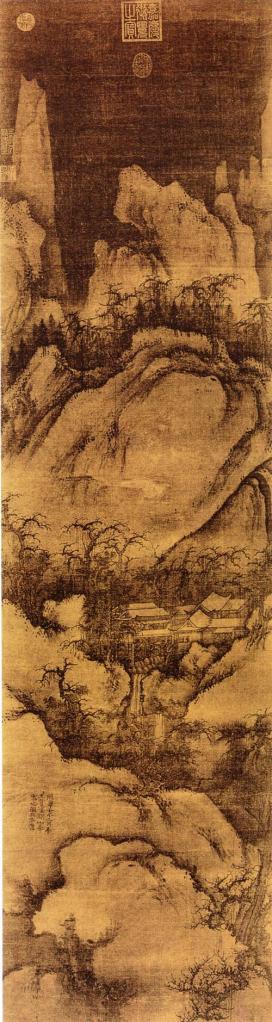
1_202716_1I would like to focus mainly on the role of space and time in this painting. We live in the confines of space and time. Our thoughts are mostly structured in terms of space and time. When we look at art, we look at it in a particular space and in a particular moment in time.

But when it comes to paintings, people often think of space as being two-dimensional, though sometimes creating a feel of it being three-dimensional. And unless an art-work takes on the form of a narrative, the concept of time does not seem to apply.

And yet, in Chinese landscape art, the artist tries to situate the viewer within space and time.

With reference to this particular painting, I would like to show how Chinese landscape art tries to create a sense of traversing a three-dimensional space, while simultaneously embodying the movement of time in a non-narrative still image. After which, I hope to be your guide, and bring you through this beautiful landscape, and at the same time to experience the progression of space and time in a painting like this. I hope that in the process, you may also be able to commune with nature and come face to face with the Tao (道).

Formal Properties

This painting, entitled, “Snow in the Early Spring at Guanshan” (關山春雪圖), is painted on silk, measuring 197.1cm by 51.2cm.

Notice how there is a cliff at the bottom. Kuo Hsi (郭熙) painted it to give the viewer the illusion of standing at the edge of a cliff to admire the scenery before him. Keeping in mind that this painting is about two metres tall, Kuo Hsi (郭熙) invites us, the viewer, to first situate ourselves there and to admire the rest of the painting with him.

Look away and now, look back at the picture again. What is the first thing that captures your attention? It will be the sky. Kuo Hsi (郭熙) cleverly painted it to contrast it from the rest of the snow-covered mountains.

This would be the first thing in which we have been invited to look at and contemplate (默觀 moguan). Its Chinese meaning is very deep. 默 (mo) refers to being silent and still. 觀 (guan) refers to studying, observing, and at the same time, refers to looking with one’s eyes. These two words come together to form a beautiful understanding of contemplation: To contemplate is to be still and silently study and observe the Tao (道).

Let us return to the painting. The darkness of the sky sets the mood for us. On a cloudy day, or even at night, if one were to be by himself in such a setting, one naturally gets a sense of the serenity. There is no else but me, and I am as such, led into a contemplative mood.

Notice how Kuo Hsi (郭熙) first gives us a sense of vastness by darkening the sky, so as to contrast the snow-covered mountains. Had the sky been the same colour as the mountains, the immense ridges would not stand out, nor would we be able to perceive the dark area at the top, and the area of white at the bottom. This creates the impression that what is before us is an immense space of sky and mountains. Despite the thin narrow frame of the artwork, what is before us is a landscape both far and wide.

Having thus admired the sky, we lower our gaze down to the tall mountain peaks that decorate the distant space (backdrop) of the scenery before us.

Notice how these peaks have been painted with smooth brush strokes, with angles that are not so sharp. The tension-free strokes of Kuo Hsi (郭熙), creates a calming effect. In the early Spring, where the snow has not yet melted away, all is but calm. Life has not sprung into its full bloom, and so the activity of nature has not reached its peak.

Let us now lower our gaze just a little. Notice how in the region just above the trees and the peaks (in the distant space), and the region between the trees above the houses and the presiding hill behind it, there is what seems to be a white mist.

This technique is known as “atmospheric perspective”. It is a method Kuo Hsi (郭熙) used to create the illusion of space and distance by depicting objects in progressively lighter tone as they recede into the depths. These areas of mists obscure the top of trees and increase the sense of height by masking the bases of these cliffs. Look very carefully at the painting and you would notice that the bases of the hills are absent. As such, we are left to imagine just how high up in the heavens we are, as we picture ourselves moving around in the landscape.

Let us lower our gaze once more, now focusing on the presiding hill that is crowned with the lush vegetation on its top, and just in front of it at the bottom, a hut, designed rather simplistically. Notice how the simplicity of the hut contrasts with the complexity of the lush vegetation that surrounds it, both around and above. And below the hut, we find a stream of water flowing down a small waterfall, into the murmuring river.

Notice how all these “activity” converges around the hut. Notice how this activity adds life to the still serenity of the entire painting. And notice how the hut contrasts with its surroundings by displaying a kind of stillness. This stillness dissipates the surrounding tension. Even in the midst of the serenity and activity of nature, Man is still quite capable of achieving that contemplative serenity within him. He remains a person unperturbed by his surrounding.

This hut is the only presence of human activity in the painting. This is significant on several levels. Human activity is depicted to draw the viewer to a new awareness of the relationship which one has with nature.

But what is this new awareness of the relationship about?

Just as how we find trees and rocks in nature, the hut is made up of trees and rocks (soil included). Earlier I spoke about how Man seeks communion with nature. Here, we see the hut surrounded by nature and its activity, and yet the hut does not stand out like a sore thumb. Here we see that Man is one with nature. Man complements nature, and is in turn, complemented by nature.

The Symbolic Meaning

So far, I have said very little about space and almost nothing about time. How then do these elements come into play?

As I had mentioned earlier, the purpose of Chinese landscape art is to invite the viewer to roam around freely in the landscape as a way of experiencing and communing with nature.

Let us begin traversing the painting.

As I mentioned earlier, when we first stand before this beautiful work of art, it is as if we are standing at the edge of a cliff, admiring the view before us. We begin our gaze of admiration from the top and move downwards, slowly, admiring every fine detail before us as a lover of nature would.

When our eyes have reached the hut, we re-position ourselves as if we are standing in the hut, peering out of the window to admire the vast scenery before us. Here and now, we are in the heart of nature, communing with nature as the elements converge into the middle space in which the hut occupies.

Eventually, we find a little walkway on the hill, towards the right, inviting us to leave the house and walk through that path. And so we walk. Notice that as you ascend that little hill, your gaze begins to rise higher and higher.

And so, slowly yet steadily, you ascend the path up the hill. And finally, you have reached the top of the presiding hill, on a sort of plateau, surrounded now by the lush greenery around you. And again, you pause to walk around and soak in the atmosphere, to soak in the beautiful scenery that stands before you, of the trees, of the mists separating you from the mountain peaks, and of the snow-covered mountain peaks.

No one else is with you. You are alone, but yet, you are not alone. Nature surrounds you and is your company and friend.

Now, look up. Admire those tall peaks that stand so solemnly as if deep in thought. Join them in their contemplation of nature. Raise your head a little higher now, and admire the rich blue sky. Peer into the heavens and, like a bird, let your gaze and your thoughts sore through the sky.

When you are done, you may now begin your slow descend of the hills and return back to the hut, and eventually back to the world.

Notice how, as I guided you through the landscape, you have experienced a sense of space and time?

Though the art work is still, notice how we have nonetheless moved through space by moving in and out, up and down the various portions of the landscape. Notice how we have also moved through time. Even though the painting is a still image, its individual parts come alive as we move through it, as if we were watching a video documentary of Guanshan Mountains. Or, better still, it is as if we had actually been there, walking in the midst of it, admiring its beautiful scenery, and communing with nature.

If you have tried your best to follow me on that journey, are you left in wonder? Are you amazed at its beauty? If so, are you able to express that beauty and wonder in words? Or does it fail you?

If words are not sufficient to express what you have experienced, you have come face to face with the Tao (道).

References

Fung Yu-Lan, A Short History of Chinese Philosophy (New York: Free Press, 1948), pp.16-29

George Rowley, Principles of Chinese Painting (New Jersey: Princeton University Press, 1959), 2nd ed, pp.3-22

James Cahill, Chinese Painting (New York: Rizzoli, 1985), pp.2-63

Nicole Vandier-Nicolas, Chinese Painting: An Expression of a Civilisation (New York: Rizzoli, 1983), Translated by Janet Seligman, pp.99-108.

“宋郭熙关山春雪图”, 百度百科, accessed 7 September 2010, http://baike.baidu.com/view/621756.htm

Learning (學 Xue)

xue

Wrote this today with a new calligraphy pen brush that I bought from Daiso (I just love this Japanese shop a lot!)

This is another favourite word of mine.

學 refers to learning/studying.

This word has a very beautiful etymology.

On the left and right of the top portion, is a pair of hands. But what are the hands holding? It’s holding this thing that is signified by the character, 爻, which refers to two things. (1) It refers to dried grass used for divination. (2) It also refers to the Book of Changes (an ancient book that records the changes in seasons and what should and shouldn’t be done). Both of which are associated with religious practices.

In the middle, is the character, 冖, which represents a table.

At the bottom, is the character, 子, which represents a person. But it is not just any person, but a child.

So, what we have is a child, holding the dried grass or Book of Changes, on top of a table.

What’s do all these mean?

Learning (學) is a religious act! St. Thomas Aquinas himself said that when learning takes place, the God’s light of Truth shines into one’s mind, raising the knowledge from potential knowledge to actual knowledge!

But learning not just about simply memorising what’s before you. One of my professors said that if learning is simply about memorising, there’s this thing in the world that does exactly the same task, but even better – a scanner!

Learning involves the study and contemplation of the subject, and being able to apply it in day-to-day life, just as how the ancient Chinese would closely study the Book of Changes (or the dried grass) and use it for the application of their daily life.

But why is a child (子) in the the word? It does not literally mean that learning is confined to children. In fact, the great masters of Chinese philosophy have the title, 子, after their names. E.g. Confucius (孔子), Mencius (孟子), Hsün Tsu (荀子), Lao Tzu (老子), Chuang Tzu (莊子) and more.

Learning requires us to be like little children, who with great inquisitiveness, seek out knowledge for itself, and be marvelled and wondered at the beauty of newly acquired knowledge. When was the last time you went “WOW!” at something that you just learnt? If it had been a long time back, perhaps it’s time to be like a little child once again, and marvel at the beauty of Truth.

A child is, more often than adults, open to what comes his way. As we grow older, we become more narrow minded. As such learning becomes harder as we tend to mis-interpret or simply brush aside things based on whatever biasness we may have developed.

The great masters of philosophy were open to the study of whatever came their way. They were open to see what the other side has to say, and if there was any merit to their arguments worth learning.

DIY Todo List Stand

I got inspired to make this todo list stand while browsing at Muji.

todolist

It occured to me that I could simply design a single page list and put it behind a piece of plastic, thereby making it reusable. I went to Daiso to buy a stand, and went back home to design and print the todo sheet. And viola!

It’s so cool! I’ll probably have to buy a thinner white-board marker though. The words are a bit too big for me to write much on it.

Once I figure out how to carve words in wood, I might take this project to the next level and carve the words “Todo” on it.

Contemplation

I just realised that the Chinese word for “contemplation” is 默觀 (moguan)

Though there are several phrases for the word, “contemplation”, in Chinese, this term stands out as the most meaningful one.

默 (mo) refers to being silent and still.

觀 (guan) refers to studying, observing, and at the same time, refers to looking with one’s eyes.

These two words come together to form a beautiful understanding of contemplation:

To contemplate is to be still and silently study and observe the Way, the Truth (and the Life), that is, the Tao (道).

In so doing, one comes to “see” (觀) the Truth with the eyes of one’s mind. This thus leads to a clear understanding (ming 明) of the Tao.

The Observatory


tumblr_l86j8toykf1qcp6ti

I visited The Observatory today with some friends. It’s located in the Singapore Science Centre.

I heard about this place almost one year ago, and at long last, I have finally made a trip down to see it.

It was simply amazing! I was told that it’s the largest telescope along the entire Equator! Theoretically, being along the Equator has its perks. One can see the constellations on both sides of the hemisphere every night!

However, there was one problem. Tonight’s sky was terribly cloudy, and so we weren’t able to see anything.

Nonetheless, the technician was kind enough to adjust the observatory roof to spin around, so that we can have a glimpse of the surrounding area. It was really awesome standing inside, watching the roof rotate very very slowly.

I’ll probably have to find the time to visit it again.

Being Human

The Chinese character for man (male and female) is 人 (ren)

In Chinese culture, ren (人) does not refer to the biological understanding of man. Rather, it refers to what a man ought to be – what makes a man a fully human person. One big difference between Western and Chinese philosophy is that in Western philosophy, the major question is “What is man?”, whereas in Chinese philosophy, the major question is “How to become one?” (为人)

And so, it is essential for a every single person to learn how to be a man (为人), so that he/she can become one (成人).

This is realised/fulfilled through his relations with others. Hence, the importance of ren (仁, also translated as humanity or benevolence). The etymology is quite simple. It just means two (二 er) persons (人 ren).

When two people can live in harmony with each other, only then can both fully realise what it means to be a man (二人为人 eren wei ren).

In Memoriam – Josephine Teo (RIP)

Of the many Catholics that I know, only a handful of people have lived such inspirational lives – so inspirational – that they have made a huge impact on me.

One such person is Josephine Teo.

I first got to know her about ten years ago through the Legion of Mary. What struck me about her was her devotion to the Legion.

Legion was not just any ministry that you would join and leave after some time: it was not some group where you would come in as and when you would. No, for her, Legion was her life.

Among all the Legionaries that I’ve known in my entire life, she was one of the few who knew the handbook – it’s rules, principles, and spirituality – almost inside out. And she lived them. She lived it so devotedly that her life was almost inseparable from it.

Even as a mother, and a full-time nurse, she had been so dedicated to the works of the Legion, going overseas to carry out missionary works, and works that I would term, “diplomatic relations”, with the Legionaries around the region. The amount of time and effort that she gave to the Legion was so much, one would have thought that she was single and/or working part-time. I was very surprised when I found out much much later that she had a daughter (maybe more? Am not sure) and was working as a nurse.

Truly, she gave her all.

What also impressed me is that she was a great planner and leader. She handled large-scale events so well: in leading, planning, and executing. So professionally was it done, it just leaves me with awe and respect. She did all that despite work and family commitments.

Amazing.

More amazing would be that despite her battle with cancer, she still continued to be very active in her services in the Legion, doing everything well, as always, and making sure that everything was going smoothly.

I suppose this was her remarkable sign of holiness. People mistake holiness to mean doing holy things (and being very dull and boring). Rather, holiness is in being disciplined and regular, especially in doing the small things. Indeed, she took up many big projects. But those big projects would not have been a success had she not, in the first place, been successful in keeping faithful to doing the small little tasks well. In fact, for her to be able to copy with family, work, and her duties in the Legion is indeed a sign of the effects of supernatural graces at work. Did she possess a great love for God? Presumably so (I can’t say definitely since I don’t know her that well) from all that commitment and dedication made towards serving the Church through the Legion.

If there’s one thing the Church needs most, it’s people like Josephine, to constantly inspire others with her love, faithfulness, dedication, and holiness. To be like Our Blessed Mother, in saying, “Let it be done according to Thy word”, with such great faith and love, that enables the Holy Spirit to work with and through her in all that she does.

The usual mantra of today is that we have no time to do great things for God. And yet Josephine has shown in her entire lifetime, that despite family and work commitments, she was able to do so much for the salvation of souls.

We need more people like her to give testimony by the example of their lives. To show to other Catholics that such dedication is possible. That agreeing to co-operate with God’s Divine Will, allows Him to perform the supernatural through ordinary natural hands. We need more people like her to inspire more people to live good Catholic lives.

She had indeed been a source of great inspiration for me. And I pray that many more will come to be a source of inspiration to others.

Well done, good and faithful servant. Enter into the joy of your master!
(Matthew 25:21)

Requiem aeternam dona ei, Domine.
Et lux perpetua luceat ei.
Requiescat in pace. Amen.