2014 Year-End Review (Part 1) – A Gap Year of Exploration

Wow… Time really flies, perhaps faster than ever before. It’s hard to believe that a year has passed because I still have very vivid memories of all the events that happened in the past year (and even further back in time).

I’ll have to say that the year 2014 has been the most challenging year ever. Yet, despite all these challenges and occasional set-backs, I feel like I’ve grown a lot, and gained a lot of insights. And to top that off, I’ve met a lot of profoundly inspiring and amazing people, many of whom have restored my faith in humanity, and given me new lenses with which to see the world.

It’s amazing!

In order to make sense of 2014, I really should talk about it in the context of 2013, only because 2013 was the year that I made a few major decisions on what to do with my life, and it’s only in 2014 that many of these decisions began to unfold in interesting ways.

(I realised, having written so much, that it would be unrealistic to cram all my year-end reviews in a single post. So I’ll split it into several parts. Here’s Part 1…)


A Gap Year of Exploration

At the end of my undergraduate life, I decided to take a gap year from study, so that I could take a step back to explore my options and discover what I might want to do with my life.

I was quite burnt out in my final year of university, to the extent that I didn’t want to go through the ordeal of writing papers night after night. It seems that the experience was so bad that it has developed in me, a small yet powerful dread of writing, to the extent that I don’t enjoy writing very much. In the past, I could just sit in front of the keyboard and words would flow from my mind through my fingers onto the screen. But now, I’m always confronted with a dread and a kind of mental block. Words don’t flow so easily, and it takes me some time to settle down and calm my mind to overcome that psychological obstacle.

Much as I love academic philosophy, I always had this nagging feeling that I might not want to pursue this, or at least not in the way that I encountered it in my undergraduate life. I love the learning, I love reading, I love the process of growth, but I just do not enjoy the painful process of writing academic papers. (But as I slowly come to realise: three positives versus one negative, maybe that’s not too bad? There is no career that is 100% enjoyable, is there? Well, that’s something I still need to discover for myself)

So, instead of plunging myself into graduate school like many of my peers. I figured it would be better to try other things. But I had a lot of reluctance because I couldn’t seem to find a first job that really interested me. Moreover, I was quite afraid that I’d end up doing mindless, meaningless tasks, no more than a cog in the machine.

That all changed one day when I met a professor for lunch one day. (Some introduction to the professor:) This was Prof. Lo Yuet Keung from the NUS Chinese Department. I never thought I would sit in for a class taught in Mandarin, but I did back when I was in my first year (2009). It was the only Chinese philo module that was offered at that time. Though I didn’t understand Chinese very well, I was blown-away by what I could understand. But most of all, Prof. Lo made a very deep and profound impression on me. He was the first person I encountered whom you could call a junzi (君子 gentleman). I looked at him and told myself: this is the type of awesome person I’d like to be. I wanted to study Chinese philosophy the way he did, to be transformed by the wisdom of the ancient philosophers, as he was.

Anyway, many years later, I was very touched to find out from a friend that Prof. Lo remembers me (even though I never interacted with him during or after class in any of his modules). So I decided to drop him an e-mail, asking if it were possible to have lunch. And we did. It was by far, the most life-changing lunch appointment ever. I shared with him my hesitations on applying for a job, and told him that maybe I should take up a course or some certification class. In reply, he said something that changed my reality for the better:

Prof. Lo said: “Why bother paying money to learn a skill, when you can be paid to learn?” He went on to elaborate that I should perceive each and every job as a course in itself. Lessons and insights to acquire every step of the way (and you get paid as well – a double bonus!).

That changed the way I looked at the world, and it helped me with my search. With great confidence, I set out to apply. I eventually landed with a job at an electronics company, handling both the marketing of electronics and training the people who used it. It was a lot of fun.

Half a year later, I got a call from Nanyang Technological University (NTU). They heard that I was looking for a research-related job, and they offered me a position to co-develop a course on Chinese philosophy with the Dean of the College, who was also quite a big name in the field of Chinese philosophy. It was an opportunity too good to miss. And I figured this would be ideal, as it might help me to decide whether or not I should pursue academia as a career.

I said yes, and it was by far the best decision of my life.

It’s been 10 months since I joined NTU. There’s been many challenges and difficult moments. But every step of the way has been meaningful, and it’s been great.

The greatest highlight of my time in NTU was to be involved in a project exploring ways to overcome the East-West barrier, how Chinese philosophy might help to enrich complexity thinking in the sciences (and social sciences), and how the two might just be related to each other. As part of this project, we organised two surveying workshops and invited several prominent researchers, directors of research institutes, and top public servants from around the world. It was amazing sitting in the midst of great and brilliant people.

This very experience gave me two very deep and profound realisations: (1) Firstly, it made me realise that my training in academic philosophy was insufficient in enabling me to comment on policy issues or matters of current affairs. I could listen and critique the ideas of others, but I’ve been unable to formulate anything positive on my part. This has been important to me as I’ve always aspired to be a public intellectual, using my philosophical skills to comment or critique pressing issues of society, or provide ideas, solutions or insights into certain matters. I always felt a sense of this inability, and in some ways, I’ve struggled with trying to write about such matters. But it was during those discussions that this inability became strongly apparent. Here I was, struggling with my training, knowledge, skills, and insights, yet what could I say? I could only speak theoretically (and naively even) about ideals, and I was unable to translate or connect it back to real events or issues. It was a challenge.

(2) Secondly, I came to the realisation that when you study philosophy along with several other disciplines, you will gain very interesting insights that you would not have acquired simply from the study of philosophy alone, or even from a mere interdisciplinary study of philosophy with one other discipline. No, it’s not just about one or two disciplines coming together. It is about bringing several disciplines together like a complete package (e.g. studying these disciplines together at the same time on a particular issue: philosophy, economics, politics, sociology, history). It is through this approach, that one could see certain issues very differently.

These two insights have changed my priorities and objectives. While I would still like to pursue a PhD in Philosophy, I would nonetheless like to branch out and study something else, maybe related to philosophy, but also related to other disciplines, as a good stepping stone in enabling me to address the two realisations above. I’m applying now for a Masters programme. But I’ll say more later once I’m done writing the proposal. What I can say now is that I’m going to take a rather unconventional route, but it seems that this choice will open more doors for me, and lead me to far greater growth.

With 2014 coming to an end, I realised I exceeded the time frame I gave myself when I took the gap year. I expected myself to have started graduate studies by now, or at least to move on to begin building my career.

For a while, I felt rather guilty, but recently, a very brilliant person commented that we all have cycles of activity and cycles of recuperation. Rather than to be worried about not being in the active cycle, I should instead focus (and not feel guilty) about my recuperation period, to recover and prepare myself intellectually, psychologically, and emotionally for all the great challenges and obstacles that will come my way once I begin graduate studies.

There should always be progress, but progress is to be made in the context of cycles of activity and recuperation. When such cycles are disrupted in the name of “progress”, it is not progress but haste. And it is in haste that we lose all insights and direction, and it is because of haste that we tire easily and burn ourselves much sooner than we expect.

In that case, I look forward to prepare myself slowly yet steadily for the changes to come next year.

With a new year starting, I think I now have a sense of what I’d like to pursue, at least over the next few years. In so many ways, I’m glad I didn’t simply rush into graduate school. I wouldn’t have had so many opportunities and life-changing insights. In 2013, I struggled so much trying to find some solution as to what to do next with my life, and thankfully, in 2014, I think I found the answer.

It has been a good year.

A hot cup of toffee nut latte on a cold rainy day

I love how Christmas is coming. Every year Starbucks will offer its special Christmas brew. I look forward to it every year.

A cup of toffee nut latte with its fragrant smell and taste brings me so much happiness. And especially on a cold rainy day, this drink is the perfect beverage to compliment the lovely chilly weather. MMMmmm…

I’ll be honest and say that I don’t particularly like the drink so much anymore now. I guess as one grows with age, one outgrows one’s liking for sweet drinks.

So why do I still drink it? Mainly, for the nostalgia, but also as an annual reminder for what it now represents.

This was the drink that has accompanied me for so many cold and rainy nights back in my undergraduate days, where at the end of the semester (well, at the end of every Semester 1) I’d spend several, almost-consecutive nights in a row, working overnight on campus to write papers after papers, until the sun rose at about 6+am (no kidding!).

It was the drink that in many ways, stayed beside me, sitting with me, keeping me up, keeping me going. The fact that it was a seasonal brew made it all the more special. It also, in a way, gave me something to look forward to at the time when assignments are aplenty, and where stress is high.

Now that I have graduated and don’t need undergo such academic toiling, this drink brings me lovely memories of the those times where I stayed up to write papers. While in some ways, I hated the experience, I still loved it for the kind of peace and quiet that I enjoyed. There’s something really wonderful about sitting in a dim room in the middle of the night, with a small desk lamp over your head, with another one or two other students working in the study room. Maybe it’s the combination of the lack of sleep, stress and the caffeine, but the experience of solitude as you think and write is magical… But I digress.

More significantly, this drink stands as a symbol of the silent companion who stands by your side, cheering you, giving you (mental) strength to keep going, to keep thinking, to keep writing. That you’re never alone even as you’re writing at 4am in the middle of the night, where everyone else is asleep.

That companion, who transforms and gives new meaning and understanding to the experience of the toil and suffering of work; transforming toil into toil-AND-pleasure, adding an element of joy – sips of joy full of flavour, stimulating your senses as if setting off a series of fireworks in your mind – with every small sip I took, as I wrote my papers with frustration.

Toil transformed into toil-and-pleasure.

It is a hopeful drink. It serves as a reminder of those moments, and how I overcame those moments year after year till graduation, with this simple seasonal drink.

To drink it once again, today, on a cold rainy day in December. A timely reminder. A comforting thought. A heartening sip.

The Consummation and End of My Undergraduate Life (and What is to Come)

I’ve finally graduated!

After four exhausting years of toil, of literally blood (having gone to the hospital thrice and getting needles injected all over my body), sweat, and coffee, I’ve survived university and graduated!

Well, as some of you know, I’ve been pretty busy  finishing my Honours Thesis in my last and final semester.

My thesis was entitled, “Notions of Harmony in Classical Chinese Thought.” In it, I set out to investigate and reconstruct all the various notions of harmony that could be found in the Analects, Mozi, Daodejing, Mencius, Zhuangzi, and the Xunzi. The problem with much of the scholarship on harmony is that scholars have often assumed harmony to be more or less the same idea across thinkers throughout Chinese history. My project was to demonstrate that this is not so. (If you are interested in reading it, please leave me a comment, and I’ll e-mail it to you!)

The final week before the Thesis submission deadline was extremely stressful as I was up almost every night until 3-4am trying my best to edit and polish up the paper.

Friday, 26 April 2013 was the thesis submission deadline and thankfully, I managed to finish my thesis by then.

That day was, for me, a very momentous occasion – it was the big day where after one entire year of researching and writing, the time has finally come for the paper to be printed and submitted! Wow… You know, I never thought it would ever have been possible to write such a lengthy paper. My thesis was approximately 12000 words, and it consisted of 42 pages! That’s right! 42! The number, the answer to life, the universe, and everything!

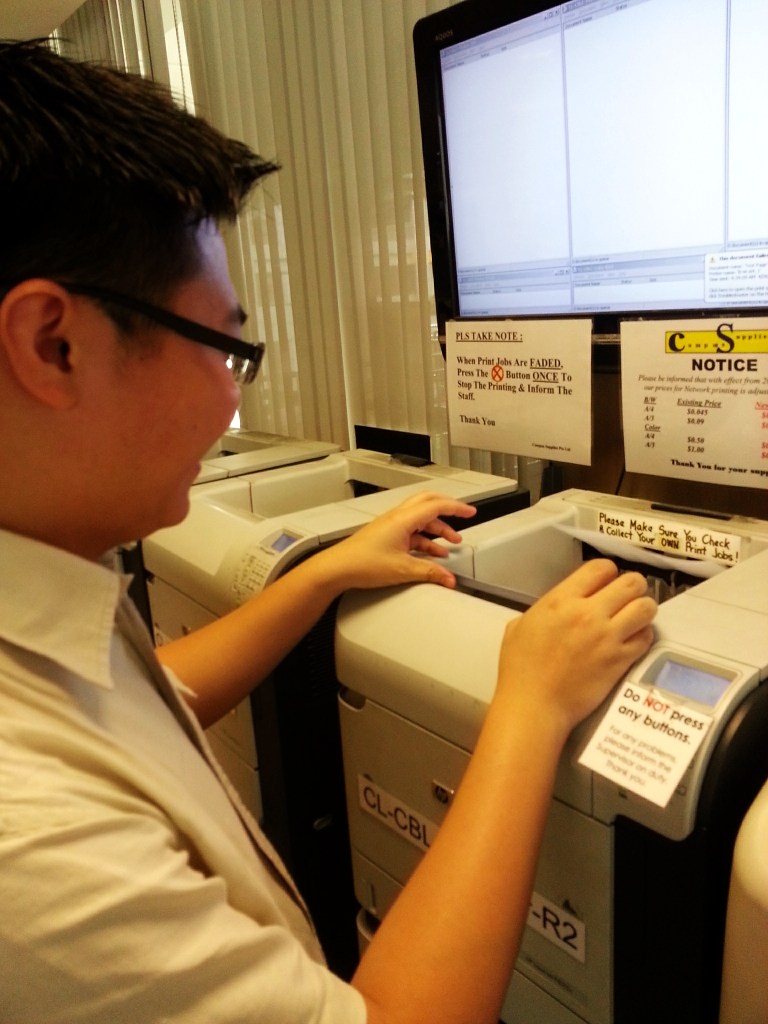
Somehow, the entire day felt like a momentous victory! I met a friend at the library who was more than happy to help me photograph the momentous occasion while I printed my thesis:

Waiting anxiously for my thesis to be printed - all 41 pages of it!
Waiting anxiously for my thesis to be printed – all 41 pages of it!


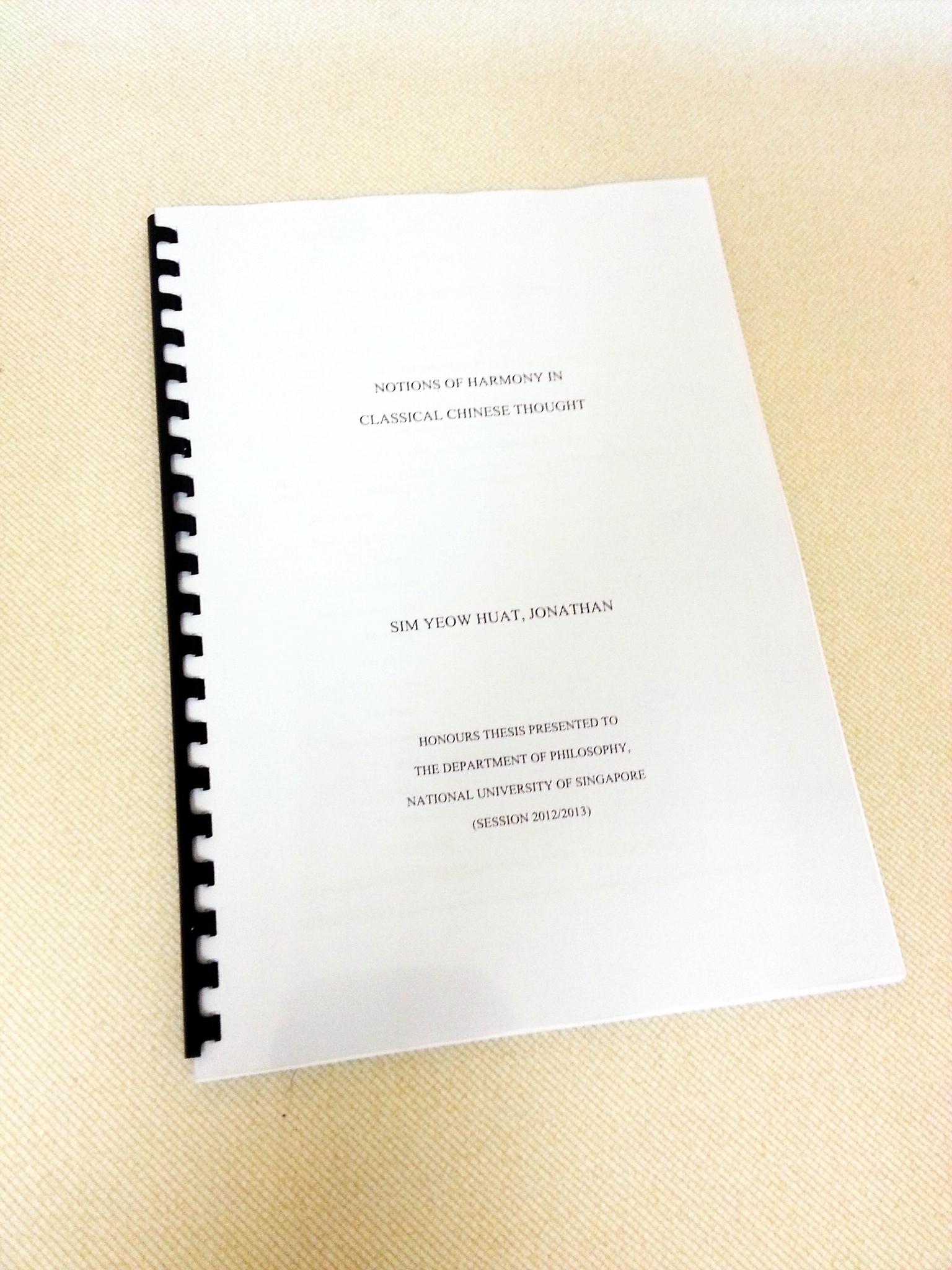
Proudly displaying the printed thesis! Notice the disheveled hair from the many overnight editing/writing marathons.


The finished product: complete with binding!

The finished product: complete with binding!


It was somewhat unfortunate that I didn’t have the time to bind my paper into a hardcover book (which was the tradition for submitting theses). Oh well, I didn’t have the luxury of time to do it. But that’s ok. Hardcover isn’t a submission requirement.

With the Honours Thesis out of the way, I felt a huge burden lifted from my shoulders.

But I could not heave a sigh of relief yet as I still had exams to study and sit for. And so, after a day of rest, it was back to the books.

Unfortunately, the exams didn’t end on a very happy note. My last exam was an engineering module (for the life of me, I still don’t understand why on earth did I decide to do an engineering module). It wasn’t an introductory module either (I really have no idea why I put myself through such pains). Anyway, it was the last exam of my undergraduate life, but the paper was so difficult, I was faced with a very real possibility of failing the paper. I counted the marks of the questions where I think I would have gotten right, and I only had just enough to pass. If bell-curve moderation was not in my favour, there was the very very real possibility that I would have failed this paper, and worse of all, I would have to repeat a semester. Gosh… It was a very horrible feeling to have while walking out of the exam hall.

But no matter. A few days after that traumatic experience of the final exam, I was out of the country for a holiday to Penang (I’ll write more about it later). Then it was off to Kuala Lumpur to run some errands and enjoy a bit of holiday by the side. The Girlfriend’s grandmother came down to Singapore some time back and discovered the wonders of the Internet, specifically YouTube, and she wanted to have this amazing Internet in her home. So I volunteered to go down to KL and help buy and set up a computer and an Internet connection. And after Kuala Lumpur, I was off to Bangkok. These three places were amazing in their own way, and I think I’ve grown and learnt a lot while I was there. (But I’ll keep all those thoughts for another blog entry here).

Let me just fast forward by about 2 months to the last seven days leading up to my graduation ceremony.

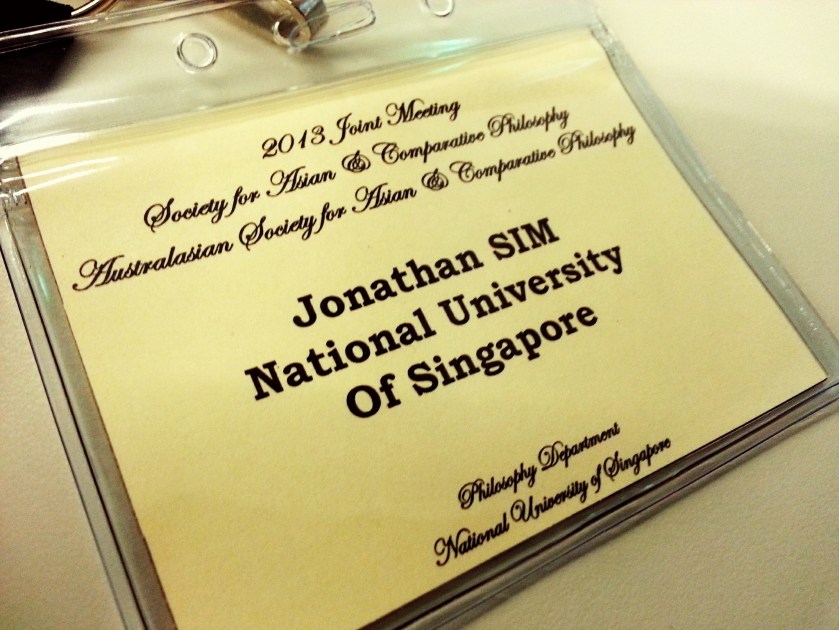
Gosh… It was quite an exciting week! I was given the opportunity to present a section of my Honours Thesis at an international philosophy conference. It was the 2013 Joint Meeting of the Society of Asian Comparative Philosophy (SACP) and the Australasia Society of Asian Comparative Philosophy (ASACP).

Name tag for the conference. It's such an honour and privilege for an undergraduate/fresh graduate like me to be present wearing this name tag amidst a crowd of about a hundred professors and PhD students all over the world, and to present a paper just like them!
Name tag for the conference. It’s such an honour and privilege for an undergraduate/fresh graduate like me to be present wearing this name tag amidst a crowd of about a hundred professors and PhD students all over the world, and to present a paper just like them!


Not only was I busy helping out with some of the logistic matters, I was also rushing to edit and present my paper for the event. It had been two months since I last wrote papers. It felt good to be writing a paper once again. I had a cup of coffee by my side, soft piano music playing in the background, and I was all ready to write my paper all the way into the midst of the night. So for three consecutive nights, there I was sitting before my computer, typing away until 3am. It was tiring, but it felt so good to be engaging in this paper writing ritual. There’s something so comforting and wonderful about the experience.

Monday, 8 July 2013. At last, it was the day of the Conference. I had to present my paper on the first day, in the afternoon before many academics, some of whom were really really BIG names in the area of Chinese Philosophy. It was intimidating, but nonetheless, a huge honour!

The paper I presented was entitled, “Reconciling Culinary and Musical Models in Classical Chinese Thought.” There’s been some sort of academic debate where there is disagreement as to whether the culinary and musical models of harmony have merged into a single unified notion or remain as two separate models in classical Chinese thought. In my paper, I attempted to present a new way of looking at the relation of the two models and how they can be reconciled together into a single theory despite remaining as two separate yet distinct models.

Did you notice the Dao (道) on my laptop? It's a MacBook Air. I took a piece of card and cut out the Chinese character and pasted it over the Apple logo. It's perfect for a Chinese philosophy conference!
Did you notice the Dao (道) on my laptop? It’s a MacBook Air. I took a piece of card and cut out the Chinese character and pasted it over the Apple logo. It’s perfect for a Chinese philosophy conference!


The cup of coffee on the left was meant to keep me going throughout my paper presentation. I was running on only three hours of sleep.


It turns out that my paper presentation was a huge success! Everybody present enjoyed it and they found the contents very interesting!

The biggest WOW experienced I had was during another panel’s Q&A session. One professor (Prof. Alan K. L. Chan), who is quite a big name in Chinese philosophy replied my question saying that he actually had read my Honours Thesis during his flight to Singapore, and he found it (to quote him), “an enjoyable read” and that it “was very interesting.” Immediately after that, the people sitting on my left and right turned to me asking if I could send my thesis to them.

WOW! If writing an Honours Thesis is meant to make one feel honoured, I think it’s working! I felt so honoured at that moment. Wow…

Anyway, the conference was really amazing. I had the chance to meet so many amazing people. It was also pretty amazing to finally see the faces of people whose books and papers I’ve read and cited in my papers. To be standing amongst the greats in Chinese philosophy from around the world… Woah… All I can say is that it was very inspiring and really awesome to see a bunch of people who are just so passionate about what they’re doing. It was lovely.

The conference went on for three whole days! On the fourth day, Thursday, 11 July 2013, it was finally the day of my graduation ceremony!

Four years of hard work has finally led up to this epic moment:

Notice the Chinese calligraphy necktie?


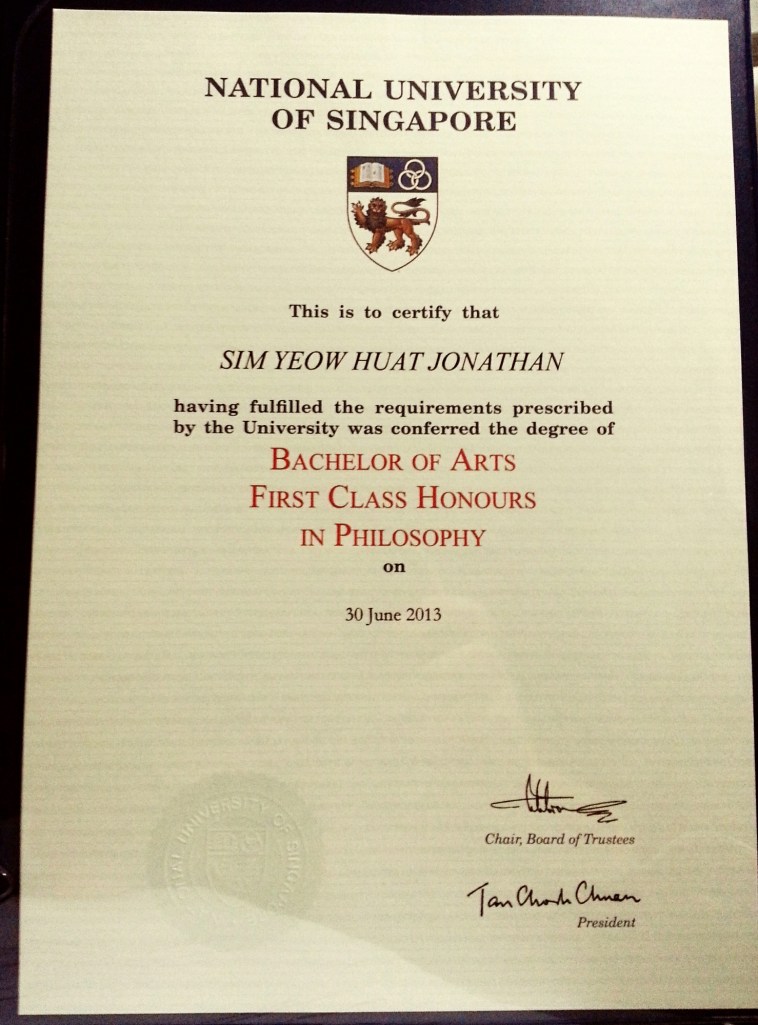
Let me now present you with the fruit of my labour – the fruit that took four years of coffee, blood and sweat (no tears thankfully):

OMG!!! First Class Honours!!! I never thought that this day would have been possible!


You know, it’s crazy… Ever since my first year in university, I never thought that it would be possible for me – a person who came from the science stream and who initially majored in Computer Engineering – to be able to get this.

But with lots of hard work and the encouragement and support from The Girlfriend, the wonderful professors in the NUS Philosophy Department, and all my other friends both online and offline, I was able to endure and persevere all the way till the end.

So what’s next? Well, if you asked me this question two months ago, I would have only been able to shrug my shoulders and sheepishly reply, “I don’t know.”

But since last month, I’ve slowly come to realise that my true calling is in academia, and especially in (Chinese) Philosophy. In the past months, I’ve been looking through job ads after job ads, and I was never really interested in what was on offer. The greatest tragedy perhaps, was the constant thought of never having to pursue philosophy once again. Every time I contemplated that thought, a part of me dies. It was painful.

It was only at a recent farewell party for a professor that I realised that I should do whatever I can to pursue philosophy. There and then, we were having a fantastic time discussing philosophical issues. My heart was on fire once again after quite a period of dreaded boredom. The pursuit of wisdom has left me thirsting yet for more.

The pursuit of philosophy is an arduous process. It is mentally and even physically exhausting staying up late just to research, think, and write. But it is a process that I value so greatly. These four years of my philosophical pursuits have transformed me in many wonderful ways. And I wish to continue to be transformed, and shaped by the pursuit of wisdom, just as how it has transformed and shaped the professors in the Philosophy Department here in NUS. I’ve interacted with many of them, and all I can say is that I feel like I’ve been interacting with wise exemplary sages.

I want to be as wise and awe-inspiring as they are, and continue to pass on this most splendid and awesome tradition.

But in the mean time, I’ll take a year’s break from study to work. I intend to focus on publishing at least one paper in an academic journal. That would help me get a better chance of securing full funding for a PhD scholarship. And by next year, I shall be off to some other country to pursue my studies in Chinese Philosophy.

It looks like I have a really exciting life waiting for me in the years to come. I look forward to that as I take life one step at a time.

Impending Deadline

I’ve not been updating this blog for a while. I’ve been quite busy writing my Honours dissertation.

I’m just happy to say that it’s almost done. All it needs is several rounds of editing before I can declare it as the greatest accomplishment of my life.

Anyway, there’s four days left before the submission deadline. I hope to get over and done with this as soon as possible because I still have exams to study for.

Here are the books that are currently stacked up next to me:

This is only half of my final bibliography. The rest of the books are in the library. I don’t drive, so it’s very difficult to carry huge heaps of books in my bag pack.

The dissertation is currently 45 pages long. My current word count is 13,147 words. I need to keep everything below 12,000 words. That’s the word limit. It’s a strict limit, so I don’t have the luxury of exceeding it a little. I’ll need to find some ways to shave off those excess words without affecting the presentation of the paper.

Yup! That’s how life has been thus far. I’m crossing my fingers, hoping that I can finish this by tonight.

Wish me luck!

Research, research, research…

The second week of school has just ended, but it has already been quite an intensive week for me.

I’ll be officially starting on my honours thesis next semester. However, my supervising professor will be away for a while during that time, and it would be quite inconvenient to attempt a thesis under such conditions. So, I figured it’s better that I begin my research now while the hell of assignments hasn’t yet been unleashed onto me. I hope to finish as much research now, so that I have the luxury of time to write and do more stuff when I begin my thesis officially.

This was how my table at the library looked over the past few days:

img_3508

Yes, your eyes do not deceive you. One of these books has Chinese words! I’m researching on an ancient Chinese text known as the Chung-yung (中庸, famously known as the “Doctrine of the Mean” or more accurately as “The State of Equilibrium and Harmony”). It’s written in classical Chinese.

What I’ve been doing the past week, was simply reading through the entire book in its original text, and comparing the various translations that I could get my hands on. Classical Chinese is a unique language in that it has a lot of ambiguities (it’s a unique feature of the language that allows the author to do a lot of amazing things, e.g. embed several different meanings onto the one same phrase). The problem with translations is that authors will have their own subjective biases, which affect the interpretation and thus, the translation of the text. In each translation, you’ll have different things missing while the translator focuses on one interpretive key. Hence, the importance of comparing translations along with the original text.

I’m glad I’ve made quite an effort over the holidays to work on my Chinese. I used to fail Chinese (or just barely pass it) back in secondary school and junior college. Now – I’m quite surprised at myself – I am able to read the entire text in Classical Chinese. That’s quite a marked improvement.

Well, with the week over, I’m more or less done with one little portion of research. Reading the original text and its translations is just the first step. More books and journals to read in the coming days. I expect my usual table at the library to be stacked with even more books.

READ ALL THE BOOKS!!!

The Consistency of the Life of Contemplation with the Rest of the “Nicomachean Ethics” and its Usefulness in Morality

This paper was written for my philosophy module on Aristotle. It concerns my favourite activity – contemplation. I hope that you will find this paper enriching.

Aristotle argues that the life of contemplation is more excellent than the life of political excellence. Yet, in doing so, he appears to be inconsistent with the rest of the Nicomachean Ethics. In this paper, I argue that this apparent inconsistency arises because of interpretative issues related to the meaning of happiness (eudaimonia). Aristotle maintains an ambiguity over the term “happiness” so as to preserve two notions of the word: (1) happiness as living well, and (2) happiness as acting well. The apparent inconsistency comes about when these two notions of happiness are collapsed into one.

In Section I, I will summarise Aristotle’s argument in favour of the contemplative life over the political life. In Section II, I will then elaborate on the dual notions of happiness which Aristotle uses, and, in Section III, demonstrate how the use of only a single notion will result in inconsistencies. Using the dual notions of happiness, I shall then clarify what Aristotle meant in his discussion of contemplation, by highlighting a distinction between the contemplative life and contemplative activity, in Section IV. Last but not least, in Section V, I shall then anticipate an objection against the consistency of contemplation with the rest of the Nicomachean Ethics, on the grounds that contemplation has nothing to do with morality, and respond to it by showing that contemplation is useful to morality, thereby maintaining its consistency. This will be done by showing how contemplation enriches the life of the contemplative person in a way useful to morality, and that it can lead the individual to right action.

I. The Excellence of the Life of Contemplation

It is necessary to first understand the reasons why Aristotle argues that the life of contemplation is more excellent than the life of political excellence.
Aristotle defines happiness as consisting in (1) “action conformable to virtue, and if there are a number of virtues, action conformable to the best and most perfect of them.” [1] As the end of all human actions, happiness is (2) the “perfect self-sufficient good” [2], that is (3) “always desirable for itself and never for anything beyond itself.” [3]

Contemplation fits this definition perfectly as it is (1) “the highest operation, since the intellect is the best element in us and the objects of the intellect are the best of the things that can be known.” [4] It is also (2) self-sufficient as the contemplative man can contemplate by himself [5], since contemplation requires no external goods for its practice. On the other hand, external goods are needed for the life of political excellence for such a man will need them for the exercise of morally virtuous activity. Contemplation is also (3) desired for its own sake since “nothing is produced by it apart from the act of contemplation”, while practical activities (which pertain primarily to the life of political excellence) are pursued instrumentally for something apart from the action itself [6]. Furthermore, contemplation is the perfect activity as it is also the most continuous activity for “we can contemplate truth more continuously than we can carry on any other activity.” [7]

It is for these reasons that Aristotle considers the life of contemplation the happiest life, while the life of political excellence is “happy only in a secondary degree.” [8]

II. The Dual Notions of Happiness (Eudaimonia)

Throughout the Nicomachean Ethics, Aristotle switches between two notions of happiness as (1) living well and (2) acting well. Though they may be the “popular sense of happiness” [9] as understood by the “common people and the educated” [10], these two notions of happiness are nonetheless closely related to each other since “happiness as living well is characterised by acting well.” [11]

Happiness, according to Aristotle, is “the activity of the soul according to reason” [12], which is to say that happiness consists in acting well. Yet, it is interesting that Aristotle arrives at this conclusion even though he sets out at the beginning to investigate happiness as the best life to live (living well). Aristotle did not forget about happiness as living well. In fact, his investigation of happiness from living well to acting well was meant to show that happiness (in the form of living well) consists in virtuous activities [13]. And so, a well-performed activity according to reason (virtuous activity) is not just an ingredient for happiness (as living well), but also happiness itself (as acting well).

III. The Inconsistencies that Result from using a Single Notion of Happiness

Unfortunately, Aristotle fails to explicitly spell out these two notions of happiness [14]. As such, confusion arises especially with regards to his discussion on the life of contemplation, as most people would read it understanding happiness as either living well only or acting well only. In this section, I will show how using only one of the two notions will result in consistencies with the rest of the Nicomachean Ethics, when used to interpret a portion of the discussion on contemplation:

Contemplation seems to have self-sufficiency, leisureliness, freedom from labour (as far as humanly possible), and all other activities usually assigned to the happy man. Therefore, man’s perfect happiness will consist in this activity of the intellect, is a long span of life be added (as nothing belonging to happiness should be incomplete). Such a life is higher than the human level; and it is not lived by man according to the human mode but according to something divine in him. [15]

If one were to interpret this passage using the notion of happiness as living well only, the inconsistency arises as it seems that since the life of contemplation is so self-sufficient, there is no need for practical wisdom and the moral virtues, external goods, and even friendship. Such a life is so self-sufficient that a well-lived life of happiness can simply be attained by engaging only in contemplation. This seems to be inconsistent with so many portions of the Nicomachean Ethics, namely the areas that deal with practical wisdom, the moral virtues, external goods, and even friendship. This interpretation, therefore, leaves many protesting that this life of contemplation is a life that “humans cannot live” [16].

Or if one were to interpret this passage using the notion of happiness as acting well only, the inconsistency arises as such a reading seems to suggest that contemplation is the best and most perfect activity of the soul, such that all other activities (especially morally virtuous activities) need not be pursued. If happiness consists of only acting well, then one can be happy simply by engaging in only contemplation. Were this really the case, the earlier books of the Nicomachean Ethics can be forgotten since one does not need to cultivate moral virtues within him.

IV. Clarifications on the Contemplative Life and Contemplative Activity

The problems of inconsistency do not arise if one was aware of the dual notions of happiness employed by Aristotle. In fact, he makes a distinction between the contemplative life and contemplative activity:

For action, many things are required and the more so the greater and nobler the deeds are; but for the activity of the contemplative man, nothing of the kind is needed. In fact, it can be said that external goods are obstacles to contemplation. But the contemplative person, insofar as he is man and lives with others chooses to perform virtuous acts. Hence he will need external goods to live a human life. [17]

In describing contemplation as having “self-sufficiency, leisureliness, freedom from labour, and all other activities usually assigned to the happy man” [18], Aristotle meant to describe contemplative activity as the best activity that any human person can pursue. As mentioned in Section II, virtuous activity is not just an ingredient for happiness (as living well), but also happiness itself (as acting well). Likewise, contemplative activity is not just an ingredient for happiness (as living well), but it is also happiness itself (as acting well). Though the activity of contemplation is central to the contemplative life, the contemplative life does not consist in contemplative activity alone. While contemplation is the best activity, it cannot be the only activity of a human life. Aristotle recognised that it is not possible to live a life which consists solely in contemplation. Anaxagoras and Thales are cited as examples of people who sought to do nothing but engage in contemplation, but they are criticised for their lack of practical wisdom because they did not “seek human goods” [19].

Therefore, the person who wishes to embrace the contemplative life must not only seek to act well by engaging in the highest activity of contemplation, he must not forget the other aspect of happiness, which is the notion of living well. As it was mentioned earlier, happiness (as living well) consists in virtuous activities (contemplation being the best amongst them) and external goods. Since happiness (living well) is an end “altogether perfect in every respect” [20], insofar as the contemplative person is a human being and lives with others [21]; he cannot neglect his biological needs nor neglect his nature as a social animal [22]. As such, he must not be lacking in virtue nor must he be lacking in the external goods necessary for his survival and for the exercise of virtue. The contemplative person will also need friends as “what is desirable for the happy man, he must have, or else he will be in want” [23]. Since happiness is an end perfect in every respect, the contemplative person must not be left in want, or he will not be fully happy.

It has thus been demonstrated that a correct reading of the discussion on contemplation will reveal that there is no inconsistency with the rest of the Nicomachean Ethics.

V. Objection and Response

However, one way in which the discussion of contemplation seems to be inconsistent with the rest of the Nicomachean Ethics is that contemplation does not seem relevant to morality at all. Many contemporary virtue ethicists “embrace Aristotle’s theory of moral virtue and practical wisdom”, but they do “not judge the theory of contemplation well.” [24] Because of this, contemplation is left out of their moral theories.

Contemplation is an “activity in accordance with theoretical wisdom (sophia)” [25], which involves science (episteme) which is the theoretical knowledge of unchanging demonstrable principles [26]; and rational intuition (nous) which is the knowledge of undemonstrable first principles [27]. Practical wisdom (phronesis), on the other hand, deals with “human goods which we deliberate”, as it considers universals and knows particulars (since action is concerned with particulars) [28]. Matters of morality are particular matters which are dealt with by practical wisdom. As such, it appears that contemplation has nothing to do with matters of morality, and is thus inconsistent with the rest of the Nicomachean Ethics.

Nevertheless, Rorty argues that since wisdom is able to contemplate “the unchanging form of what does change” [29], wisdom should be able to contemplate on “humanity and its proper ends” [30] since it is “a pattern of temporal life” which “can be comprehended in one timeless whole” [31], so as to come to a deeper knowledge of “our general ends” which “are the actualisation and exercise of the basic activities that define us.” [32]

Rorty speaks of the prudent man (phronimos) who “knows what to do and how to do it” as he has an “implicit knowledge of human ends” [33]. The prudent man possesses practical wisdom which is able to “grasp the general ends of actions” [34], and therefore “virtue and knowledge are fused” within him [35]. But he “does not necessarily know why his virtues are virtues” [36], since he lacks the theoretical wisdom to understand the purpose and meaning of his actions in the grand scheme of human life.

When Aristotle argued that theoretical wisdom is not applicable to practical matters [37], his intention was to resist its assimilation into practical wisdom, so as to clearly distinguish one from the other. Though theoretical wisdom does not deal with particulars, nor substitute for the development of virtue, it can nonetheless contemplate on “humanity and its proper ends” [38], thereby analysing the ends of human life so as to determine the activities and processes that constitute a well-lived life. Though contemplation does not help to create a “better decision procedure” for the prudent man, it would nonetheless “perfect his knowledge” [39].

Earlier, it was mentioned that the prudent man “knows what to do and how to do it” [40] but not the reasons for it, for he lacks the theoretical wisdom to understand “humanity and its proper ends” [41]. Because of this, he does not understand why he acts virtuously, nor is he aware of how he should order his life, nor be able to fully actualise his potential as a human person for he is unaware of these things. While such a person may indeed be happy (acting well) from the exercise of virtuous activity, he would not be able to achieve the fullness of happiness (in terms of living well), for Aristotle describes happiness (living well) as an end that is “altogether perfect in every respect” [42].

The greatest benefit that contemplation brings is that by contemplating on one’s actualities, the individual comes to realise his formal identity as a human person. This paves the way for the individual to realise his potential as a human person, and to recognise his actions in relation to the larger whole.

It was also mentioned earlier that Aristotle argued that theoretical wisdom is not applicable to practical matters [43] so as to resist its assimilation into practical wisdom. This however, does not mean that theoretical wisdom and practical wisdom cannot communicate with each other. The contemplation of “humanity and its proper ends” [44] provides clarity on the potentialities of a human person that wait to be actualise, and his actions with regards to a larger whole. Such insight into life is able to direct the contemplative man to action, for it allows him to order his life and actions towards that greater end. This way, every virtuous activity is not just a random act of goodness, but is ordered towards a grand scheme of things. Moreover, as contemplation has made clear his ends, the individual is therefore able to deliberate on the means to attain it.

It is here that one finds practical wisdom and theoretical wisdom working together. The principles that have been made clear to theoretical wisdom, through contemplation, are applied by practical wisdom to the daily necessities of life. It is also applied to the overall ordering of one’s life, as one would require practical wisdom in order to deliberate on the means to attain his ends in life, now made clear to him through contemplation.

This is hugely significant for morality, because it gives meaning and order to each and every single moral act. As such, one does not do acts of goodness and avoid acts of evil simply because morality requires it, but one can perform moral actions in a way that is part of a larger “plan”, and which will guide the individual to fully actualise his potentialities as a human person (in addition to the exercise of virtuous activities) in such a way that he may come to live the good life, and not neglect any aspect of his life out of ignorance. Furthermore, because the end of humanity is the same for all people, a person may, as a politician, teacher, or parent, guide others in a way that will enable them to fully actualise their potentialities as human persons, so as to live a rich and meaningful life, rather than merely doing good and avoiding evil without knowing the reasons why.

And so, contemplation is useful to morality for it not only enriches the life of the contemplative person, but it provides him with clearer principles on his end as a human person, which practical wisdom uses for the deliberation of the means for action. Contemplation, therefore, is not inconsistent with the rest of Aristotle’s account of morality in the Nicomachean Ethics, since it provides an enriched account of morality, endowing it with purpose and meaning in the grand scheme of life and of the end of humanity.

VI. Concluding Remarks

Throughout this paper, it has been demonstrated that contemplation does not conflict with the Nicomachean Ethics in any way. The life of contemplation is hailed as the most choiceworthy, excellent life, because it involves the activity of contemplation – the best and highest activity of the human soul – and every other virtuous activity and external goods which a person requires as a human being living with others. It is more excellent than the political life because the contemplative life can incorporate elements of the political life, such as the practice of virtuous activity and external goods, in a far richer way since contemplation helps to provide clarity on humanity and its proper ends, thereby enabling one to attain happiness (both living well and acting well) in a manner that fully actualises one’s potentiality that is in line with his proper end.

Endnotes

[1] Aristotle, Nicomachean Ethics, 1098a17-20
[2] Ibid., 1097b20-21
[3] Ibid., 1097a32-35
[4] Ibid., 1177a19-21. The soul can be divided into two parts – the rational part and the irrational part. The rational part is superior to the irrational part is the excellence of the irrational part is to be subordinate to the rational part, i.e. obeying reason. Within the rational part, the two intellectual virtues are theoretical wisdom (sophia) and practical wisdom (phronesis). Theoretical wisdom deals with necessary things that are unchanging, while practical wisdom deals with contingent things. Aristotle concludes that theoretical wisdom is superior and the best. Therefore, the activity of theoretical wisdom, contemplation, is the highest operation of the human person and the best activity of the soul.
[5] Ibid., 1177a27-b1
[6] Ibid., 1177b1-4
[7] Ibid., 1177a21-22
[8] Ibid., 1178a8
[9] Jiyuan Yu, The Ethics of Confucius and Aristotle: Mirrors of Virtue, p.173
[10] Aristotle, Nicomachean Ethics, 1095a19-20
[11] Jiyuan Yu, The Ethics of Confucius and Aristotle: Mirrors of Virtue, p.173
[12] Aristotle, Nicomachean Ethics, 1098a16-17
[13] Cf. Ibid., 1099a30-31
[14] Jiyuan Yu, The Ethics of Confucius and Aristotle: Mirrors of Virtue, p.173
[15] Aristotle, Nicomachean Ethics, 1177b22-28
[16] Jiyuan Yu, The Ethics of Confucius and Aristotle: Mirrors of Virtue, p.197
[17] Aristotle, Nicomachean Ethics, 1178b1-7. Emphasis mine
[18] Ibid., 1177b22-24
[19] Ibid., 1141b3-7
[20] Ibid., 1101a19-20
[21] Cf. Ibid., 1178b5-6
[22] Aristotle, Politics, 1253a9
[23] Ibid., 1170b17-19
[24] Jiyuan Yu, The Ethics of Confucius and Aristotle: Mirrors of Virtue, p.219
[25] Aristotle, Nicomachean Ethics, 1177a25-26
[26] Cf. Ibid., 1139b18-36
[27] Cf. Ibid., 1140b31-1141a8
[28] Ibid., 1141b14-15
[29] Amelie Oksenberg Rorty, The Place of Contemplation in Aristotle’s Nicomachean Ethics, p.344
[30] Ibid., p.346
[31] Ibid., p.345
[32] Ibid., p.346
[33] Ibid., p.349
[34] Ibid., p.349
[35] Ibid., p.347
[36] Ibid., p.350
[37] Aristotle, Nicomachean Ethics, 1140a31-b4
[38] Amelie Oksenberg Rorty, The Place of Contemplation in Aristotle’s Nicomachean Ethics, p.346
[39] Ibid., p.350
[40] Ibid., p.349
[41] Ibid., p.346
[42] Aristotle, Nicomachean Ethics, 1101a19-20
[43] Ibid., 1140a31-b4
[44] Amelie Oksenberg Rorty, The Place of Contemplation in Aristotle’s Nicomachean Ethics, p.346

Bibliography

Amelie Oksenberg Rorty, The Place of Contemplation in Aristotle’s Nicomachean Ethics. Mind, New Series 87 (Jul. 1978): pp.343-368

Aristotle, Nicomachean Ethics, in Commentary on Aristotle’s Nicomachean Ethics, trans. C. J. Litzinger, O.P. (Indiana: Dumb Ox Books, 1993)

Aristotle, Politics, in Aristotle: Introductory Readings, trans. Terence Irwin and Gail Fine. (Indianapolis: Hackett Publishing Company, 1996)

Jiyuan Yu, The Ethics of Confucius and Aristotle: Mirrors of Virtue. (New York: Routledge, 2008), pp.169-221