Do universities need a rethink on AI use for students? Singapore’s NTU case causes a stir [South China Morning Post]

I was interviewed by the South China Morning Post (SCMP) about the incident in NTU where three students were accused of academic misconduct over the use of #GenAI, though they claimed they did not use GenAI to write their essays. Here’s what I shared with them:

Jonathan Sim, who teaches AI and philosophy at National University of Singapore, urged educators to exercise nuance and improve their knowledge of AI tools. “The main message is everyone needs to upskill. Educators are no exception.”

He also pointed out that generative AI was becoming increasingly commonplace and available on search engines such as Google.

Fong agreed and said: “The instructors and lecturers have an onus not to vilify AI … Creating a culture of ignorance when students use GenAI in their daily life is like an ostrich sticking its head in the sand and ignoring what’s going on in the world.”

Sim echoed his university’s emphasis on trust between students and teachers in dealing with generative AI disputes. He noted that what was needed urgently in the education system was to build trust between teachers, students and the AI tools.

“Since the day ChatGPT came out, trust has been fractured between teachers and students. And we need that trust for teaching and learning to be effective. This is not an AI issue – it is a human issue.”

Link to article: https://www.scmp.com/week-asia/people/article/3316155/do-universities-need-rethink-ai-use-students-singapores-ntu-case-causes-stir?module=perpetual_scroll_0&pgtype=article

Helping Parents Guide Children in Using Smartphones and Computers: Digital Parenting Guide Proves Effective [Lianhe Zaobao 联合早报]

Thank you once again Lianhe Zaobao 联合早报 for interviewing me about IMDA’s digital resources for parents. Here’s a translation of what I shared for the article:

Jonathan Sim, a lecturer in the Department of Philosophy at the National University of Singapore’s Faculty of Arts and Social Sciences, views the digital parenting resources as a significant step in providing professional and practical guidance for parents.

“In recent years, the most common complaint I’ve heard from parents is that they feel powerless when their children become absorbed in digital devices.”

He believes that many parents lack the knowledge or skills to tackle this issue effectively, making peer support insufficient. This guide acts as a “map,” offering parents a general direction and helping them initiate conversations with their children.

“Such conversations can help parents recognise their own gaps in knowledge or skills, prompting them to seek resources and strategies for self-improvement. Ultimately, this empowers parents to better fulfill their role in guiding their children,” he concluded.

Link to article: https://www.zaobao.com.sg/news/singapore/story20241201-5359974

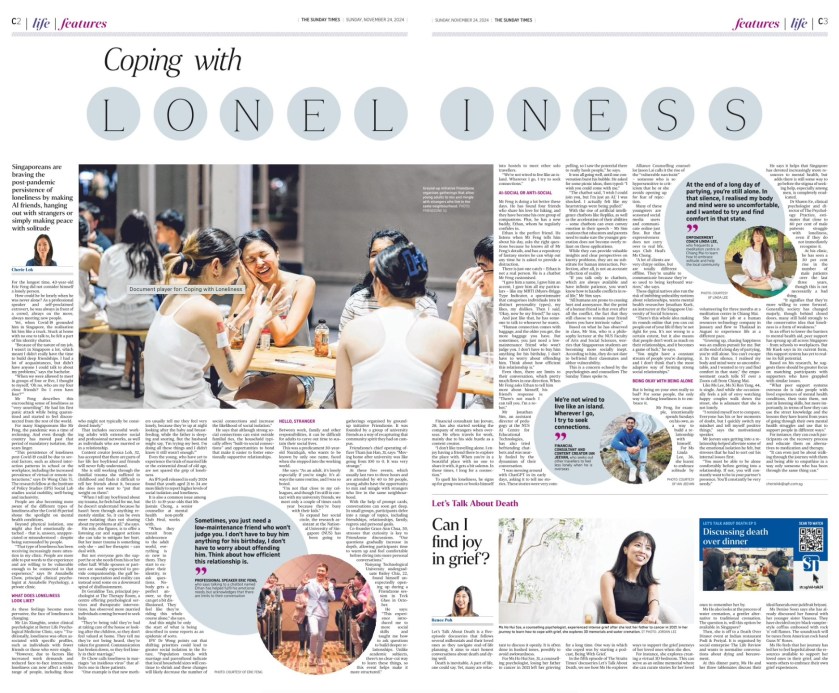
Is being alone really so bad? Coping with loneliness by befriending ChatGPT and embracing solitude [The Straits Times]

Was interviewed for this beautiful and thought-provoking piece for The Straits Times. Here’s an excerpt of what I shared:

“The chatbot said, ‘I wish I could join you, but I’m just an AI.’ I was shocked. I actually felt like my heartstrings were being pulled.”

With the rise of artificial intelligence chatbots like Replika, as well as the acceleration of their abilities – some chatbots can even convey emotion in their speech – Mr Sim cautions that educators and parents need to make sure the younger generation does not become overly reliant on these applications.

While they can provide valuable insights and clear perspectives on knotty problems, they are no substitute for human interaction. Perfection, after all, is not an accurate reflection of reality.

“If you talk only to chatbots, which are always available and have infinite patience, you won’t know how to handle conflicts in real life,” Mr Sim says.

“All humans are prone to causing hurt and annoyance. But the point of a human friend is that even after all the conflict, the fact that they still choose to remain your friend shows you have intrinsic value.”

Link to article: https://www.straitstimes.com/life/is-being-alone-really-so-bad-coping-with-loneliness-by-befriending-chatgpt-and-embracing-solitude

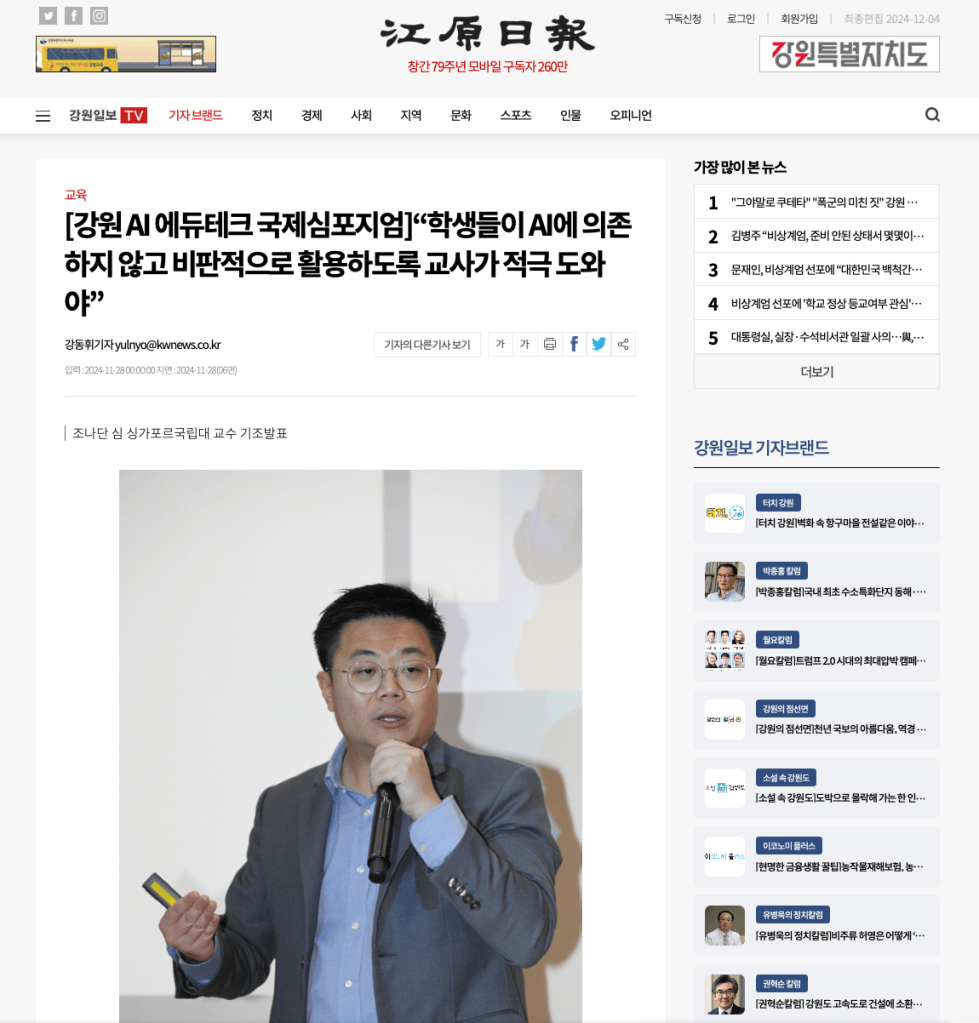
Teachers should actively help students use AI critically rather than depend on it [Gangwon Ilbo 강원일보]

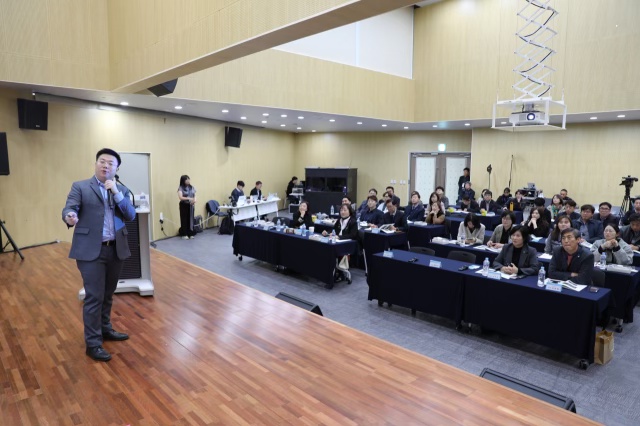
I had the opportunity to visit South Korea recently to share insights as a keynote speaker at the Gangwon AI Edutech International Symposium.

The event brought together many senior leaders from Gangwon’s Provincial Office of Education, allowing for a meaningful exchange of ideas.

The provincial newspaper, the Gangwon Ilbo (Gangwon Daily), published a summary of my talk:

Here’s a translation of the article (with minor edits due to reporting errors):

Keynote Speech, “From Books to Bots” by Jonathan Y. H. Sim, National University of Singapore

I am delighted to visit the beautiful city of Chuncheon. Today, I would like to share lessons learnt from implementing AI in Singapore’s education system. The latest version of ChatGPT demonstrates astonishing capabilities, making it difficult to distinguish between AI tasks and human efforts.

The Singaporean government has already mandated that all students and civil servants must learn AI; and we must ensure out students are prepared for the digital future from an early age. At the same time, it is crucial to maintain human empathy and emotional intelligence.

From a teacher’s perspective, using technology to improve teaching methods is essential. Teachers must serve as role models because students learn and adopt technology by observing them. However, the application of technology fundamentally depends on people. Simply adding more technology is not enough. Educational innovation is not about technology alone but about pedagogy and teaching methods.

How can teachers ensure students retain their creativity and learning abilities? First, building trust and motivation between teachers and students is crucial. Education is, ultimately, about managing the learner’s motivation.

Next, we must address the cognitive confusion caused by a loss of autonomy when we use AI. If AI provides all the answers, we lose our ability to decide and we lose our sense of autonomy. Socrates, long ago, criticised writing as a technology that made people overly dependent on written records. This reduced their efforts to memorise things. Today, we celebrate writing as a tool that enhances our thinking. Similarly, technology like AI should enhance our capabilities rather than diminish them.

As educators, we must ensure students do not rely on technology uncritically. AI should be used in ways that enhance creativity and critical thinking. For example, instead of using ChatGPT to generate answers, it can be employed to help students create meaningful questions. AI can also make learning more enjoyable; for instance, by asking it to create math problems in the context of stories like Star Wars. Math could become more engaging for students and provide them with concrete examples that they can relate with to understand better.

The potential applications of AI in education are limitless.

Link to article: https://www.kwnews.co.kr/page/view/2024112623274546546

Ministry of Digital Development and Information: Singapore Plans to Require Social Media Operators to Take Greater Responsibility for User Age Verification [Lianhe Zaobao 联合早报]

I was interviewed for an article for Lianhe Zaobao 联合早报. Here’s what I shared:

Children are not only affected by social media – adults are just as susceptible! Regardless of age, if we don’t have the right values/guidance/practices inculcated in us, we will not be well-equipped to handle the negative influences of social media.

Banning social media for those under 16 is not the right solution. IT-savvy kids will know how to circumvent such bans, so we’re back to the same problem. All it does is delay the inevitable yet important issues that we must confront with our children.

Many parents complain that they don’t know what to do when their child uses digital devices – they can’t understand or make sense of what their child is doing; and/or they don’t know how to talk about these matters in a productive way. They often receive conflicting advice from other parents who may not be well-informed.

What we need are resources – concepts, ideas, good practices, and given guidance and advice – to best manage the issues we face online, regardless of age. This will better equip parents to teach their kids well.

IMDA is doing the right thing by providing parents with sound and sensible guidance.

However, these resources are not enough to fully equip parents. At best, these resources can be thought of as a map, providing us with a general direction on how to guide our children well. They give us something to kickstart these conversations with our kids. These discussions will help us identify what we don’t know so that we seek out the kinds of support and resources we need to better guide our children well.

Some say that the problem is that we do not have age appropriate spaces meant for children online. It’s true that we cannot control who our kids interact with online, and it is challenging to ensure that they avoid materials inappropriate for their age.

The same can be said about our physical world – we are less worried about our children being exposed to dangers in the physical world than in the online world. That’s because we often accompany our children when we go out together, but we do not always accompany our children when they go online – we often think of online activity as an individual activity where we are literally left to our own devices.

This is implicitly the thread underlying IMDA’s resources – just as how we would not let our child freely roam the streets alone, we should not let them freely roam the Internet without adult supervision either. As parents, we should experience their world together with them and have conversations about what they encounter – as moments for parent-child bonding, and as opportunities or moments for learning and growth for both parent and child.

Link to article: https://www.zaobao.com.sg/news/singapore/story20241121-5382735

Don’t complain for the sake of it. Make it count [The Straits Times]

I had a great time speaking with Chang May Choon for her article on Singapore’s complaint culture in The Straits Times.

Here’s an excerpt from the article:

Excessive or habitual complaining, however, breeds negativity and holds us back from taking necessary action.

Mr Jonathan Sim, a philosophy lecturer at the National University of Singapore (NUS), told ST: “If we keep complaining, we end up in a situation where it becomes harder for us to see and appreciate good things. We tune ourselves to keep focusing on all the flaws and all the things that need improvement.”

The frustration and angst that emerge together with a rant blur the line between complaint and feedback, and effort is needed to leave the emotions out so that the complaint can be taken more seriously.

“Yes, people are complaining. But some people do have sincere intentions of wanting to give feedback as well, and sometimes this gets tangled up,” said Mr Sim.

Some Western scholars distinguish between a complaint and an emotional lamentation, he added. There is a difference – complaining is expressing that something is not right, but lamenting is an airing of your emotions and how you’re feeling. But in Singapore, all these get combined together into what we call complaints.

“In a sense, to be a complainer, one must also be a master of one’s emotions and not be dragged on by compulsions to complain and instead use it strategically to connect with others.” Making it count

One way to make complaints count is to raise the issues with the relevant authorities or on a platform where community action can be taken. Having been away for nearly a decade, I was pleasantly surprised to find that our civil service has upped its ante in addressing public complaints.

The OneService app, for instance, receives 1.7 million complaints a year from civic-minded residents regarding problems in the neighbourhood, from littering to damaged road signs to pests. It is heartening to know people care enough to take a photo of the problem and upload it to the app, instead of just complaining to a family member. More On This Topic Podcast: Why does it feel like Singaporeans are angry all the time? Singaporeans less happy, but those with balanced approach to life more satisfied: Survey

Internet forums and community chat groups are also filled with complaints, but it’s not all negative. In my neighbourhood Telegram chat, at least, I see the good intentions behind the complaints about errant behaviour, such as incorrect disposal of trash and unsupervised children playing dangerously.

Given the ease of complaining anonymously on various online platforms, Singapore’s complaint culture has turned into constructive feedback on these channels, Dr Atiqah said.

“Now when we have social media, we’re adding on to the complaints of other Singaporeans and it can be tagged directly to whatever policy or issue. So the complaining becomes more targeted, and in a way, we are turning our complaints to something more instrumental.”

Mr Sim from NUS, however, warned of a downside to this.

“Because we have such a strong complaint culture, we also end up in a situation where we need complaints to hit a critical mass before people start to take them seriously,” he said. “But I’d rather have people complaining than apathetic people. It means they still care enough to voice their opinion, and they still feel some raw involvement with the community.”

This brings me back to my friend. She’s no whiner, but when something crosses her line, she is dogged enough to go the extra mile to make herself heard. “Service will never improve if no one complains,” she tells me. I applaud her effort in voicing out. She is, after all, trying to make her feedback count.

Digital Learning Camp Enables a Thousand Students from Disadvantaged Families to Learn Programming and Assemble robots [Lianhe Zaobao 联合早报]

I was recently interviewed by Lianhe Zaobao 联合早报 about the launch of a digital bootcamp for children.

Here’s what I said in the interview:

At the moment, I think the market is too saturated with workshops and programmes teaching kids digital/tech skills. What’s really missing are programmes for parents to empower them and build their capabilities to meaningfully engage with their children on these devices, to understand what their children are doing online.

A comment I hear too frequently from parents is, “I don’t know what my kids are doing.” This knowledge gap is what makes it difficult for parents to fulfil their roles effectively. What this means is that even if the kids learn all these wonderful things – more often than not, there is no continuity because the parents can’t help to maintain the interest or help to keep their interest going; or even participate in what their kids do to bond together. These digital skills and device use becomes an increasing point of divide separating parents from their children.

Link to original article in Chinese: https://www.zaobao.com.sg/news/singapore/story20240905-4638569

GEP ‘not only about academics’: Current, former students highlight small class sizes, special resources [Channel News Asia]

I was interviewed about changes to the Gifted Education Programme. Here’s an excerpt of what I shared with Channel News Asia:

The changes to the selection criteria, in particular, take into account that students mature at different stages of their lives and send a “strong message” about second chances, said Mr Jonathan Sim, a philosophy lecturer at the National University of Singapore (NUS).

“The stress of our education system has always been that people feel that there is no second chances – you either make it or that’s it. This creates a lot of unnecessary pressure,” said Mr Sim who is also fellow at the NUS Teaching Academy.

“This (gives) our learners the psychological safety they need to experiment, explore and grow well.”

Here, I’d like to add a further thought on the matter: There are concerns that gifted students will not have the opportunity to learn in a conducive environment outside the nine GEP schools. We must not forget that it is the responsibility of educators to create conducive environments for their learners. The move to push GEP beyond the nine schools is a good strategic move – if this is done well, what it means is that we will commit more training and resources to our teachers and schools, enabling more teachers to have what it takes to provide their students with enriching learning opportunities and to create the necessary conducive environment they need to thrive well.

Link to article: https://www.channelnewsasia.com/singapore/gifted-education-programme-gep-revamp-students-parents-concerns-4558096

Nearly 90% of local workers use AI on the job; experts warn it may impact corporate data security [Lianhe Zaobao 联合早报]

I was recently interviewed by Lianhe Zaobao 联合早报 about a recent report by Microsoft and LinkedIn on the “State of AI at Work in Singapore.”

I was asked two questions. Not all I said made it to the final article, but I thought it’s worth sharing my answers here:

Q1: “84% of Singapore AI users are bringing their own tools to work—Bring Your Own AI (BYOAI)—putting company data at risk.” Why are people doing this and what can we do?

For starters, there are some who are unaware of their own company’s data management/protection policies, so they don’t realise that what they are doing is risky. There are some who violate these policies because they cannot find a better AI alternative, and they downplay the risks – it’s hard to see negative consequences now because we won’t know if or when the data we give feed to the AI will be used to train another AI model in the future. It’s more important that employers have a good discussion with employees on what constitutes good practices and be clear on what kinds of information should not be uploaded to AI tools.

Q2: “77% of employers say they’d rather hire a less experienced candidate with AI skills than a more experienced candidate who lacked them.” What are the downsides to such hiring practices? What can we do?

The term, “AI skills,” is a very ambiguous term. It can mean technical skills at developing AI, and it can also mean skills at using Generative AI (GenAI) tools like ChatGPT. We need to be cautious with people who claim to have GenAI skills – it is important to discern whether they are only good at using it as a substitute to their own ability, or if they are they very good at using it to enhance their abilities, how they think, write, learn, and work.

I have met many capable A-grade students who don’t like to use GenAI. They say that they’d rather use their time to do the work themselves because they can produce better results. I found that many of these students have not explored the full capabilities of what these GenAI tools can do. If we can train them to use such tools effectively, they will have the capabilities to go even further, and to do so much.

At the end of the day, AI can only enhance what one has. If you give it to someone less capable, AI can only go so much. But if you train up someone who is very capable, they will go very far with the assistance of AI. People can learn and adapt. If they are lacking AI skills and are keen to learn, we should give them the chance the learn it.

Link to article: https://www.zaobao.com.sg/news/singapore/story20240604-3795476

Unintentional Rudeness Is Everywhere! What Can We Do About It?

The other day, I read the book, “The Wrong of Rudeness: Learning Modern Civility from Ancient Chinese Philosophy” by Amy Olberding. I was particularly struck by her comments on Analects 4.17, where Confucius said, “When you see an unworthy person, look inward and examine yourself.”

Reflecting on this passage, Olberding wrote about how there are times where we get offended by someone only because we misunderstood the intention of their words or actions. And it is very scary to think that the words or actions of someone who meant well could be so wrongly interpreted as rudeness, disrespect, or worse, malevolence!

Looking back, I can definitely think of many instances in the past where I have either misunderstood someone, or I was misunderstood by others.

By far, the most revealing example comes from my teenage years. My peers and I used to get very upset by the uncles and aunties in the neighbourhood who would see us and ask very obvious questions like, “Going out ah?”, or “Going home ah?”, or “Going to eat ah?” It felt very intrusive and it upset a lot of us as we didn’t understand why these older folks liked to state the obvious in the form of questions – at that time, it felt like they had nothing better to do but to poke their noses into our lives. It was only much later when I took a module on sociolinguistics that I discovered that it was a practice of their generation, one where asking the obvious was a way in which they greeted someone and expressed care for them.

And just to share another story, some time ago, I spoke to a very well-respected individual in her 60s, and she commented that she found it very rude when junior people write, “I look forward to hearing from you soon” (or anything to that extent). She said that it reads like a passive aggressive way of demanding a response.

I was surprised! I’m guilty of writing such things in my e-mails. I always thought it was a friendly gesture to show excitement in hearing from the person, but it seems that people of her generation do not use it the same way that we do! (And of course, it made me wonder how many people I may have accidentally offended in the past.)

The point in sharing these two stories is to highlight that communicative practices can differ across different groups of people. The same words can be used differently and can mean very different things to different groups of people. It may be respectful to one group, but disrespectful to another.

From a Confucian perspective, we refer to these communicative practices as li 礼 or ritual propriety. It refers to social rituals, i.e. social conventions and social etiquette for appropriately expressing ourselves. It includes words like “How are you?”, which is used as a greeting in some circles (but misunderstood by other circles as a question of actually wanting to know more about the person’s state of life); it also includes certain actions like hand shakes, a high five; and it also includes other social conventions like queueing in line (which is why people get upset if someone cuts the queue in front of us), staying silent in a talk to not disrupt the speaker even if one disagrees with the content to allow the person to finish, and more.

It’s one thing to have good intentions for someone, but without learning the appropriate conventions for expression, we can come across as either rude, creepy, or something worse. For example, I once told a student (male) that I was very busy and quite stressed out by work to explain why I don’t have the bandwidth to mentor him. In response, the student loudly exclaimed, “I care for you! You can tell me your problems, and I will be there for you to help you in whatever way that I can!!! Just tell me! I won’t abandon you!!!” I know he meant well, but lacking the appropriate li conventions to express himself, it just came across as super creepy.

We learn about the best li, the best communicative practices from the people in our social circles, and we practice these forms of expression with them. And given how we are understood by the people in those circles, it’s easy to forget that people outside our circles may not actually understand us in the same way.

Again, another example that struck me recently was how my students have picked up the li practice of speaking a bit too freely and in an unfiltered way because they have been practising this li on social media. My colleagues and I have oftentimes been quite affected by the abrasiveness of their words over e-mail, and so one day I talked to students about this and they shared with me that their time on social media taught them that it is appropriate to speak and write in that way. Never once did it occur to them that other people did not converse in a similar way, or that it could appear rude and offensive to others.

So for me, the biggest lesson I’ve gained is the realisation that people around me – especially those outside my regular social circles – may have different li communicative practices, and so they may say or do things that may seem rude, disrespectful, offensive, hurtful, or even malevolent.

Personally, I think social media has made this problem worse. These days, we interact with more people through our screens than in person. Furthermore, the personalisation algorithms operating behind the scenes tend to recommend us more of the same – people with similar interests to us, content of a similar nature, etc. We are either connecting with very similar people, or at least learning the communicative practices from similar groups of people – and because we connect and interact with so many of them around the world, it’s easy to get the wrong impression that everyone behaves and communicates like us. It’s a false sense of homogeneity.

And if we do want to be effective communicators with other people, what it means is that we do need to get out of our shell to learn about the diverse li communicative practices in other circles, and by the various generations of people.

Of course, that’s just the first lesson. There’s still a second lesson that is most impactful for me. To reiterate Analects 4.17, Confucius said, “When you see an unworthy person, look inward and examine yourself.”

Isn’t it interesting that Confucius prescribes that the first response to feelings of offence or hurt is to examine ourselves?

It is one thing to feel hurt, offended, or disrespected. But it is another thing entirely how we respond to such negative emotions. I was sharing this thought with some people, and one person shared a story of how he was driving in the car, and the driver behind was horning at him repeatedly. A horn is just a sound that can be used to signal to other people around us. It doesn’t always mean that it’s a rude gesture. He highlighted how interesting it is that we can feel so upset when someone horns at us, that the first thought to rise up in our mind might be: “The driver is so rude!”, or “The driver is so impatient!” But it could very well be that the driver horning him from behind was trying to alert him to some imminent danger – which turned out to be the case!

The valuable insight here is how easily we take offence by what others say or do is more a reflection of our own moral imperfection than it is a reflection of the other person’s moral flaws. In fact, it’s easier to feel offended than it is to reflect and ask ourselves, “Why am I so easily offended or upset in the first place?”

Olberding shared some stories in her book of giving others a chance. They may unintentionally come across as rude or abrasive. If we reciprocate apparent rudeness with rudeness, we only make the situation worse. But if we give them a chance and treat them with kindness and patience, we may start to see that they may not actually have intended to upset us. This will then allow us to have civil and respectful conversations.

And, as I mentioned earlier, as I looked back on the times I was misunderstood by others for being rude/offensive, and the times where I misunderstood others as being rude/offensive, I realise that many of these situations could have been defused with patience and kindness.

Admittedly, it is not easy to be patient and kind especially when people have said or done things to rile us up. It doesn’t mean we are bad people, but that we need to be more mindful in practising kindness and patience so that it becomes second nature to us. And in many ways, I do admire those people who are able to spontaneously respond to hurt or offence with patience so naturally. They are a rare breed.

Seeing the degree of misunderstandings and miscommunication that’s been going on in this world, I do think the world needs a lot more kindness and patience.

Perhaps, one good way to get started with becoming a more patient person is to assume that everyone around us – including ourselves – are simply bad communicators. And our task is to try to understand why they said what they said, or why they did what they did, rather than to immediately jump onto the anger bandwagon.
A Return to Journalling

After a long pause, I’m finally making my return to journalling.

I was quite intrigued by an idea I read from the Harvard Business Review. The article was entitled, “The More Senior Your Job Title, The More You Need to Keep a Journal” by Dan Ciampa. In that article, Ciampa wrote about how the pace of work increases the higher one rises in one’s career. This means having less time to process information, and less time and space to reflect about our actions and to learn from these events.

It is only when we slow things down to reflect that we can approach problems with greater clarity that puts things in perspective, but also a chance to approach them with greater creativity. It can be very difficult to be creative or even effective when we are not given enough time to think and strategise.

This article resonated a lot with me. In many ways, a career feels a lot like a game of Tetris. The better you are at the game, the more challenging the game gets – pieces fly down at a much faster rate. Work too is like this. The better you are, the more work comes flying at you at a faster pace. (And the name of the game is to clear those blocks of work before you get drowned in them)

Just as how I enjoy the challenge of Tetris, I enjoy the challenge of work. But the pace has been increasing and the days just fly past me like a blur. And just as how it’s hard to put down the controller when one is at a really high level of Tetris, I realise it’s been hard to take a pause with work as well.

Nonetheless, this article has been bugging me at the back of my mind for months. It made me quite painfully aware of how little time I have been giving myself to breathe and think about things, or to recollect and learn from my many actions – whether they are successes or failures, both of which I have accumulated many in the past year alone.

To be clear, it’s not that I have not been learning at all. Rather, I have not had the chance to really digest many of the insights I’ve gained in the past months in ways that should impact me more than they should.

I think one of the negative consequences of not having enough time for myself to think is that I forget things more easily. It’s funny how stress makes one forgetful, and discovering that my memory is not as strong as before is even more distressing.

Nonetheless, I definitely do not want to lose any of the valuable life lessons and insights I have accumulated over the course of my work as an educator and philosopher. If anything, my interactions with students has been the greatest source of learning for me – especially to the question of what it means to be human and humane.

Well, the academic year has ended, so at least I now have some time to recover and breathe. So I’m hoping that I can instil this exercise of journalling as a regular habit.

How to Design Unforgettable and Satisfying Learning Activities that Help Students Learn Better

One of the interesting topics that arise when I converse with students is how many of them struggle to remember what they did in modules from previous semesters.

Such discussions got me thinking about how to design learning activities that are unforgettable. There is a quote famously attributed to Albert Einstein who said that “education is what remains after one has forgotten what one has learnt in school”. And I want to ensure that my students remember what they have learned from me especially after all the hard work that they have put into my course.

I began experimenting by implementing techniques that I myself used as a student. I had a very unorthodox method that was very much inspired by the comedian and counsellor, Mark Gungor. He had said that if you take an event and attach a strong emotion to it, that event will be seared into you for good. I applied this principle to my learning by creating jokes for everything I wanted to remember. The funnier the joke, the stronger the emotion, and the better my memory of it.

Activities to Reinforce Learning

I thought it would be interesting to apply this approach to my own teaching, regardless of whether it was a quiz, a group project, or a tutorial activity. So every learning activity I created came packaged with its own scenario. The more fun the scenario was, or the more shocking the conclusion was, the better the students remembered the learning points and what they did to achieve it.

And you can tell how effective this approach has been, when students consult me for help. Instead of explaining the concept, I can just invoke the name of the relevant learning activity. For example, I could say: “Do you remember how you found the spy in the ‘Who’s the spy?’ activity?” Immediately, students light up as they suddenly recall the concept or what they did previously.

Engaging the Imagination

And this is not the only ingredient for making learning activities unforgettable. The other reason why I create fictitious scenarios and situate learning activities in them is that it provides fertile soil for the students’ imagination. This is very powerful especially when we invite them to role-play. There, students step out of their identities to be someone else – which enables them to have more fun learning.

This is especially useful for group projects and discussions, where students within the group may differ in abilities and competencies. Fast learners may not feel a need to help their slower counterparts, and slower learners may be too embarrassed to seek help. In the context of the role play, learners become united by a common mission to save the day by solving a problem for a group of people.

This common mission prompts learners to emotionally invest themselves into the topic and to collaborate with each other in order to solve the problem. And because they are given the chance to momentarily be someone else, they can put aside the stress that they tend to impose on themselves and have fun. As someone else, students are more inclined to engage in peer teaching and learning with each other. They can contribute their own insights on the matter and help one another out (whether technical or not) if they find themselves lost without additional promoting. This helps to further reinforce the culture of collaboration that we try to foster in the module.

Difficulty and Challenge

However, there is another issue. If we design activities meant for stronger students, the weaker students will feel lost and end up disengaging themselves from class. If we design for the weaker students, the stronger students will complete the task quickly on their own, get bored and disengage from the class.

To solve this conundrum, I found it effective to borrow two categories from game design: “difficulty” and “challenge”. A problem can have a low difficulty (be easy) but be challenging; or it can be difficult but not challenging at all.

A problem is difficult when it is hard to accomplish, and it depends very much on the learner’s ability to be able to succeed. A sharp learner, for example, may not struggle very much with a difficult problem, but a slow learner may feel very lost and be unable to solve the problem unless someone steps in.

On the other hand, a problem is challenging when it requires effort rather than ability to solve it. Hence, a challenging yet easy problem can be solved by both fast and slow learners, and they will both need to work hard to find the solution since the answer is not immediately obvious.

With these categories in mind, we can design learning activities that have low difficulty but are still challenging enough for stronger students. This is achieved by providing just enough scaffolding and guiding resources (such as a Q&A resource page) that weaker students can refer to for help. This mirrors the way computer games leave clues and hints lying around.

For formative activities, I will calibrate them to be easy yet challenging. In my course, this means that someone who has just learnt Microsoft Excel will be able to solve the problem even with minimal experience. But it is challenging in a sense that the most experienced Excel user will not find the answer immediately and will have to work for the answer too.

For summative assessments, I will calibrate them to be just as challenging but with a higher difficulty level. There will be fewer scaffolds and guiding resources available. I typically achieve this by picking out scenarios where there are no clear answers, and so students will have to discuss within their groups to convince themselves of the right solutions.

Ensuring Satisfaction

One thing to note is that the greater the challenge of the activity, the more we need to ensure that students find the activity satisfying, as a reward for completing the challenge. Some activities are already satisfying once the learner completes them. But sometimes the satisfaction may not be enough. To combat this, I usually test these activities with my Teaching Assistants (all undergraduates). I will observe their behaviour and note their feedback for improvement.

Role playing is useful in augmenting the level of satisfaction. Depending on their assigned scenario, accomplishing the task can leave students feeling as if they’ve just solved one of humanity’s greatest dilemmas, or that they have just made the world a better place with their solution.

Or sometimes, we can conclude the activity with a shocking revelation or a mind-blowing learning point that they least expect. For example, in one of my learning activities, students felt accomplished that they had allocated students to limited enrichment programme slots. At the end, we got them to reflect on the criteria used and how that could favour wealthier demographics.

Our learning activities may be somewhat theatrical. But they do help in generating strong emotions, which help to sear students’ learning deeply into their memories. The result: an unforgettable learning experience. I stay in touch with many of my former students from two years ago and they still fondly remember the various activities and learning points from my module. I believe this is an education that Einstein would be proud of.

This article is part of a series of articles on pedagogical methods and education.

How to Effectively Induct Students into the Flipped Classroom Paradigm

The flipped classroom format is a type of blended learning where students are required to do some preparatory work – such as watching lecture videos or completing some assignments – before coming to a face-to-face class to work on more challenging problems with the facilitation of an instructor.

However, one challenge of teaching flipped classroom modules is that a big proportion of students often came to class unprepared. They either do not watch the lecture videos or they quickly skim through them before the tutorials. Thus they lack a proper understanding of the content. The tutorial ends up becoming a lecture where we go over the lecture content instead of challenging them to go further, as many students are unable to participate in the activities.

When I asked my students why this happens, the most common reason was their unfamiliarity with this new learning paradigm. Raised in the traditional classroom paradigm, almost all students are not used to the flipped classroom. They enrol with the expectation that they can learn more effectively in the presence of a live teacher, where they can pick up hints and clues on what they should be focusing on when they review the course materials. This way, they feel assured that they are “on the right track” when they revise the course materials on their own.

Limited Effectiveness of Quizzes

One of the most common solutions is to implement graded online quizzes that are due right before face-to-face classes. I experimented with this and found the effects quite limited. Quizzes alone are insufficient in inducting students to this new learning paradigm.

Also, students can score well at online quizzes but still retain many defects in their learning. I like to think of the flipped classroom as analogous to learning to drive by watching videos. It is not possible to drive well from watching videos alone. Quizzes are insufficient in testing or reinforcing their driving abilities. More needs to be done to facilitate the student’s learning. The student cannot know what he or she does not know until the student has had the experience of being on the road, so to speak.

The Benefits of Pre-Tutorial Discussions

Over the semesters, I have found that a really effective way to induct students into the flipped classroom paradigm and ensure higher levels of pre-class preparation. This is achieved by introducing the Pre-Tutorial Discussion – an open-ended assignment of 600 to 800 words – that is due before each tutorial.

Students are given a scenario and a problem to solve. The discussion invokes their imagination by inviting them to role play. For example, an assignment topic could be: “Imagine that you are an intern and your boss has tasked you with developing an algorithm to determine a delivery route for emergency medical supplies.”

Role playing is powerful because it invokes the student’s imagination, forcing them to step out of themselves and, for that moment, pretend to be someone else. This compels them to feel a strong vested interest to solve the problem to the best of their abilities as they can sympathise with the people they are tasked to help. Furthermore, the sense of accomplishment for completing the task is a lot greater, making the activity very satisfying (almost like playing a game).

The scenario is designed such that it requires students to creatively apply what they learn in the lectures. This compels students to ensure that their understanding goes beyond a superficial level of comprehension as they try to apply their theoretical learning into something practical (analogous to attempting to drive a car instead of having the idea of driving it). It helps students discover and rectify defects in their learning. Students have provided feedback on how this has helped them think more deeply about the course materials as they revise the lectures and quizzes, or seek clarifications from my teaching team.

The scenario is designed such that there is no one clear answer. Instead, there are a myriad of possible solutions. This point is emphasised by basing assignment grading not on getting the right answer (because there are many possible ones), but on the way they explicate their thought process to demonstrate reflective, self-critical awareness. This encourages students to experiment and explore various approaches before presenting what they think to be the best solution.

I inform students that tutorials are built on what they have done for the Pre-Tutorials. This sets expectations on what needs to be prepared before coming to class. And when students see what is expected of them in the Pre-Tutorials, they put in more effort in ensuring that they are well-prepared for the greater challenge that awaits them later.

The introduction of the Pre-Tutorial has been very effective in flipped classroom courses. With a well-designed Pre-Tutorial activity, I was able to get about 80% of my students to come to class well-prepared for the challenging tutorial activities in Semester 2 of Academic Year 2020/2021. This is compared with about 40% to 50% of students in the earlier semesters when I was still experimenting. As a result, we were able to take their learning a lot further in class.

More importantly, students provided feedback that the Pre-Tutorial Discussions have helped to induct them into the flipped classroom paradigm. This has helped them learn to become more independent learners as the discussions provided them with the structure to confidently pursue self-directed learning and exploration.

This article is part of a series of articles on pedagogical methods and education.

Alleviating Student Anxieties in Interdisciplinary Learning and Empowering Them Through the Telegram Messaging App

Since I began teaching in 2017, I found that there are other challenges to interdisciplinary learning unique to this generation of students. The challenges to interdisciplinary learning are more psychological in nature. In my discussions with students, I found that many have high levels of anxiety when it comes to learning something outside their intended major.

They may be nervous about potentially failing a module. Having to do a module outside what they are competent/familiar with increases the likelihood of having to experience failure. Many students in University managed to go through their prior years of schooling without encountering failure. And because of this, the idea of potentially failing for the first time induces a great deal of stress and anxiety.

Here, I wish to highlight that this problem is not unique to Singaporean students. I have encountered many international students enrolled into my module voicing the exact same anxieties towards interdisciplinary learning.

Because of these anxieties, students imagine that there are many others who are better than them, and the moment they face a struggle, they are quick to imagine that they are the only one struggling with it, which further perpetuates the stress.

The issue is compounded when the module is taught in the blended-learning format, where students learn some parts of the module in isolation at home. They cannot see their classmates or how they are doing, and the stress drives them to imagine the worst. This affects their motivation to learn as they do not see any chance in scoring well for the module.

It also affects students’ willingness to ask for help. I also encountered many students who feel that they need to get everything in order (compile all their questions so that they can ask everything in a single setting, or be able to articulate their questions to show that they did preparation work) before they come for consultations. Otherwise, they feel they may waste the instructor’s time. However, I have come to realise that because the student is dealing with a subject so alien to them, they sometimes struggle to articulate their question. And in such situations, students do not ever reach a situation where they feel ready enough to approach the instructor for consultations.

Overall, these anxieties and self-imposed stress that many students face becomes an inhibition to learning effectively. In my teaching experience, I found that these issues must be addressed if we want to assure and motivate students to learn well.

And in my years of teaching, the Telegram messaging app has become a very integral support system in my teaching, and it helps to alleviate students’ anxieties and empower them in their learning.

Each semester, I create a Telegram Helpline where students can seek help directly from me or one of the Teaching Assistants (TAs) in the teaching team. It allows me to interact closely with students and to show them that I am serious in wanting to help them learn well. I answer questions without judgement, and I collect new questions to add to a library of Q&A that everyone can access for their benefit.

Telegram is a powerful platform because students can seek help, even anonymously (platforms like WhatsApp don’t allow this). It helps with student motivation because students can see their peers working when they ask their questions on the Helpline. Students see that there’s movement and it motivates them to work as they know they can benefit from the stream of Q&A that comes in.

More importantly, students can see their peers asking questions and their struggles are made visible online. Other students see this and it makes them aware that they are not struggling alone. It helps students feel more confident about their learning and about themselves. More importantly, it greatly reduces their anxieties over learning something so new and daunting, knowing that they can come to me for help, even if they struggle to articulate the problem.

What I like about the Helpline is that it allows me to shape and foster a positive learning culture for students. It allows me to demonstrate good learning qualities/values and shift their mindset away from one of competitiveness to collaboration. As I foster trust in them and create a safe environment for them to seek help, more students begin to participate actively in helping to answer queries by their peers. I know I have succeeded with cultivating the positive learning culture when students regularly respond to one another’s questions and help each other online.

Knowing that help is just a text message away, or that there is a comprehensive Q&A knowledge base they can refer to verify their understanding empowers students greatly, because they recognise that it is possible to master something new entirely on their own (with some assistance, of course), and they would not have to face the situation of discovering that they are not good enough. This helps to greatly alleviate the self-imposed stress felt by such students.

In general, using the Telegram Helpline as a teaching tool helps to reduce the stress that students are facing when learning something outside their specialisation because they know they are not struggling alone and that there is help readily available in the event that they require it. Furthermore, the collaborative culture that it fosters also mitigates stress because students do not feel like they are competing with each other for grades. As such, the Telegram Helpline helps empower students to internalise their interdisciplinary learning.

This article is part of a series of articles on pedagogical methods and education.

How to Effectively Engage Students when Teaching Interdisciplinary Modules

In recent years, the National University of Singapore has been emphasising the importance of interdisciplinary learning as it helps to equip students with various competencies that will enable them to solve problems outside their area of specialisation, thereby preparing them well for the workforce and giving them the flexibility to engage in life-long learning. It is for this reason that the University made it a graduation requirement for students to read a few common interdisciplinary modules.

However, I have noticed that students have been apprehensive towards such interdisciplinary modules that teach content outside their major. I spoke to my students about this issue and I found that many of them do not understand the purpose of such modules. They rely on the testimony of their seniors, who may emphasise the importance of specialisation in one’s major over a breadth of outlook and skills.

As a consequence, many students do not see the point of interdisciplinary learning, and they enrol into these common modules with little interest. This is a major problem I have been facing since I began teaching interdisciplinary modules from 2017.

In 2019, I became the Module Coordinator for GET1050 “Computational Reasoning,” where I teach coding and data analytics to 700 students in the Faculty of Arts and Social Sciences each semester. At the start of each semester, about 70% of my students do not fully engage with the course materials due to the poor perception they have of interdisciplinary modules. To tackle the problem, I have to invest a significant amount of effort to win them over to see the purpose and value of the module. By the 7th week, I estimate that I have won over and engaged most of my students, with the number of non-engaged students dropping to about 30%. This is still a problem because the content of each week builds on the previous weeks. By the time students see value in the course, they may be unable to catch up on their own.

I have since learnt that teaching interdisciplinary modules require a great deal of effort on the part of the instructors to engage students, spark an interest in them and to help them to see both the beauty and the value of what they are learning. If you can win students over and give them a positive perspective about the course, they will be happy and willing to do all kinds of things for their learning, and students will be more engaged in the assignments and tutorial activities.

Here are a couple of things that are essential to generate student interest in interdisciplinary modules:

(1) A personable instructor who can connect with students. This is essential especially for large modules on the blended-learning format, which is the norm for many common interdisciplinary modules offered here in NUS. The online learning experience can be cold and impersonal.

So, the instructor must try to connect with the students online in a very personal and warm way, through the various modes of communication. This humanises the online learning experience and makes the process a lot more pleasant to consume.

I have learnt is that it is important for the instructor to project a strong image of care (and of course, to act on it). Students are more receptive when they see that they have a lecturer who cares for their well-being and their learning. Simple things like making an attempt to remember students will go a long way.

I will also make visible all the effort I am doing to help them learn well – improving the videos or assignments, or grading their work. Firstly, this humanises me, which is very important in improving the experience of online learning. Secondly, when students see the effort their educators put, they will want to reciprocate the effort. This is evidenced by remarks that I often hear from my students such as, “I simply wanted to barely pass this module, but seeing you work so hard so that I can learn well, I feel that I must work just as hard not to let you down.”

(2) The purpose and value of interdisciplinary learning should not be communicated in a formal manner. Communicating the importance in an informal way generates the greatest impact because the message becomes very intimate and personal. One thing I do is to record a fortnightly chit-chat session which I insert as the first lecture video in the fortnightly series.

In these videos, I dress less formally to signal that it’s something different from our regular programme. I begin the video announcing the date and time just to let them know that it is not a video recycled from a previous semester. I will use the video as my way of checking in on them; talk about things in my life; and use it to address the more pertinent questions and concerns that students have raised.

This provides a platform to talk about the real-world applications of interdisciplinary learning or the applications of what I teach in my course. I share with them stories about my peers who have long graduated: how one of them could not fulfil his dream of being a journalist because he didn’t know Microsoft Excel when asked at an interview; or how half of my peers (7-8 years after graduation) are now required to learn coding at their work (even though they are working in non-technical roles). This makes a huge impact on the students, and it motivates them to take their learning more seriously.

I also use the fortnightly chit-chat video to praise and assure them that they are doing fine. It is more personal for them to see my face and hear my voice saying it, than to write it as an announcement. It makes them feel more confident in what they’re doing.

(3) Negative comments from seniors can severely affect the receptivity and openness to learning in the next semesters’ cohort of students. And similarly, if seniors have positive things to say about an interdisciplinary module, their juniors will be more open and receptive to learning. It is therefore important to ensure students get a good experience from the module since these students will very quickly become seniors themselves, and they will influence their juniors.

The efforts I invested in for the first two semesters (such as the strategies mentioned in (1) and (2) above, and the effort to ensure students enjoy the experience) started paying off in the third run of my course. My module had developed such a strong positive reputation within the student culture that juniors are so happy to learn in my module because they are surrounded by seniors who are just as happy to support them in their learning.

To aid in my attempts at shaping students’ receptivity towards my module, I have found it very useful to have a website showcasing the value of the module and students’ feedback about it. I also curated testimonies/feedback about how students secured their internships, or how they found their learning so applicable to their internship/work. This is important because students will search online about the course once they know they have been pre-allocated the module. If we are able to make a strong positive first impression on them, they will be more open and receptive to learning when the semester begins.

The efforts I discuss above proved very successful, and I was able to achieve significantly higher initial take-up rates, with about 60% of the cohort fully receptive and engaged in all the learning activities at the start of the semester. Overall, that cohort was a lot more receptive, and almost every student came to class well-prepared. And by the 7th week, about 80% were fully receptive in their learning.

Overall, students were won over by the expressions of care and concern for their learning, and the personal stories of how their seniors have to engage in work that demands an interdisciplinary mindset or approach. These help to generate interest in students to be fully engaged with the course.

This article is part of a series of articles on pedagogical methods and education.

Do you have any advice for those who are interning for the first time?

A student sent me this question:

Do you have any advice for those who are interning for the first time? I’ll be interning soon this summer and I’m afraid that I’d be clueless towards some very important things.

Yes I have some advice about what to do when you embark on an internship or your first job:

(1) First, you need to go in with a mindset change. I’m aware a lot of students think that they should do jobs where they know they are already good at (or think they’re able to do well in). This is a bad mindset. If you do this, you will have no room for development and growth. You’ll stagnate, or worse, regress!

So let me share with you the words a wise professor shared with me when I confided in him my worries about work after I graduated. He said, “When you go to school, you are paying to learn. When you go to work, you are being paid to learn.”

So, it’s all about being open to learning. Be hungry to learn and gain as many new experiences as possible. Don’t just do things that you’re comfortable with. You should at least have one project that’s outside your comfort zone to constantly challenge you to grow.

I have a personal philosophy when it comes to work: “Say yes first and figure it out later.” This has been my guiding principle for a lot of the new projects that I take on. I wouldn’t have gained such a wide array of experience and skills if I didn’t give these things a try.

The working world is very forgiving about failure, esp. if you work very closely with your supervisor, as that means that you have many opportunities to refine and improve the thing you do. This way, you’ll develop many achievements that you can proudly pin on your CV that will help you move on to your next job.

(2) Secondly, I’ve noticed that many students treat the work assigned to them like school assignments. So they’ll keep quiet and struggle to complete the task without consulting anyone. This is bad!

You need to have the humility to seek help from anyone and everyone. We owe our success to the people around us. And the most successful people are those who know how to seek help from people both inside and outside the organisation. This includes your supervisor, your colleagues, and even friends from school. You should NEVER struggle in silence, or just rely on Google.

To go far in your career, you must know how to tap on your social network – not just use them in a very utilitarian way for your own personal advantage, but to always collaborate and find win-win situations from everyone, esp. the people you seek help from.

Even when I started GET1050, I didn’t come in knowing everything that I taught. I didn’t know how to do data analysis or code in VBA. I spent a lot of time watching YouTube videos and also seeking help from friends. I also relied heavily on the first generation of TAs to help me come up with learning activities that would be fun and effective for students.

I know it’s very scary to go about doing things that you don’t know. But this relates back to the first point. Work means we’re being paid to learn, so we should do all we can to learn as much as possible by our own, and from the people around us. No challenge, no growth. So keep challenging yourself and learn from others.

(3) And this brings me to my third point: You must develop a close working relationship with your supervisor. Update him/her regularly (even if it doesn’t sound impressive), and seek clarifications when you’re unsure. You need to put yourself in your supervisor’s shoes. Imagine you’re a supervisor. If your subordinate doesn’t talk to you, would you know whether your subordinate is doing work? No. Would you be able to trust your subordinate when s/he’s silent most of the time? Again, no!

So you do need to talk to your supervisor regularly. Be proactive about it. Don’t wait. And do not give the excuse that you’re afraid of troubling your already-busy supervisor. It’s better to trouble him/her to clarify than to submit work that’s done completely wrong too close to the deadline. You’d be troubling him/her a lot more if you do that.

I’ll illustrate with a real incident: Not too long ago, someone did work for me. She had forgotten what I taught her and she didn’t consult me to clarify. She submitted work that was done wrongly. It was very close to the deadline for releasing something (she had one month to do it). And because of that, it was incredibly stressful for me as it meant that I had to give up on sleep and redo everything in about 20 hours to get the thing out on time.

It’s things like this that will sour your relationship with your supervisor.

So make it a point to update your supervisor on a regular basis. Not complete? That’s fine. Have the humility to report everything – the good, the bad, and the ugly. Have the humility to ask for clarification all the time. I’d rather have someone who clarifies and does the work correctly, then someone who doesn’t clarify and gives me the wrong thing at the end, only for me to redo everything.

One further point, trust is cultivated not by doing work well. Trust is cultivated by regular and quality communication. If you want your supervisor to let you in on more important tasks, or trust you enough to do other interesting projects, you need to cultivate that trust by checking in regularly and talking to him/her regularly. If you don’t dare communicate with your supervisor, it reflects badly on you as it shows that you don’t trust your own boss enough to seek help from him/her.

(4) Fourthly, don’t be passive and wait for your supervisor to give you work! Either ask for more if you feel you’re not being challenged enough, or better yet, take ownership and initiative to improve things on your own! Sometimes, they are unable to assess whether you are able to cope with the load, so they err on the side of caution. However, if your internship is too comfortable for you, it means that you’re wasting your time, because you don’t get to accomplish many things during your internship. You won’t have much to show on your CV.

Supervisors love it when you help to add value to the organisation on your own initiative. As it is, supervisors are already busy with their own workload, so it can be very difficult for them to find work to give you. If you are able to find other projects to busy yourself with (that will help your supervisor), oh you are going places!

Of course, don’t be too over-enthusiastic in wanting to change everything on Day 1. Spend the first week or two to understand EVERYTHING in the department – the people, what each one does, the kinds of problems they encounter, the problems your supervisor encounters, the kinds of problems you encounter in the course of your work, etc. Spend moments of each day thinking how you could improve the process, or what interventions can help make things better. And then find the time to share these ideas with your supervisor. S/he will really appreciate it, and can help give you deeper insights on the matter, and maybe connect you to other people to assist you with improving things.

Now, the things I said above may sound like common sense, but shockingly they are not practised by everyone (it’s human nature to be lazy or find the easy way out). So if you do these things, you will actually stand out in any and every organisation.

And I want to end by saying that good talent is actually rare and hard to find. Companies will do everything in their power to retain good talent if they come across one. If you do the things I mentioned above, you will not only gain the attention of your immediate supervisor, but also the attention of senior management. And they will go out of their way to take care of you. If it’s an internship, they’ll reserve a permanent position specially for you when you graduate.

This is already happening with some of my students. So it is well within your power to achieve all these when you go out for an internship. So go out and make us proud!

All the best!

How can I boost my CV/portfolio while studying without exhausting myself in the process?

A student asked me:

How can I boost my CV/portfolio while studying without exhausting myself in the process?

It’s practically not possible to do that. There’s 24 hours in a day, and if you want to do anything beyond academics, you will need to set aside time outside of your lessons to do that. It may mean less personal time, or less sleep (though I don’t recommend sleeping less). But the moral of the story is that something has to give way for you to be able to invest the time and energy for it.

One thing I did so that I didn’t exhaust myself too much would be to only take on projects I really enjoy. That way, I don’t find the work a chore, and I am very delighted to pour hours of my time on it.

In my first year of undergrad studies, I used to conduct language classes in the evenings after classes. It was fun (and earning money’s always fun), and my desire to teach better led me to read up more about different techniques for facilitation and public speaking.

From my second year onwards, I started to work as an undergraduate Research Assistant for one of my profs. And I was very passionate about the research area and that really helped me to grow and develop myself intellectually and academically in the process. I read hundreds of books, and I wasn’t complaining because I actually enjoyed it. And the research area overlapped with a lot of the modules that I took. So I didn’t actually have to read much for those modules because I already had the background knowledge and familiarity with many of those topics.

When I took over the leadership for the Philosophy Interest Group, I did a lot of work, but I wasn’t so exhausted nor did I consider it extra work because I thought it was a nice platform to make new friends and try to form a philosophical community, which was already something I personally aspired to make. So I never thought of it as extra work. I just did it because I enjoyed it and personally wanted those things.

And it’s only when I sit down to craft my CV did I realise, “Oh wow! I’ve done so much that boosted my portfolio!”

Now, what’s the point in sharing all these?

If you noticed, I didn’t specifically go out of my way to do things to boost my portfolio. I just took on things I enjoyed doing because I wanted to do them. This is a more organic way, and more importantly, the portfolio/CV that I craft at the end of it all is a true reflection of who I am and what I want to do with my career. I want to build communities, make new friends, learn and read up about the stuff I enjoy, and just teach things that I enjoy teaching. These are things I would prioritise in my life, and they overlap with the kind of work that I want to do.

So the moral of the story is: find opportunities that you actually want to do, or create the opportunities yourself to do the things you want to do. Don’t just do stuff for the sake of adding to your portfolio, especially if it leads you to do things so grudgingly or hesitantly. And I say this because I’ve encountered people who want the achievements, but they don’t want to do the work, or they don’t enjoy the work.

And if you don’t know what to do, then just try anything and everything that comes your way. At least you’ll discover for yourself what you can orcannot do, and what you like or dislike doing.

Some people tell me that university is the last time for us to be carefree young adults before entering the workforce, but shouldn’t I be studying for my future instead?

A student wrote to me, asking:

What does it mean to have a vibrant university life? Some people tell me that university is the last time for us to be carefree young adults before entering the workforce, but shouldn’t I be studying for my future instead?

You are right that you should be preparing yourself for the future. And that means developing yourself holistically. Grades aren’t everything. And if you make the mistake of only developing yourself academically, you run the risk of not developing every other aspects that matter when you go out to work. There are many graduates with fantastic grades who struggle to succeed in the working world. And many employers often complain that these people are very incompetent. If you only focus on grades, you only know how to read, memorise, analyse, and write.

Work is more than that. You need to convince and persuade others. You need to solve problems. You need to sell yourself and/or your company and its products/services to go far. You need to lead people, make decisions on behalf of the people under your charge. You need to work with people you can’t choose, some of whom you’ll have difficulties dealing with on a personal level because of their work styles or personalities.

University modules will provide you some opportunities to develop these from time to time. But there’s only so much your lecturers can do for you. To fully develop yourself, you’ll need to immerse yourself in the richness of student life. Go organise things, persuade people to join you to do stuff, and then advertise it so that other people will participate in it. The very act of doing these things will give you the experience you need to make it in the working world. And what’s most important of all is that these are opportunities for you to network and form real authentic friendships, many of which will last long after graduation. And you’ll discover that many years after graduation, these real and lasting friendships will prove essential when you need to create new leads or opportunities for your work.

And for that matter, the very act of socialising with a diverse group of people from different backgrounds will give you more insights into the varieties of people that you will have to deal with in the future, whether professionally or personally. And as you try to make new friends or form romantic relationships, every attempt adds to the rich tapestry of experience that will form you to be a more matured person. You will have a vast library of experiences you can tap into whether it’s dealing with people or work. And with these experiences, you are more than prepared to go out into the working world.

If you want to prepare yourself well for the future, my idea of a vibrant university life is to make as many friends as you can. And I mean genuine friends you can hangout and chit chat with, do stuff together and all. I don’t mean superficial hello-byebye friendships where you befriend people for utilitarian purposes. I’ve met people who make friends for that reason, and they come across as very sleazy because it’s very apparent that they’re not really interested in forming genuine friendships.

Some of the most incredible people I know back in my undergraduate days formed large networks of friends, it’s amazing to count the number of people they greet as they walk from the Arts Canteen to the Central Library. It’s like a 5 minute walk, and every few seconds, they bump into different people. It’s fun to enjoy one’s school life like that.

I’m more introverted, so I never really made friends to such an extent. But it’s always nice to bump into at least one person I know when I along that path. It’s nice to know that I’m going through this academic journey with friends.

Now, one thing I do strongly recommend you to do is to challenge yourself to join a society, club or interest group, and try to organise something at least once a semester. The more events you can organise, the better. It can be a CCA that you are already good at or something you are interested to learn. What’s more important is that you have the experience of organising things. It forces you out of your comfort zone to understand the administrative, logistics, operational, and marketing aspects required to get something done.

It’s a pretty accurate representation of what the working world is like. And those who are enriched by these experiences are more empowered when they go out to work as compared to those who didn’t enjoy such experiences.

How do I go about choosing my major or what field I should specialise in?

A student asked me:

How do I go about choosing my major or what field I should specialise in?

I am of the firm belief that you should major in a discipline that you enjoy and are very passionate about. For most people, university is their last stage of their education. So it’s all the more important to end it with something you enjoy. After all, the assignments are tough and very time consuming, so if you enjoy what you’re learning, it makes it a lot better. Otherwise, you’ll be spending 3-4 years suffering in misery learning something you have no interest in.

I have said this before, and I’ll say it again. Your major does not make you more or less employable. YOU make yourself employable. The soft skills of expression, of writing, of presenting, of persuading, of working together in a team, of leading others in a team, of being able to learn new things fast and on your own – these are more important than your major. These will determine whether you will get called up and succeed in an interview, and these soft skills will determine whether you will progress fast in your career or not.

The only reason why some majors look more employable is because certain disciplines tend to attract lots of people who are already very employable. They are very career-minded and self-driven. And with these same personal qualities, they would go just as far if they had taken another major. The issue really isn’t the major. It’s whether you bother to take the initiative to learn beyond your major, and to develop yourself professionally and intellectually.

Many of the assignments and modules you’ll take in University will try to prepare you in one way or another in many of the soft skills I listed above. Things like group project, etc., are already ample training grounds to hone these skills.

Lastly, I don’t recommend taking a major just because it is “practical.” What’s my issue with “practicality”? Well, this is speaking from observation. I’ve noticed that students (and my peers) who say they chose a “practical” major use this reason to give themselves a false sense of assurance that their future is secure. But what they don’t realise is that they often blackbox the entire thing, thinking that the having the name of their major printed on a piece of paper will do miracles for them, and so many of these students don’t actually develop themselves professionally and thus they go out into the working world unprepared and quite incompetent in what they do. Or in the case of my peers who lied to themselves that they had chosen a “practical” major, they ended up worrying about jobs and job security the same way as everyone else towards the end of their uni life. So the choice of their major really made no difference. It just made them feel comfortable for the first 3 years.

I also have issues with deciding a major based on whether or not it is “employable.” Employability will depend on the economic tides. In my time as an undergraduate, life sciences was the fad while computing was the dumping ground. Many of my peers took up life sciences in the hopes of making it rich, and very few took computing. Fast forward a few years later to today, now computing is the fad and all the life science graduates are having difficulties finding a job.

The same will go the way of computing/data analytics now that they are the “in” things. What many students don’t realise is that industries are very happy to drive more people into studying computing/data analytics because they want to increase the supply of talent so as to reduce the cost of manpower. Right now, such good talent are low in numbers and they are expensive to hire. By driving up the supply of talent, they can reduce salaries for such talent in the near future. This, by the way, is true of every discipline that gets caught up in the employability hype. Once the fad dies out, these majors will question the employability of their degrees once again.

Similarly, many chemical engineers are out of a job now because the oil and gas industry isn’t doing so well (it used to be booming so fantastically well years ago). Many Grab drivers I spoke to in the past year hail from the oil and gas industry. Some even hold PhDs in chemical engineering! What you study and the level of your qualification isn’t always everything. We’re all subject to the changing tides of the global economic situation.

So choosing a major based on “employability” is rubbish advice. What is employable now may not be employable in the future. And with the rise of AI and technology, experts cannot predict the next rising or failing industry

What is it that keeps those people employed in these shifting tides?

The same soft skills and qualities that I mentioned earlier. Why are they so important? Because these are the very qualities that enable an individual to add a lot of value to the organisation. It’s an intangible value that’s hard to measure, but it plays such a crucial role in the lifeblood of the organisation, whether it is the people and culture, or the business operations itself.

So once we’ve discounted “practicality” and “employability,” what are we left with? Well, like I said, it doesn’t matter what you major in. It’s the soft skills and people skills that matter waaaaaaay more than what you study in uni. So you might as well just choose a discipline that you enjoy learning. At least that way, when passion kicks in, you’ll gain so much more and those years of learning will be the best years of your life.

What advice do you have for someone who isn’t interested in dating or marriage in general but faces lots of parental pressure to do so?

A student sent me this question:

What advice do you have for someone who isn’t interested in dating or marriage in general but faces lots of parental pressure to do so? I don’t really have any interest in dating or marriage. I had some crushes while growing up but nothing much. I’m single currently (and I’m very pessimistic about finding a partner in the future because of circumstances) and I’ve tried to talk about this to my parents many times. But I still face a lot of pressure and sometimes I feel really annoyed.

My advice is to hold your ground firmly on your position. Even if you give in to parental pressure, the annoying questions will not go away. Once you start dating, the new annoying question will then be, “When are you getting married?” And once you get married, the annoying question will be, “When are you going to produce a baby?” Once you make one, the new annoying question is, “When are you going to make another?” And when the kids grow older, your parents will have yet more annoying questions to ask you. So in the grand scheme of things, the annoying questioning and pressure won’t ever go away.

So don’t cave in to the pressure.

There are three possible reasons why parents do shit like this. (1) The biggest reason is that they are concerned about your well-being and happiness. Even if you tell them that you are happy being single, they don’t believe it (because they’re married, so they don’t understand what it means to be happy being single, and they may not understand that it could ever be possible). But more importantly, marriage is seen as the rite of passage into becoming a full grown adult. There is some truth here. And in general, you will find that people who are married are more mature in certain things than single people (let me emphasise: in general – this may not be true for some). So parents do want the best for their children, and for them, it means seeing their children grow and mature in a path that they are familiar with (i.e. marriage). If this is their motivation, you can set their minds at ease by showing/demonstrating to them in the little and big ways how you’re more responsible and how you’re more sensible in your thinking. I find that once you start becoming responsible for other people and their future, the maturity sets in a lot faster (because you don’t have the luxury of time to procrastinate on it).

(2) The second possible reason is that as you grow older and spend less time with them, there will come a point in time where your parents struggle to find common conversational topics to sustain a conversation with you. And so the only thing that they know to talk about are the default questions. So what appears to be pressuring to get married is just an attempt at striking a conversation. Remember: a lot of people are very bad at social interaction. Many parents included. If you feel socially awkward, what more your parents? So if this is one of their motivations, then you can easily resolve this by just steering the conversation to other topics. They’ll be happy to just be able to talk to you about anything about your life or whatever.

(3) The third possible motivation is annoying. Just as how students like to compare and are afraid of losing out, some parents also compare. Some don’t actually like to compare, but they are surrounded by boastful parents who brag so much that they make your parents feel inadequate (just like how some students boast on social media about their achievements making some other students feel bad about themselves – seems like people don’t really change as they grow up, yea?). In such a case, the motivation is just insecurity or feelings of inadequacy. They probably won’t tell you that this is the motivation. After all, it’s embarrassing to say something like this. Nonetheless, be aware that this shit does happen behind the scenes with your parents and their peers.

The thing is this: you should never be a pawn for someone else’s insecurity. So if they are motivated for this reason, give them something else to be proud of. Your parents may not win on your dating/marriage front, but you can give them something else to be proud of, whether it is a work achievement or academic achievement. In some ways, this will give your parents some ammunition to fend off their annoying peers, or even make these arrogant people feel bad. So in some ways you’re helping your team to score. Haha!

I have this horrible half-uncle who loves to brag and boast about his achievements and the achievements of his children. He’s the most insecure and wretched human being I’ve ever met. He does it all the time without anyone asking. And I can see how he actively makes my parents feel inadequate by his endless bragging.

Anyway, when I appeared on Channel NewsAsia, my parents finally got some ammunition to make that horrible half-uncle feel less superior about himself. After that, he tried so hard to pressure his son to study Chinese Philosophy in order to compete with me. What a loser. But at the very least, even though I’m not on good terms with my parents, I got the satisfaction for scoring one for the team.

So stand firm to what you want. And try to discern the motivation behind the pressure. It could be one of the three I mentioned above (or a combination), or there could be other reasons that I might have missed. Whatever it is, getting into a relationship and marrying won’t stop your parents from pressuring you to do things. It’s more important to get to the heart of the issue.